China's state broadcaster showcases Z-20 family, displaying expanding tri-service versatility; platform suits military and law-enforcement roles: experts
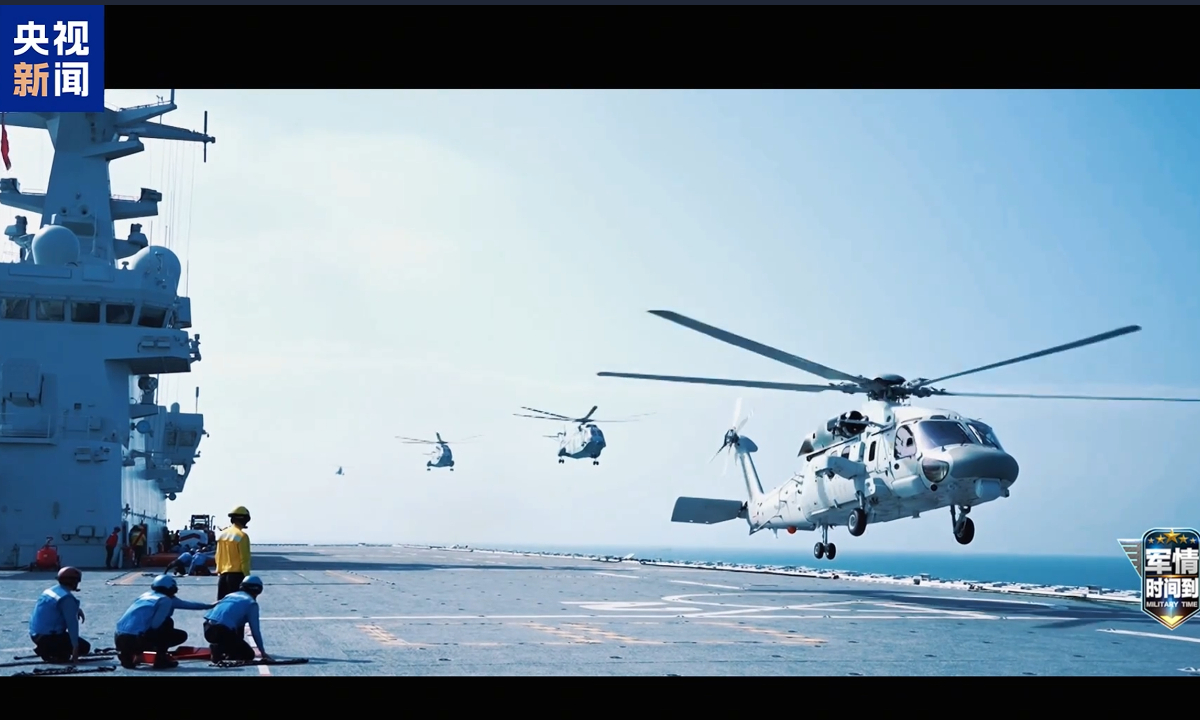
Z-20J helicopter in operation Photo: Screenshot of CCTV News report
China's state broadcaster on Saturday released footage showcasing the expanding Z-20 helicopter family and its service across the country's ground, naval and airborne forces, with images of the shipborne Z-20J conducting takeoff and landing training aboard a Type 075 amphibious assault ship drawing particular attention.
Chinese military experts said the 10-ton-class Z-20 has evolved from a single helicopter model into a highly adaptable platform capable of serving different military branches and potentially law-enforcement, maritime and firefighting agencies. Its balance of payload, endurance and shipborne compatibility could eventually make it one of China's most widely produced and deployed helicopter types, they said.
The footage and photo collection released by CCTV News showed multiple Z-20 variants during training. During an exercise involving an Army aviation brigade, Z-20 and Z-20T helicopters launched missiles that struck their targets and conducted heliborne operations.
On land, the Z-20 family can undertake multidimensional offensive and defensive operations, troop transport, logistical resupply, casualty evacuation and emergency rescue missions, according to the CCTV report.
The report also introduced the naval Z-20J and Z-20F variants, both feature salt-resistant, anti-corrosion coatings and folding rotor blades and tail booms designed for storage and operation aboard warships. CCTV previously noted that the folding design allows the naval Z-20J to be moved and stored more easily in the confined spaces of naval vessels.
The Z-20J is primarily designed for troop transport and vertical assault missions at sea. It can operate from Type 075 amphibious assault ships and Type 071 landing platform docks, as well as Type 055 and Type 052D destroyers and Type 054A frigates, the report said.
The Z-20F, by comparison, is configured for open-seas anti-submarine warfare. Equipped with maritime-search radar, sonobuoys, dipping sonar and anti-submarine torpedoes, it can conduct integrated submarine detection and attack missions.
The report also featured the Z-20K of the Air Force, whose tail boom and horizontal stabilizer can be folded so that the helicopter can be carried inside a Y-20 transport aircraft. Designed as a key air-mobility platform for airborne troops, one Z-20K can carry a complete squad for heliborne deployment while also conducting external-load transport, casualty evacuation and logistical missions.
The development of the Z-20 family reflects the Chinese military's emphasis on adapting common equipment platforms for use across multiple services, Zhang Junshe, a Chinese military affairs expert, told the Global Times on Saturday.
Other platforms, including the J-35 fighter aircraft, have also been developed for operations across multiple services, Zhang said. Such commonality can simplify operational support and maintenance, facilitate joint operations and avoid duplicated research and development investment.
The deployment of the Z-20J aboard Type 075 amphibious assault ships could significantly enhance their ability to conduct multidimensional landing operations, Zhang said.
A Type 075 can deploy air-cushioned landing craft for a conventional beach assault while using Z-20Js for rapid troop insertion, aerial delivery or attacks against positions behind the beachhead, allowing forces to apply pressure from multiple directions, he said.
The Z-20 family has also recently attracted attention from overseas military media amid speculation that a maritime variant could be associated with the China Coast Guard.
Outlets including Janes and Military Watch Magazine cited images that appeared to show a Z-20F carrying China Coast Guard markings. Military Watch claimed that the footage indicated the maritime helicopter had entered CCG service and described it as a major landmark in the modernization of the service's anti-submarine warfare capabilities.
Compared to smaller helicopters previously operated by the service, the Z-20 offers substantially greater endurance, payload capacity and sensor performance, allowing Coast Guard vessels to maintain aerial surveillance over much larger areas while responding more rapidly to incidents at sea, Military Watch said.
The reported appearance of a Z-20F in CCG colors has not been officially confirmed by Chinese authorities.
Song Zhongping, another Chinese military expert, told the Global Times that it would be normal for an advanced 10-ton-class utility helicopter such as the Z-20 to be adopted by different military branches or law-enforcement agencies.
A helicopter in this weight category is not too heavy for shipborne operations, while remaining large enough to provide substantial payload, range and mission capability, Song said. This combination allows the Z-20 to perform effectively in a wide variety of operational environments.
The basic platform can be adapted into shipborne, Army aviation, Air Force and coast guard variants, while related models could also serve maritime and firefighting agencies, according to Song.
"The Z-20 is no longer merely one helicopter model. It has become a platform," Song said. "More and better helicopter variants will be developed on the basis of this platform."
RELATED ARTICLES