COMMENTS / INSIDER'S EYE
GT Voice: Seoul's AI blueprint needs global market to materialize
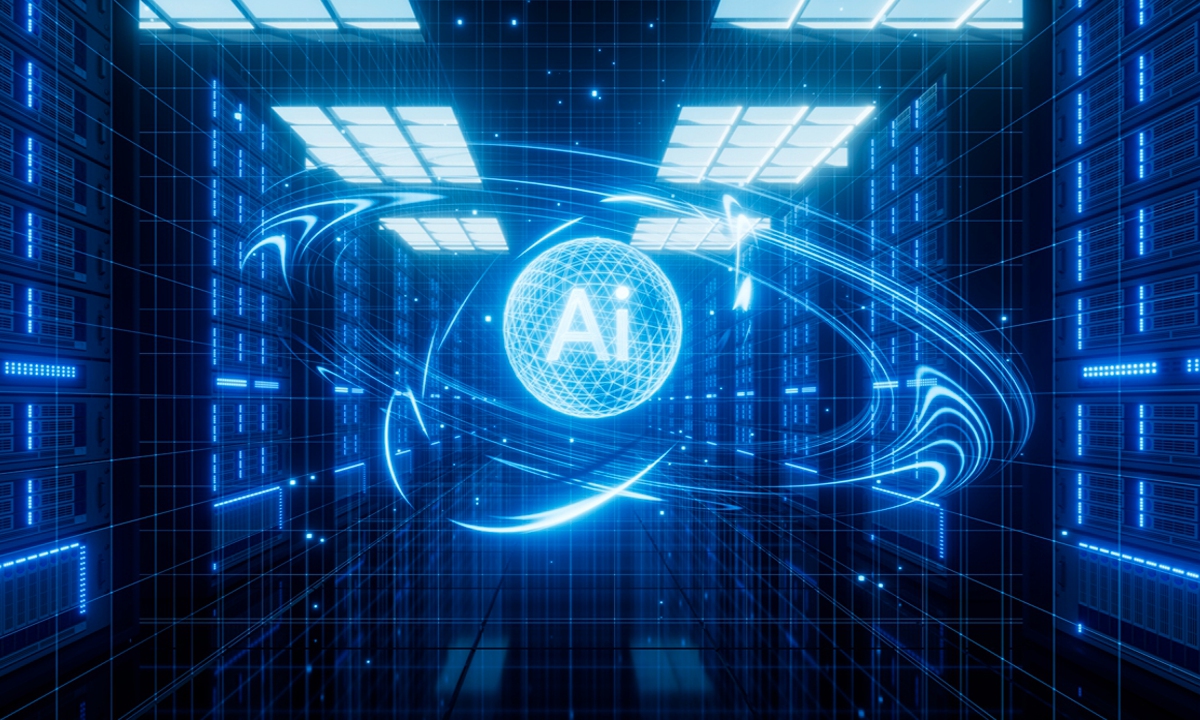
Conceptual diagram of AI Photo: VCG
South Korea is taking intensive measures to demonstrate its determination to seize opportunities in the era of artificial intelligence (AI).
South Korean President Lee Jae-myung unveiled an AI Declaration on Friday to make South Korea a "trustworthy production base and supply partner" for AI semiconductors, vowing to lead the country into becoming a major global player in the AI supply chain, the Yonhap News Agency reported on Saturday.
"South Korea will become a responsible partner that shares the opportunities and benefits of AI with the world and grows together rather than pursuing growth alone," he said.
On the same day, a group of South Korean companies and global tech giants agreed to pursue semiconductor cooperation projects that together are worth $950 billion.
In June, South Korea announced three megaprojects involving more than 4,000 trillion won ($2.73 trillion) worth of investments to build a semiconductor production cluster in the country, including physical AI and AI data centers.
This series of the government-orchestrated plans and industry actions tells the importance South Korea places on leveraging its semiconductor-making advantages in order to capitalize on the massive opportunities most likely to be induced by AI.
With its leadership in memory semiconductors, South Korea has built unique edge in the AI hardware supply chain. Nevertheless, AI development is never a single-dimensional technological competition. It is a comprehensive industrial system covering computing power, data governance, talent cultivation and market application scenarios.
Depending on the country's existing hardware edge, South Korea seems to be positioned to play a significant role in future AI development in the world, including AI-related chips production and terminal intelligence supply.
However, no country can independently complete and dominate the full AI industrial chain globally. How to realize Seoul's ambition to become "an irreplaceable, core nation in the AI supply chain" calls for greater efforts, including fairly open and unbiased international cooperation.
While South Korea has moved to deepen supply chain cooperation with the US in recent months, cutting-edge chips and advanced data centers are of limited value without massive downstream applications, diverse user scenarios, and sufficient market size to absorb the output.
It is precisely this industrial logic that explains why South Korea, while focusing on its cooperation with the US, is simultaneously reaching out to other regions and markets to build a multi-dimensional collaborative network.
For instance, South Korean Foreign Minister Cho Hyun co-chaired the Korea-ASEAN foreign ministers' meeting with his Thai counterpart on the sidelines of ASEAN-related ministerial meetings held in Manila last week. During the meeting, South Korea introduced a "Korea-ASEAN AI Partnership Initiative," aimed at building AI ecosystems, promoting AI research and talent development and supporting the safe use of AI.
In June, South Korea and ASEAN launched official talks to upgrade their free trade agreement (FTA), aiming to expand cooperation in the digital era, in critical minerals and more fields. ASEAN is South Korea's third-largest trading partner, with Seoul exporting $122.5 billion worth of goods to ASEAN countries in 2025. This market size is likely to provide valuable room for the large-scale deployment of South Korea-made semiconductors products and AI solutions, helping to compensate for the constraints of a limited home market.
In the context of global industrial collaboration, South Korea's diversified cooperation plan also includes pragmatic interactions with China. At the 2026 World Artificial Intelligence Conference (WAIC), the Korea Innovation Center in China under South Korea's Ministry of Science and ICT organized a group of eight South Korean AI-related enterprises to participate in the event.
This marked the first time that South Korean AI companies have participated in the WAIC as a group. The signal is clear: South Korea does not intend to shut itself off from one of the world's largest AI application markets. Different partnerships serve different functions in the AI value chain.
Always trying to expand cooperative partners will help South Korea form a multi-layered and effective support system to realize the country's AI ambitions. The country is by no means alone in this AI era.
Both advanced economies and developing countries are striving to find their own unique positions in the current wave of technological transformation. For every economy that aims to seize the opportunities of the AI era, a shared core proposition stands before all: how to cultivate strong core competitiveness while fully leveraging global innovation resources.
The viable path forward lies in embracing global resources with an open posture, safeguarding independent innovation capabilities, and building a highly resilient industrial ecosystem through inclusive multi-party collaboration.
RELATED ARTICLES