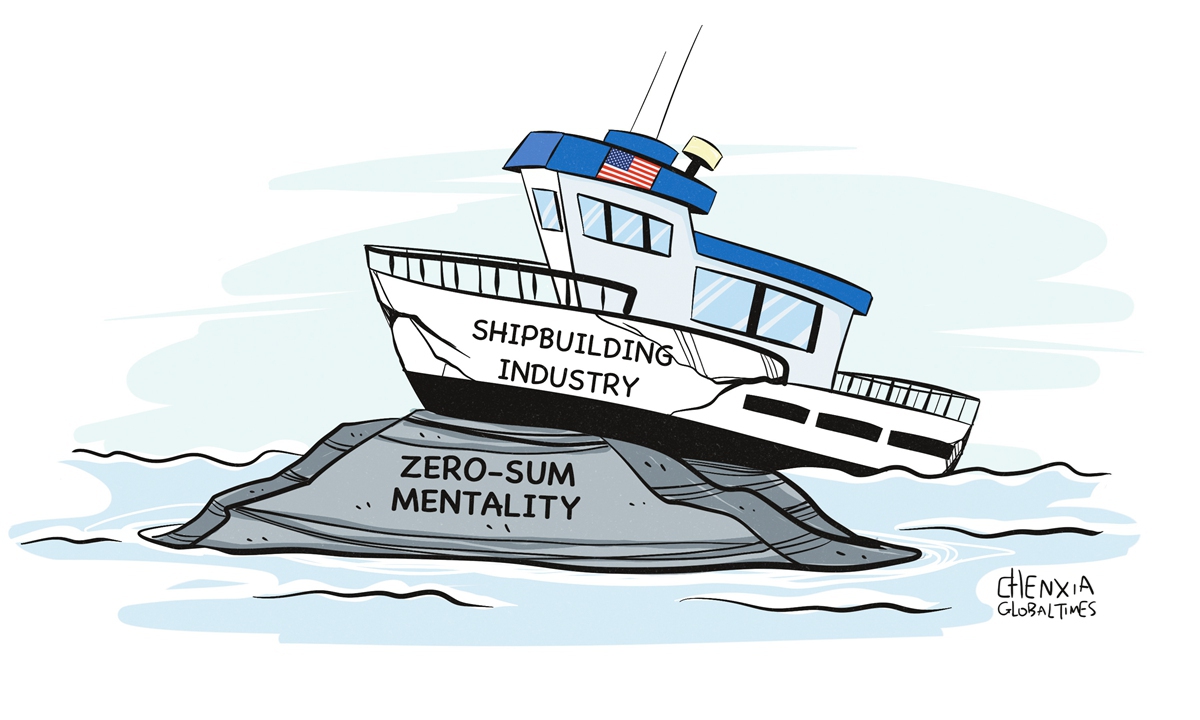
Illustration: Chen Xia/GT
The latest data from Clarksons Research showed that in the first half of this year, China took in 1,131 orders totaling 31 million compensated gross tons (CGT), about 72 percent of total market share worldwide, while South Korea brought in about eight million CGT, with just a fifth of global market share, the US-based industrial business journal The Maritime Executive reported on Wednesday. It also noted that China's market share lead over South Korea is expected to widen to 53 percentage points for the full year in 2026.Short-term factors may account for some fluctuations, yet the clear trend persists: Even amid high-profile US-South Korea shipbuilding cooperation, the underlying logic of global shipbuilding competition has not been fundamentally reshaped by geopolitical agendas as many expected before.
In recent years, the US has stepped up pressure on China's shipbuilding industry, while advancing shipbuilding cooperation with South Korea. In May, South Korea and the US signed a memorandum of understanding to advance bilateral shipbuilding cooperation, an agency of the US Commerce Department said. The MOU signing came as South Korea joined a $150 billion joint fund with the US to help revitalize the US shipbuilding sector. Some voices in South Korea argued that cooperation with Washington could offer "a rare strategic advantage."
Nevertheless, it remains a question as to whether geopolitical backing and political support can deliver fundamental industrial breakthroughs. The US-South Korea shipbuilding cooperation is essentially a strategic alignment serving the US goal of revitalizing American shipbuilding. While the cooperation may open doors in military and specialized shipbuilding, it does nothing to resolve South Korea's chronic bottlenecks: saturated dock capacity, a severe labor shortage, soaring costs, and restricted production expansion. These persistent drawbacks have prevented South Korean shipyards from capturing incremental mainstream merchant ship orders, and such deep-seated problems cannot be resolved through geopolitical alignment in the short term.
From the "Make American Shipbuilding Great Again" initiative to the Korea-US Shipbuilding Partnership Initiative (KUSPI), Washington's priority has been clear: to embed South Korea's shipbuilding capacity into America's global supply chain architecture. Within that framework, what tangible industrial returns can Seoul really expect? That question deserves far more skepticism than it has received.
Fundamentally speaking, shipbuilding is a long-cycle industry that is capital-intensive, labor-intensive, and technology-intensive. Its competitiveness ultimately rests on supply-chain efficiency, cost control, and delivery reliability. Geopolitical intervention can nudge a few orders in the short term, but it cannot overturn a long-term equilibrium shaped by the depth of industrial ecosystems and sheer economies of scale. China's dominant market share is the product of decades of industrial ecosystem development and sustained capability building, not merely market forces.
For South Korea, it is more pragmatic to embrace rational competition and cooperative opportunities with China if it wants to maintain its industrial strength. There is clear room for differentiated positioning: China dominates the mainstream commercial segment through full-spectrum supply chains and scale, while South Korea still retains technical prowess and brand reputation in premium niches such as large LNG carriers and ultra-large container ships. Moreover, the global shipping industry is navigating shared challenges including green transformation and the upgrading of intelligent shipping, which cannot be addressed by a single nation alone. China and South Korea both possess enormous potential for cooperation in low-carbon fuel research and digital shipbuilding innovation. In fact, there are already media reports that South Korean businesses are seeking opportunities in China's green marine equipment sector.
If anything, South Korea's own industrial history offers a powerful lesson. It is through its own market exploration and technological innovation that South Korea overtook Japan to become a global shipbuilding powerhouse in the past. To achieve a "second leap" today, South Korea needs to prioritize homegrown solutions and efficiency gains, rather than count on geopolitical leverage to sidestep its deep-seated challenges.
RELATED ARTICLES