Illustration: Liu Xidan/GT
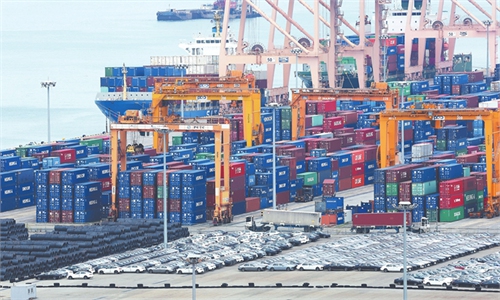
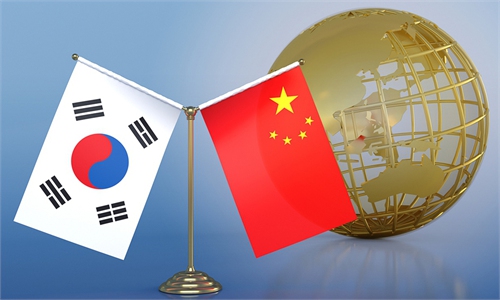
Global ship orders in March totaled 4.06 million compensated gross tonnage (CGT) or 135 vessels. Of them, China secured 2.15 million CGT or 84 vessels, accounting for 53 percent, while South Korea won orders for building 38 vessels, or 39 percent, the Yonhap News Agency reported on Monday, citing data from London-based shipping market research firm Clarkson.Together, China and South Korea took the lion's share of global ship orders, which consolidates their dominant position in the global shipbuilding industry and offers a key window into the competition and cooperation between the two countries.
China's continuous lead in global ship orders stems from the country's solid foundation and the comprehensive strength of the manufacturing sector. As the only country in the world with all industrial categories as defined by the UN, China boasts a highly mature supply chain, backed up by enhanced efficiency and an economy of scale.
These factors provide a strong guarantee for its shipbuilding industry to garner a good share of global shipbuilding contracts. From bulk carriers and container ships to sophisticated vessels such as ocean cruise ships and liquefied natural gas (LNG) carriers, Chinese shipbuilders are able to produce all types of vessels.
They can meet the global market's demand for mass production and on-time delivery while making steady breakthroughs in producing high-end vessels. Such industrial capacity has endowed China's shipbuilding industry with remarkable resilience, serving as a key pillar of stability for the global shipping supply chain.
South Korean shipbuilders saw their order share rebound to 39 percent in March, with the structure characterized by high-value-added ships. South Korea maintains its traditional competitiveness in turning out high‑profit vessels. This differentiated landscape reflects the realistic potential for complementarity between the two industries.
China excels in full-spectrum shipbuilding capacity, well-integrated supply chain, and mass production efficiency, enabling it to reliably meet diverse global demands. South Korea, by contrast, has accumulated profound expertise in the design of certain high-end vessels and the integration of major shipbuilding technologies. The two countries have different technological levels, cost structures, and market positioning, which creates room for mutually beneficial cooperation.
There are concerns that, as China's shipbuilding industry continues to move up the value chain, the room for complementarity at the whole-ship level will shrink, shifting from cooperation to competition. Such concerns are understandable, as China's capability in LNG carriers, large cruise ships, and other high-end segments has advanced rapidly, intensifying ship order competition with South Korea.
However, competition and cooperation are not categorically exclusive. Deeper industrial integration, if guided by strategic coordination, can open up new areas of complementarity and cooperation. Even if China keeps on actively improving its high-end shipbuilding capability, cooperative opportunities will not necessarily disappear; rather, they are likely to shift toward emerging fields.
Complementarity between China's and South Korea's shipbuilding industrial chains will gradually evolve toward deeper collaboration in high-end components and green shipbuilding technologies. South Korea still holds certain technological edge in manufacturing some key components, for which Chinese shipbuilders have strong demand.
In green shipbuilding technology, joint research and development (R&D), shared testing data, and coordinated participation in international standard-setting can reduce technological risks for both sides and accelerate commercial application. The global shipbuilding market is undergoing some profound changes, with low-carbon transition of ocean shipping continuing to drive sustained demand for new vessels and fleet renewal.
This environment presents both parties opportunities and challenges. Through closer cooperation, South Korea can fully leverage its technological strength in high‑value‑added segments while reducing production costs and improving efficiency by tapping into China's complete industrial chain and large‑scale production capacity. China, in turn, can gain a stable supply of high‑end components and generating more R&D outcomes.
From the broader perspective of Asian manufacturing, closer collaboration between China and South Korea in shipbuilding and also in wider equipment manufacturing will help raise Asia's position in the global value chain, allowing both parties to reap greater benefits from the continued expansion of the global market.
RELATED ARTICLES