GT Voice: South Korea’s export growth to China suggests complementarity outweighs competition
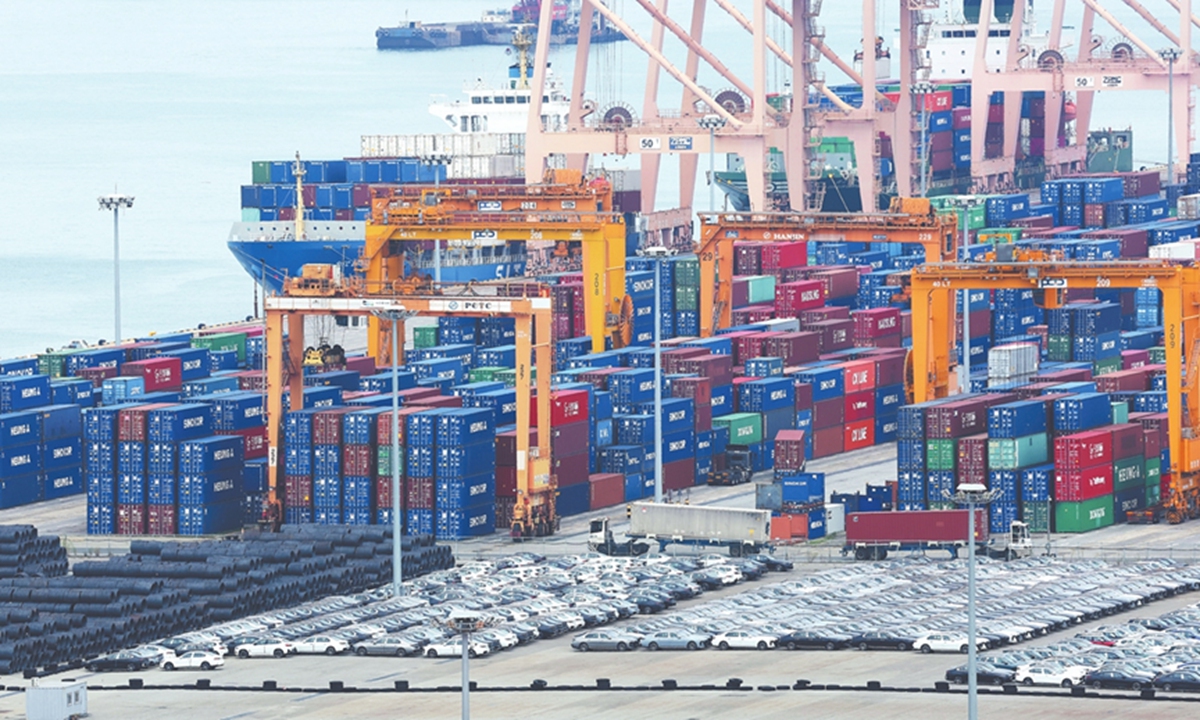
Containers pile up at Pyeongtaek Port in Gyeonggi Province, South Korea on July 31, 2025. Photo: VCG
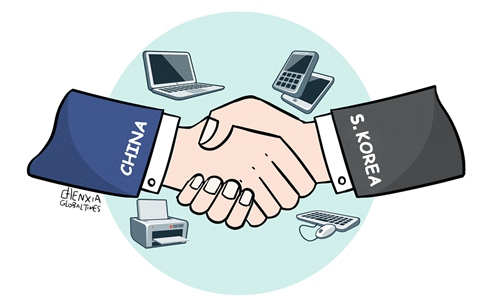
South Korea's exports climbed 29 percent year-on-year to $67.45 billion in February, the highest level ever recorded for the month, Yonhap News Agency reported on Sunday, citing data from the country's Ministry of Trade, Industry and Resources. The figures indicate sustained strength in external demand at the start of the year, with technology-related shipments contributing to the increase.China remains an important trading partner and export destination for South Korea. Shipments to China rose 34.1 percent to $12.75 billion in February, according to Yonhap, supported by demand for semiconductors, computers and petroleum products. The data highlight the scale of cross-border industrial flows between the two economies and their contribution to South Korea's overall export performance during the month.
That performance has unfolded against a backdrop of volatile global trade flows. February's figures point to pockets of resilience in Asia, particularly in technology-related sectors, even as broader currents in global trade remain unsettled.
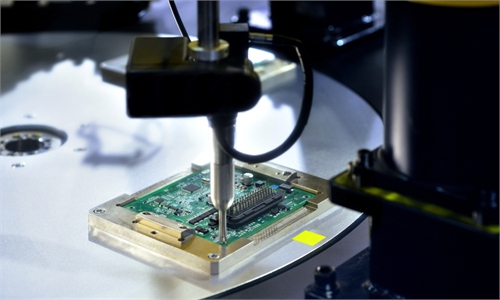
In China, demand for components such as semiconductors and computers reflects the scale and continuity of industrial activity. The steady advancement of the country's manufacturing sector is underpinning sustained import demand, particularly for higher-end components. For South Korean exporters, this translates into ongoing opportunities to supply China's industrial base.
These trade figures may offer a fresh perspective for some observers in South Korea who have focused primarily on competitive pressures from China. A February report cited by Yonhap from the Korea Institute for Industrial Economics & Trade noted that China has a considerable competitive edge over South Korea in robotics, electric vehicles, battery and semiconductor industries, excluding the memory chip sector.
The rapid pace of technological advancement in China and the rising competitiveness of its products across key industries is evident. Yet China's growing capabilities do not necessarily make bilateral trade a zero-sum competition. As China's manufacturing sector climbs the value chain, demand for sophisticated intermediate goods is expanding, creating room for specialized supply and industrial collaboration. For South Korean companies, this suggests that competitive overlaps can coexist with tangible opportunities for engagement, allowing cooperation and competition to reinforce rather than exclude each other.
As China's manufacturing sector advances, the growing complexity of its production processes is generating new demand for intermediate and specialized goods. This evolution offers South Korean exporters scope to deepen industrial cooperation by tapping into areas of the supply chain where their expertise complements China's production needs, creating further opportunities to expand exports. Realizing this potential hinges on recognizing the complementarities in the China-South Korea supply chain, rather than allowing excessive concern over competition to dominate the discussion.
In February, according to media reports, South Korea unveiled a comprehensive strategy aimed at raising exports to a record $740 billion this year through diversification of the country's key export items and markets and stronger financial support measures. The plan reflects the country's continued emphasis on exports as a driver of economic growth.
Closer industrial cooperation between China and South Korea has the potential to go beyond strengthening bilateral trade, reinforcing regional supply chains and deepening connections with other economies across Asia, including Southeast Asia. As both countries continue to raise the competitiveness of their industries, particularly in high-tech sectors, opportunities for collaboration remain substantial despite competitive pressures. In this environment, competition and cooperation coexist, and targeted engagement along the supply chain can create tangible, mutually beneficial gains across the region.
RELATED ARTICLES