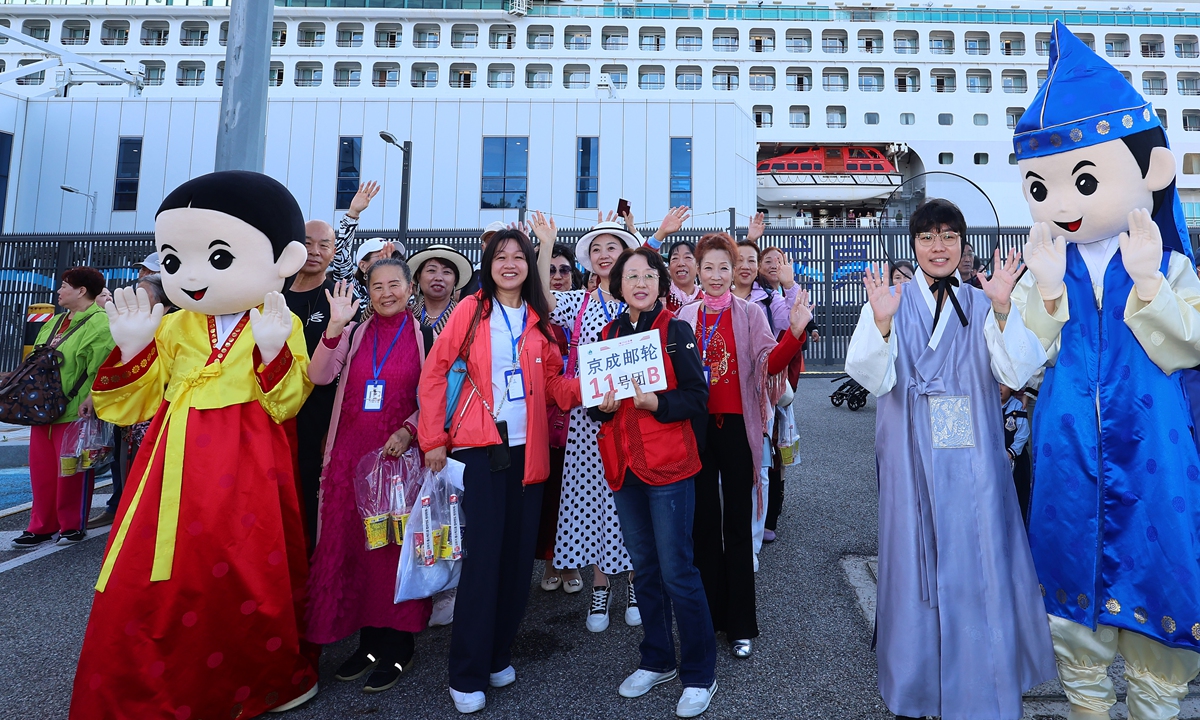
Chinese tourists arrive by a cruise ship on the first day of South Korea's visa-free entry for Chinese group tourists at the port of Incheon in South Korea on September 29, 2025. Photo: VCG
With the continuous improvement of bilateral economic and trade relations, China is increasingly regarded as one of the key factors driving the recovery of tourism to South Korea.
As Park Sung-hyeuck, president of the Korea Tourism Organization (KTO), indicated recently, the key to achieving the goal of attracting 30 million foreign tourists as soon as possible lies in seizing the initiative in the Chinese market, the Yonhap News Agency reported on Monday. The KTO will continue to deepen cooperation with major platforms and integrate channels such as cruise ships and aviation to boost demand for travel to South Korea and drive local tourism development.
Amid increasingly close bilateral economic ties, the remarks send a strong signal that South Korea's tourism industry is committed to expanding new space for China-South Korea tourism cooperation.
South Korea has set an ambitious goal of 30 million inbound visitors, seeking to boost travel demand and disperse tourism beyond Seoul, according to media reports. The implementation of the plan will be closely tied to support from the Chinese market.
The recovery momentum of the China-South Korea tourism market is strong. In January 2026, the number of Chinese tourist trips to South Korea reached 418,703, a year-on-year increase of 14.9 percent. In the first two months, the number stood at nearly 950,000, according to the China Association of Travel Services.
The number of Chinese visitors to South Korea this year is expected to exceed 6 million, South Korean Ambassador to China Ro Jae-hun said in February, according to the Yonhap News Agency. As one of the largest inbound tourist groups in South Korea, Chinese consumers have always been in a core position in boosting South Korea's tourism.
From a broader perspective, South Korea's emphasis on the Chinese market once again confirms the strong consumption momentum of China as the world's largest outbound tourism market. In recent years, with the steady recovery of China's economy, people's willingness to travel abroad has continued to rise, and consumption potential has been continuously released. This trend not only injected strong momentum into the recovery of South Korea's tourism industry, but also provided important opportunities for the development of the cultural and tourism industries of neighboring countries.
However, the recovery of the tourism market depends on more than the improvement of supporting measures such as visa policies and services. It is reinforced by stable, predictable political and economic ties. Currently, China-South Korea relations are continuously warming up, and bilateral cooperation in the cultural, tourism, economic and trade fields is constantly expanding and developing new momentum. The steady recovery of the tourism market has become an important leading indicator of the improvement of bilateral relations.
In the global outbound tourism market, China is not only South Korea's largest source of tourists but also a key driver for the recovery of the tourism industry in the entire Asia-Pacific region. Countries in Southeast Asia are also actively competing for Chinese tourists. If South Korea wants to maintain and expand its market share, the key to seizing the initiative lies in showing sufficient sincerity.
The consumption preferences of Chinese tourists are undergoing profound changes, shifting from shopping-oriented to experience-oriented, and from standardized products to personalized customization. Whether South Korea's tourism industry can capture and respond to these changes, provide more considerate services, effectively protect the safety and rights of tourists, and form differentiated advantages in product supply, service quality, and cultural experience will determine whether its goals can be truly realized.
As important neighboring countries, win-win cooperation is the eternal theme of China-South Korea bilateral cooperation, and cultural and tourism cooperation is one of the most dynamic and people-oriented fields. It can not only drive the development of related industries in both countries, but also build a bridge for the people of the two countries to enhance understanding and deepen friendship.
In the complex and volatile international environment, this pragmatic attitude toward cooperation is particularly valuable. It is hoped that both sides will take tourism cooperation as an opportunity to improve supporting services, maintain the momentum of cultural and tourism exchanges, and inject more lasting momentum into the healthy and stable development of bilateral relations.
RELATED ARTICLES