Illustration: Chen Xia/GT
China's Minister of Commerce Wang Wentao met with South Korea's Minister of Trade, Industry and Resource Kim Jung-kwan in Beijing on Wednesday. The two sides exchanged views on deepening economic and trade cooperation and other issues, according to the website of China's Ministry of Commerce (MOFCOM) on Thursday.China is willing to work with South Korea to accelerate the second-phase negotiations on the China-South Korea Free Trade Agreement (FTA), maintain the stability of industrial and supply chains, and deepen cooperation in trade and investment, Wang noted.
Chinese and South Korean trade officials have held several rounds of meetings in recent months, with advancing the next phase of FTA negotiations emerging as a key topic of discussion. The latest development signals that bilateral cooperation is set to expand beyond traditional goods trade into high-end manufacturing, artificial intelligence, and green industries.
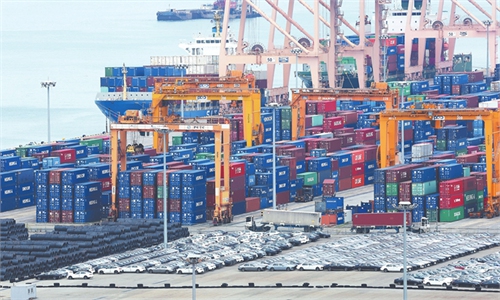
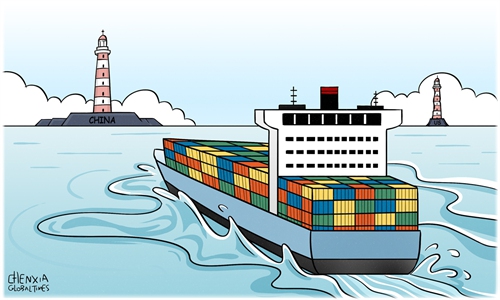
Since the China-South Korea FTA came into effect in 2015, it has consistently delivered institutional dividends. By significantly lowering trade barriers, it has propelled exponential growth in bilateral goods trade. This framework has further strengthened robust bilateral trade cooperation. China remains South Korea's largest trading partner for more than 20 years, while South Korea has solidified its position as a key trading partner for China.
From the deep integration of traditional powerhouses such as automobiles, electronics, and petrochemicals to collaborative development in emerging fields such as new energy and new materials, goods trade has laid a robust foundation for the economic relationship.
However, with the rise of trade protectionism and the accelerated restructuring of global industrial and supply chains, the traditional cooperation model can no longer meet the new needs of industrial development in China and South Korea.
Meanwhile, both countries are accelerating their industrial upgrading, with emerging fields such as high-end manufacturing, artificial intelligence, the green economy and the silver economy booming, and cooperation potential in areas such as services trade, digital trade and cross-border investment continuing to be released.
Against the backdrop of uncertainty in the global trade landscape, China-South Korea economic and trade cooperation needs to make a transformation toward higher quality, broader scope and a deeper level. Accelerating negotiations under the FTA is a necessary move to adapt to this trend. The high-end fields covered by services trade and investment, such as finance, logistics, culture and tourism, research and development and medical care, are the core intersection of the interests between the two countries in their march toward high-quality development.
Take tourism cooperation as an example. China and South Korea are important tourist source markets and destinations for each other. In recent years, two-way exchanges of people have continued to rise, and the implementation of visa-free policies has further activated market demand.
If further improvements can be made in tourism services and supporting facilities, along with the simplification of customs clearance procedures and deepening of cultural and tourism industry cooperation through FTA negotiations, it will not only drive the development of related industries such as aviation, catering, accommodation and retail, but also consolidate the foundation through people-to-people exchanges and gather a broad consensus for FTA upgrading.
Beyond tourism, the potential for collaboration in new areas such as the high-end manufacturing, green, and silver economies is also vast. Advancing the next phase of FTA negotiations is expected to provide a guiding framework for further cooperation in these new industries.
The opening-up of the services and investment fields often involves deeper issues such as domestic supervision and industry interests, requiring both sides to show greater determination and negotiating wisdom.
But the direction is set, and the consensus is clear. As both sides move forward in the same direction, these negotiations hold the promise of not only bearing fruit, but also of planting the seeds for a more resilient and prosperous bilateral relationship.
RELATED ARTICLES