China-South Korea cooperation highlighted at ZGC Forum
AI, robotics seen as key sectors for complementary business: industry insiders
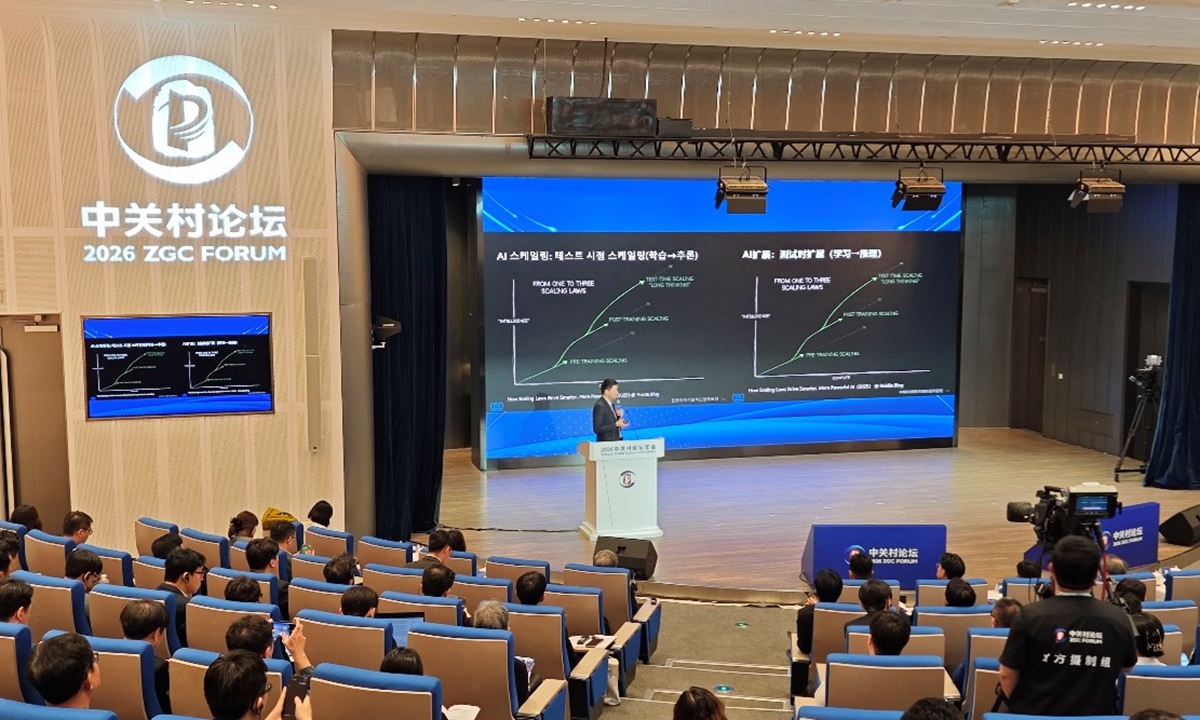
A snapshot of the China-ROK Forum on Sci-Tech Innovation Cooperation, a branch of the ongoing 2026 Zhongguancun (ZGC) Forum in Beijing, held on March 26, 2026. Photo: Yin Yeping/GT
Chinese and South Korean industry representatives on Thursday called for deeper cooperation in the innovation and application of cutting edge technologies, including artificial intelligence (AI) and robotics, as several key agreements were signed at the ongoing 2026 Zhongguancun (ZGC) Forum in Beijing on Thursday. A Chinese expert said the move could inject fresh momentum into efforts to bolster the stability of global industrial and supply chains amid rising unilateralism and protectionism.
On Thursday, hundreds of government officials, business leaders, and experts from both countries gathered at China-ROK Forum on Sci-Tech Innovation Cooperation, a branch event of the ZGC, to share insights on the potential for bilateral cooperation in the technology sector.
Several strategic cooperation agreements were signed between businesses or organizations of the two countries including the signing of strategic cooperation between China Science and Technology Exchange Center and Korea Innovation Center (KIC) during the forum.
Speaking at Thursday's forum, which was co-organized by the KIC China, Lin Xin, China's vice minister of science and technology, said that China possesses a complete manufacturing system, a large domestic market, and abundant talent resources, while South Korea holds distinctive advantages in areas such as integrated circuits and semiconductor research and manufacturing.
The Chinese side is willing to take this forum as an opportunity to engage with representatives from various sectors in South Korea, focus on developments in AI, and jointly explore new pathways and models for international cooperation, said Lin.
Park Yoon-kyu, president of Korea's National Information and Communication Agency, echoed the cooperation call, noting that both countries can leverage their respective strengths, complement each other's advantages, and advance together.
Park's remarks did not come out of the blue. China is now the world's largest holder of AI patents, with its core industry exceeding 1.2 trillion yuan ($173.88 billion) in value and more than 6,200 enterprises, making it a key engine driving the global intelligent transformation, according to media reports.
Meanwhile, the economic growth strategy of South Korea's new government aims to make the country one of the top three nations in AI, with a potential economic growth rate of 3 percent, the Xinhua News Agency reported.
China and South Korea are both embracing a new wave of technological transformation, and the model of bilateral cooperation has undergone profound changes, Chen Jun, head of the Secretariat of the China-Japan-South Korea Innovation Cooperation Center, who participated in the forum, told the Global Times.
Chen noted one notable change. "In earlier years, China attracted foreign investment and introduced technology in exchange for market access, with a primary focus on bringing in external resources. Now, a growing number of Chinese companies are also going global, expanding into markets such as South Korea," he said.
Song Tao, CEO of AtomRobot, a Tianjin-based robot company, has firsthand experience of how Chinese advanced technology products gain a foothold in the South Korean market. He participated in the branch forum as a panelist, sharing his story as an example of technological cooperation between the two countries.
His company mainly provides robotic services to the South Korean market, particularly for use in food production lines, including picking, sorting, packaging, and handling, Song said.
Speaking about the advantages of Chinese robotic products, Song said that they include stability, quality, and proven domestic applications, which enable South Korean companies to deploy them quickly. He added that the South Korean market offers strong potential, pointing to promising prospects ahead.
"China's enterprises and technology sector have developed rapidly, especially with the rise of the digital economy, gradually strengthening the country's role in the field. Meanwhile, South Korea, with its high level of digital adoption and established industrial chains, offers opportunities for collaboration and can complement Chinese technology companies," Da Zhigang, director of the Institute of Northeast Asian Studies at the Heilongjiang Provincial Academy of Social Sciences, told the Global Times on Thursday.
More importantly, in the face of rising instability and uncertainty in global industrial and supply chains, closer cooperation between China and South Korea in technology is particularly important, said Da. By combining their respective strengths and working together on innovation, the two countries can accelerate the application of new technologies, while contributing to greater stability and predictability in regional and global supply chains, the expert said.
RELATED ARTICLES