COMMENTS / INSIDER'S EYE
China's western cities offer genuine picture of what AI co-op could look like
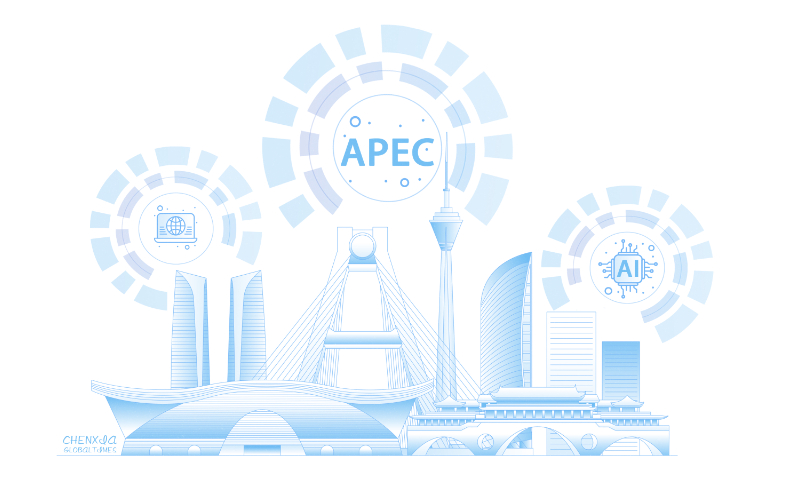
Illustration: Chen Xia/GT
As competition over AI technology intensifies globally, the development of China's western cities offers a new perspective on high-standard digital cooperation. The Xinhua News Agency reported that several participants at the APEC Digital and AI Ministerial Meeting and a series of digital events held in Chengdu, Southwest China's Sichuan Province from July 16 to 29 noted that western Chinese cities are becoming a force of growing importance in Asia-Pacific digital cooperation.
The trend suggests that regional digital cooperation may be influenced not only by technological progress, but also by how effectively innovation is applied across industries, markets and the wider economy.
For years, China's AI development has been largely associated with eastern coastal cities such as Beijing, Shanghai and Hangzhou. These cities have built some of the country's most dynamic technology ecosystems, bringing together internet companies, research capabilities and innovation resources. Yet China's AI ecosystem is extending beyond its traditional tech innovation hubs.
In western China, the growth of AI is increasingly tied to the expansion of digital infrastructure and industrial applications. Some western Chinese cities are investing in computing capacity and data centers, supported by factors such as the greater availability of land and access to renewable green power - resources that are particularly important for large-scale digital infrastructure. As these capabilities develop, western cities are becoming new nodes in China's digital economy, where infrastructure investment is increasingly supporting industrial development.
The implications extend beyond the expansion of China's digital economy. They point to a broader reconfiguration of regional connections, as digital infrastructure, industrial capacity and market linkages open up new channels of greater interaction in the whole Asia-Pacific region. Here, three areas are particularly worth noting.
First, the industrial implications are perhaps the most immediate. Western China's digital infrastructure is not a replication of the eastern coastal model; instead, it is giving rise to applications shaped by local industries and regional conditions. In areas such as smart logistics, digital agriculture and remote healthcare, these regions have developed practical solutions for applying technology in environments with complex terrains and diverse climates.
Naturally, these solutions are relevant for many emerging market economies in Southeast Asia and South Asia, where digital development is tethered to local industrial structure and geographic condition.
Second, the geographic implications are equally important. Digital infrastructure in western China is expanding connections among markets and regions. As China continues to expand economic links westward, digital platforms such as cross-border e-commerce are creating more direct links between producers and consumers.
Agricultural products from Southeast Asia, for example, could reach markets in central and western China more efficiently through these platforms. These developments show how digital technologies can help bring markets closer together and support broader economic activity, from trade to manufacturing.
Third, the technological implications are becoming clearer. Western China's AI and digital industries are becoming increasingly intertwined with high-tech sectors such as electronic displays, biomedicine, advanced materials and high-end equipment manufacturing, supported by increasingly mature supply chains. As the capabilities grow, investment in the region - including the establishment of research and development centers - could make western cities more attractive to international investors.
The development of AI and digital industries in western Chinese cities highlights how technological progress is linked with the ability to connect industries, markets and economies. This reflects the broader discussions at the APEC Digital and AI Ministerial Meeting on using digital and AI technologies to accelerate economic development and promote universal digital connectivity.
Yet some Western media coverage has placed too much emphasis on a zero-sum competition over AI, which often interpreted China's digital development through the geopolitical lens. As a matter of fact, China's AI and digital innovations are deeply embedded in industrial applications, creating huge opportunities for businesses. The development of western Chinese cities shows that AI advancement is not only about technological competition, but also about how innovation can support broader economic connections and enlarge shared benefits.
The author is a reporter with the Global Times. bizopinion@globaltimes.com.cn
RELATED ARTICLES