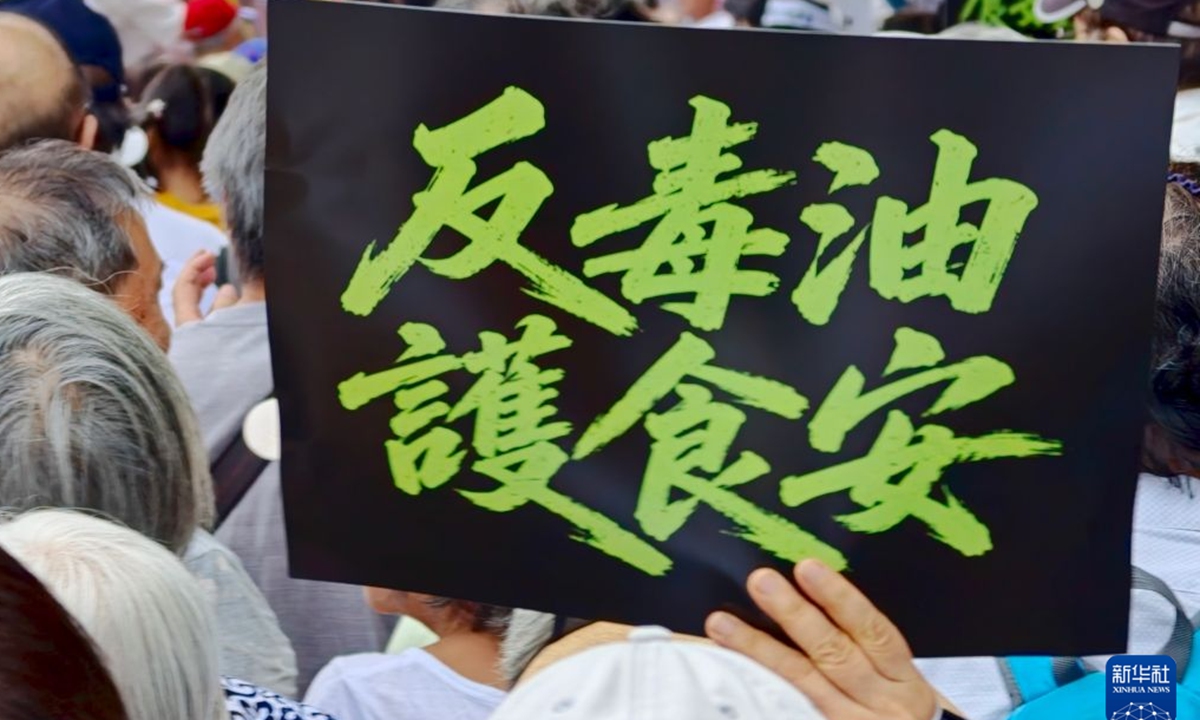
A Taiwan resident holds up a placard reading "oppose toxic oil, protect food safety" during a protest on July 25. Photo: Xinhua
On July 25, over 200,000 Taiwan residents braved the scorching heat and took to Ketagalan Boulevard in Taipei, holding banners that read "oppose toxic oil, protect food safety," shouting slogans like "I am human, I oppose poisoning Taiwan." Reports of local media described this as one of the largest-scale food safety protests in recent years on the island.This protest appeared to be triggered by the recent "toxic oil" incident involving Taiwan's China United Fats and Oils Corporation, but at its core, it was the long-suppressed dissatisfaction of Taiwan residents finally reaching a breaking point. Over 1,000 tons of cooking oil containing carcinogen benzopyrene exceeding safety standards circulated in the market for more than 50 days, affecting all 22 counties and cities across the island, and entering in large quantities into school meal programs and the catering industry.
In the face of such a severe food safety crisis, the Democratic Progressive Party (DPP) authorities have been tardy to transparently disclose the flow of the problematic oil, and their disposal plans have been subject to ongoing controversy. Many politicians have downplayed the risks and shirked responsibility.
When the governance bodies lose the bottom line and food safety standards are disregarded, public distrust spreads rapidly. Today's outrage from the public is not just about how toxic oil was produced, but also about why, after the DPP came to power, food safety rules could be changed, standards relaxed, responsibilities dodged, and bottom lines arbitrarily breached.
Food safety concerning oil reveals a stark contrast in the DPP's judgment standards before and after taking office. In 2014, when Ting Hsin's tainted cooking oil scandal erupted, the then-opposition DPP attacked the regional authorities' food safety controls, criticized them for failing to manage the issue, demanded full disclosure of the upstream and downstream flow of problematic oil, called for responsible officials to resign, and urged a comprehensive recall of all related products. Tainan Mayor at the time, Lai Ching-te, strongly opposed the problematic oil, taking a tough stance and speaking out clearly. "Protect the safety of the people's dining tables" was once portrayed by the DPP as a highly moral and legitimate public issue.
However, when similar food safety crises re-emerged after the DPP took power, they offered a completely different response. The strict standards and accountability the DPP once demanded from the opponents suddenly became ambiguous, hesitant, and lenient when applied to themselves. Previously insisting on full disclosure, complete withdrawal, and total accountability, they now emphasized "procedure" and "assessment," while downplaying "risk," calling for "cooperation," and shifting the blame onto the opposition party.
If one could excuse a single change of stance, the repeated U-turns are simply a reflection of the DPP's "double standards" logic: When in opposition, food safety is their sharp political weapon; once in power, food safety becomes a flexible political tool for appeasement and bargaining.
A typical example is the issue of ractopamine pork. In 2012, Lai Ching-te, then mayor of Tainan, publicly opposed the import of pork products containing ractopamine, emphasizing that public health must not be sacrificed for political gains. At that time, the DPP was very much united in opposing ractopamine pork, criticizing then government's decision to open its import as a blatant disregard for public safety. But in 2021, the situation had shifted dramatically. The DPP authorities forcibly lifted the ban on ractopamine imports, and Lai quickly changed his tone, claiming that ractopamine "is neither a poison nor a banned drug." Moreover, the DPP further negated local regulations that prohibited this lean-meat-enhancing chemical, overturning the food safety protections they once fiercely defended.
The DPP authorities followed the same pattern on the Fukushima "nuclear-contaminated food." After the Fukushima nuclear leak accident, the DPP repeatedly played up radiation risks and strongly opposed the import of related food products, echoing public concerns. In 2018, a referendum opposing the import of Fukushima food products passed by a wide margin in Taiwan region, clearly reflecting mainstream public opinion. However, in pursuit of economic and trade leverage and to curry favor with Japan, the DPP authorities ignored the referendum results and announced in 2022 the lifting of restrictions on food imports from five prefectures in Japan, including Fukushima, deliberately downplaying concerns over radiation. The promise to protect the people was reduced to a bargaining chip that could be discarded at will.
Since the start of 2026, the DPP authorities' retreat on food safety standards has become even more pronounced. To accommodate external pressure and advance so-called trade arrangements, the DPP authorities have taken the initiative to lower inspection thresholds for imported agricultural products. Under the reciprocal trade agreement between China's Taiwan region and the US, regional health authorities revised potato quarantine rules, relaxing the previous requirement to reject entire shipments containing sprouted potatoes and instead allowing them to enter the market after sorting out and disposing of the affected parts, completely ignoring the food poisoning risks posed by solanine, a toxin that can develop in sprouted potatoes. Meanwhile, they have significantly raised the allowed residue limits for the pesticide fipronil in apples and made one-time adjustments to pesticide residue standards for hundreds of agricultural products. "Toxic potatoes" and "toxic apples" have thus gradually made their way onto Taiwan residents' dining tables.
Ironically, while the DPP authorities continue to loosen food standards for imports from the US and Japan, they impose layer upon layer of restrictions on agricultural and fishery products from the Chinese mainland, frequently banning imports on the grounds of trace pesticide residues exceeding limits. The logic of "always being lenient toward the US and Japan while being strict toward the Chinese mainland" is plain to see. For the DPP authorities, food safety standards are not determined by science or public health needs, but by political considerations.
When food safety standards are tightened or relaxed based on who is involved, and adjusted according to political positions, public credibility inevitably erodes. This is the true source of anxiety in today's Taiwan society. People are not demanding that governance should never encounter problems; they simply hope that when problems arise, the rules are clear, standards are consistent, and responsibilities are defined. Yet what Taiwan people feel now is that rules can change, standards can be adjusted, and responsibilities can be shifted, while the risks are ultimately borne by ordinary people themselves.
From the controversial ractopamine pork policy to the toxic cooking oil scandal, from allowing the import of "nuclear-contaminated food" to relaxing pesticide residue standards for imported agricultural products, the DPP's food safety slogans can be rewritten at any time, regulatory standards can be flexibly loosened, and public health can be compromised whenever politically convenient. The one thing that never changes is the DPP's prioritization of political interests. Food safety should be the most basic and non-negotiable line of public welfare, yet this bottom line has repeatedly been crossed due to the DPP's political needs.
Ultimately, the toxic oil incident is no longer simply a food safety crisis, but a crisis of trust in public governance. When it was in opposition, the DPP exploited food safety as a tool to mobilize public sentiment, attack opponents, and win votes. After taking power, it has treated food safety as a bargaining chip that can be traded, compromised, and used for political gain. What it has exhausted is society's trust in the basic standards of public governance. The protests on Ketagalan Boulevard are a concentrated eruption of public resentment accumulated over time.
Political rhetoric may deceive public opinion temporarily, but it cannot withstand people's most basic sense of right and wrong. The DPP's greatest governance vulnerability does not lie in a single social controversy, but in the growing realization among the public that the DPP authorities' primary considerations are not people's health and well-being, but political calculations and party interests. As more and more Taiwan residents see through the DPP's food safety policies, its banner claiming "protecting people's livelihoods" will inevitably crumble.
RELATED ARTICLES