Rescuers use smartwatch data in search for survivors after flash flood in NW China that killed 10, injured 23: official
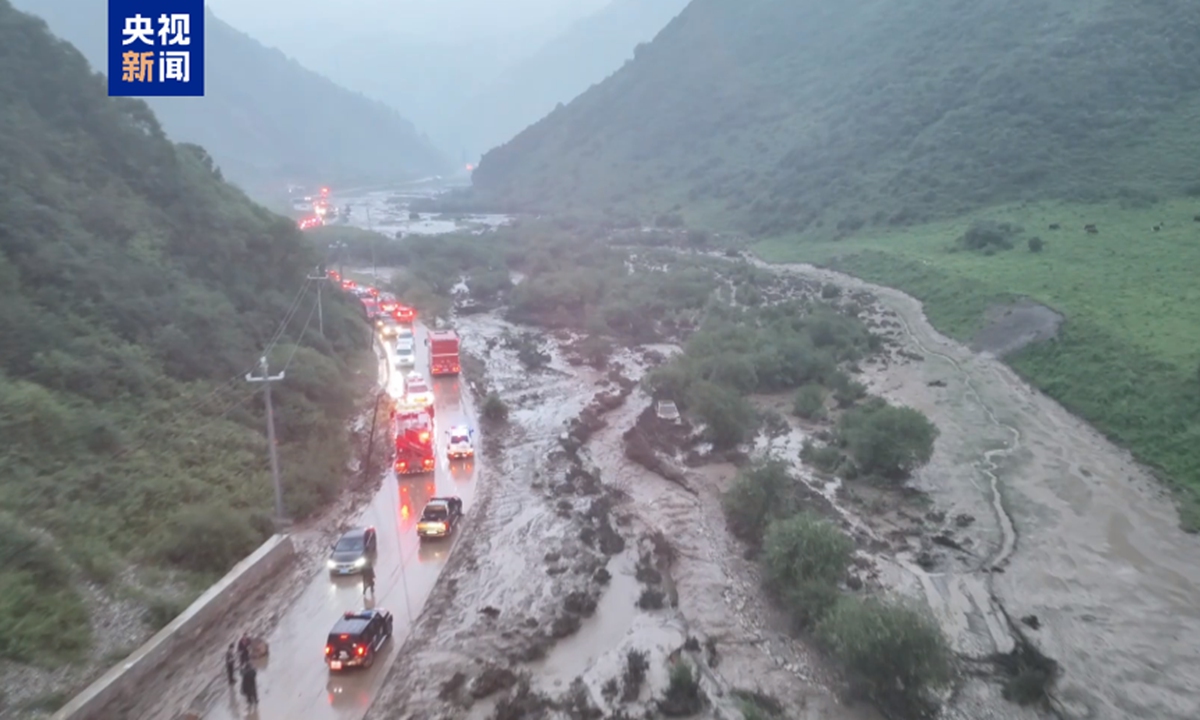
Search and rescue operations are going after a flash flood triggered by intense short-duration rainfall in Weiyuan county, Northwest China's Gansu Province, killed 10 people and injured 23 on July 27, 2026. Photo: CCTV News
Rescuers are utilizing location-enabled mobile phones and smartwatches to facilitate targeted searches for survivors following a flash flood in Weiyuan county, Northwest China's Gansu Province on Sunday that killed 10 and injured 23, the Global Times learned from local authority.
Per the latest update on casualties at around 5 am on Monday, rescue crews had located 207 individuals stranded by flash floods; among them, 10 were confirmed dead, 23 sustained injuries, and 174 were successfully evacuated to safety, CCTV News reported. That remained unchanged from the data released on Sunday evening.
The flood struck Shuangshimen valley in Huichuan township at around 2 pm on Sunday, after heavy rain upstream caused water levels to surge, trapping nearby campers and sweeping away vehicles parked along the riverbank. Local authorities have deployed emergency, firefighting, health and tourism personnel to carry out rescue operations and evacuations.
Following the disaster, China's State Flood Control and Drought Relief Headquarters and the Ministry of Emergency Management dispatched a working group to guide the response and activated a level-IV emergency response for flood control in Gansu, according to chinanews.com.cn.
Zhou Qing (pseudonym), a survivor of the disaster, recounted that at the moment the disaster struck, "a water wall towers two stores rushed in," sweeping his family roughly two kilometers away together with their vehicle. "By the time you see the flood, it is already too late to run," he was quoted as saying by media outlet Beijing Daily.
Fortunately, their car became wedged against a boulder, enabling the family of three to escape through the shattered rear windscreen and climb a large tree to take refuge. They were eventually rescued by police officers who rushed to the scene.
The Gansu provincial department of finance on Monday allocated 20 million yuan (approximately $2.95 million) to support search‑and‑rescue operations, CCTV News reported.
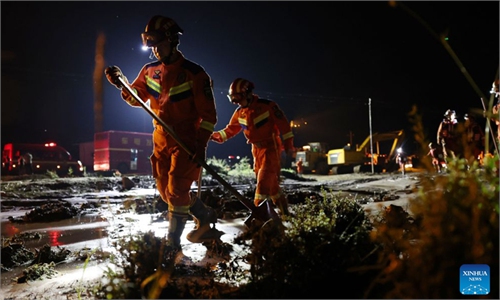
A total of 305 firefighters, 68 fire engines and four search-and-rescue dogs were sent to the scene, an official surnamed Chen from Dingxi municipal government told the Global Times on Monday.
The on‑site rescue effort was carried out with the coordinated use of construction machinery and excavators, while rescuers also employed location data from mobile phones and smartwatches to assist in the search and retrieval of those trapped, Chen added.
Another official with the Dingxi government told the Global Times that the fourth round of on-site rescue operations have concluded, yet all-area search and rescue efforts remain underway.
A total of 164 pieces of mechanical equipment including loaders and excavators have been put into service, alongside more than 1,000 professional rescuers from firefighting and medical teams. Over 400 pieces of relief supplies have been distributed on site, chinanews.com reported.
At present, the supply of various relief materials at the disaster site remains fully adequate, with no shortages reported, the Dingxi government official said, adding that the donated goods received so far consist primarily of instant food, along with basic rescue and support supplies such as flashlights, raincoats, and umbrellas.
As for the injured, most victims sustained fractures, open wounds and aspiration pneumonia. Medical experts have formulated individualized treatment plans for every patient based on their specific conditions, per CCTV News.
Local authorities have also set up two temporary resettlement sites to provide accommodation, meals and other basic services for affected tourists and their families.
RELATED ARTICLES