ARTS / CULTURE & LEISURE
Grassroots writers take the stage of literature amid ‘New Popular Literature and Art’ movement
Ordinary lives, extraordinary stories

Visitors at the 34th National Book Expo in Hangzhou Photo: Courtesy of the organizers of the expo
Writers, in the public imagination, belong in bookstores, universities and literary salons. But in China, a new generation of authors is emerging from the fabric of daily life, from delivery routes and vegetable stalls to steamed bun shops.
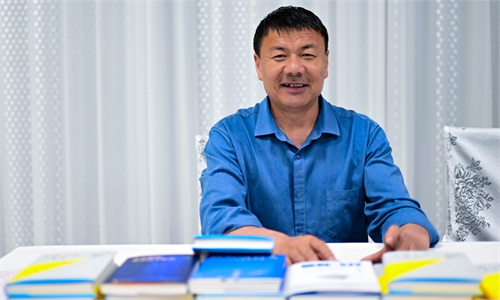
At the 34th National Book Expo in Hangzhou, East China's Zhejiang Province, three unlikely authors took center stage: food delivery rider Wang Jibing, market vendor Chen Hui and steamed bun seller Zhao Weihong. They gathered to discuss their writing journeys, offering readers a vivid glimpse into the emergence of what China now calls "New Popular Literature and Art."
This year's expo featured "New Popular Literature and Art" program by the Ningbo Publishing House, with an exhibition area showcasing books written by grassroots writers, bringing their stories from everyday life to a broader audience.
Yang Qingxiang, a professor and vice dean of the School of Liberal Arts at Renmin University of China, said China has entered "an era in which everyone can tell stories and everyone can become an author."
He noted that a growing number of writers from ordinary everyday backgrounds are embracing diverse publishing avenues to reclaim their narratives, share their lived experiences and present their own images to the world.
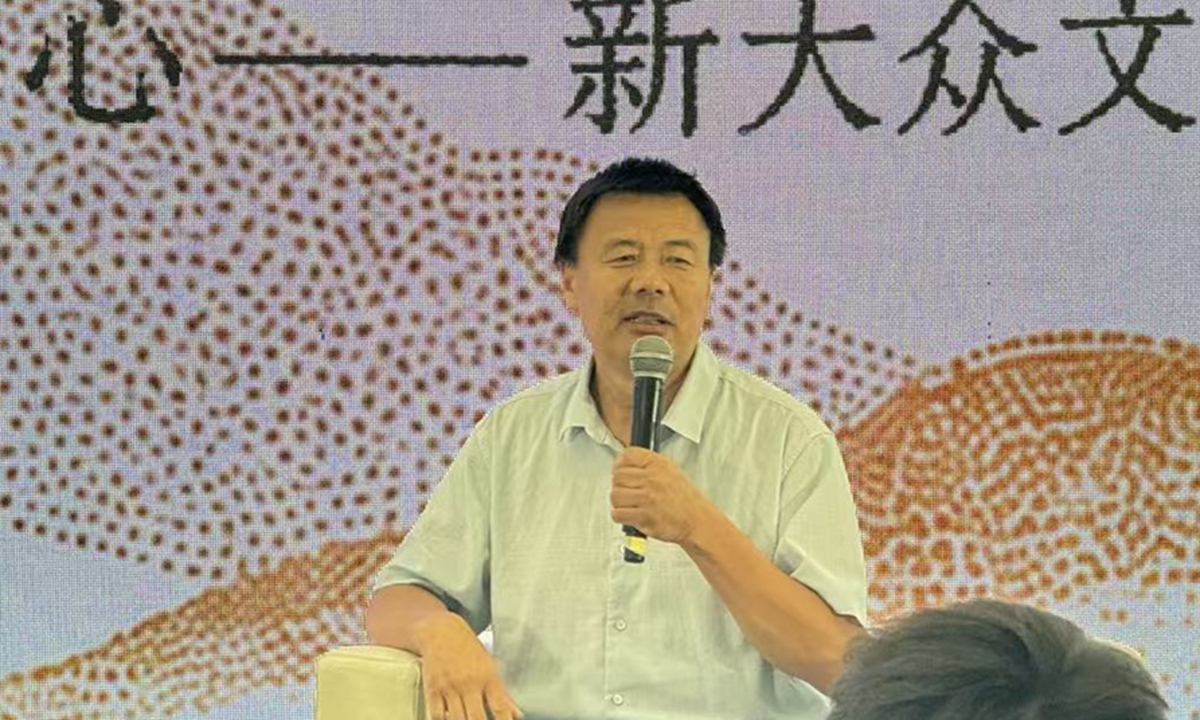
Wang Jibing speaks at a sharing event. Photo: Courtesy of Ningbo Publishing House
Life into literature
For the past eight years, Wang has spent his days weaving through city streets on an electric scooter, delivering meals to strangers. Yet he has also devoted nearly four decades to writing. The contrast between his identities as a "delivery rider" and a "poet" has made him one of the most recognizable figures in China's emerging grassroots literary scene.
Wang recently won the ninth Lu Xun Literature Prize, one of China's most prestigious literary awards, which was established to commemorate Lu Xun, the renowned modern Chinese writer, essayist and pioneer of the New Culture Movement.
Despite claiming the premier literary award, Wang told the Global Times that he has no intention of quitting his delivery job. He noted that he had completed several delivery orders that very day.
"I have spent eight years delivering food and 38 years writing. Dreams should never overshadow life," Wang said in Hangzhou. "I want to take back my time - to ride my electric scooter through the streets and piece my life back together."
Like Wang, Chen has kept her literary world closely connected to the market where she works.
"Reading and life are like two books," she said. "One expands our horizons, while the other speaks directly to the heart."
Chen continues to run her stall at Liangnong Market in Ningbo, a place she affectionately calls her "blessed land."
"If I didn't have these life experiences, I couldn't write what I write," she said.
She compares literature to everyday flavors - salty and sweet - drawing inspirations from Chinese essayist Zhou Zuoren's reflections on ordinary life. For Chen, writing is both rooted in daily experiences and a way of returning to oneself.
She does not see herself as separate from the people she writes about. Instead, she noted that her own experiences are closely intertwined with theirs.
"The market is my way of connecting with the world, and writing is how I return to myself," Chen told the Global Times.
Zhao, a young writer who runs a steamed bun shop, also found inspirations in his everyday surroundings. He borrowed an image from Harry Potter to describe his relationship with writing: Platform 9¾.
"Every wall can become a door," he said.
For Zhao, writing is much like making steamed buns. "The filling is always more important than the skin," he said, emphasizing that content remains at the heart of storytelling.
Elsewhere at the venue, truck drivers, container-haulers and community workers shared stories of writing in the margins of their busy lives.
Their backgrounds differ, but their works share a common thread: being rooted in everyday life.
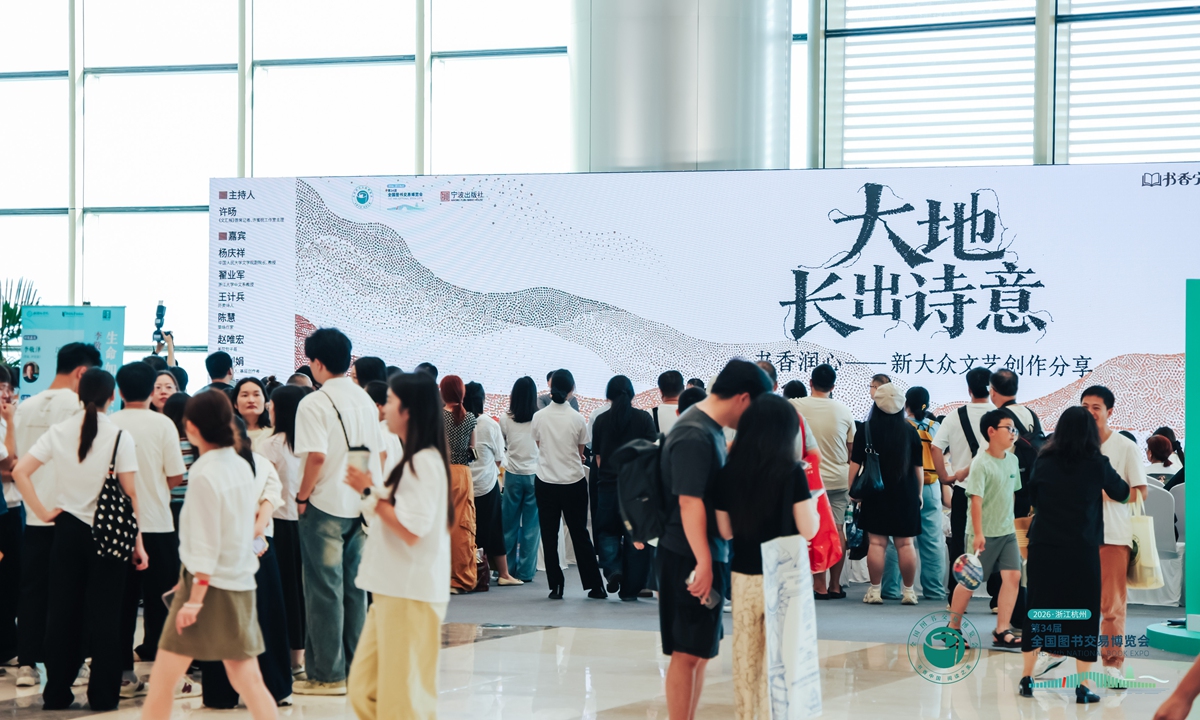
Visitors attend the "New Popular Literature and Art" event in Hangzhou, East China's Zhejiang Province. Photo: Courtesy of the organizers of the 34th National Book Expo
Making room for new voices
For a long time, literature has often been imagined as a pyramid, with a small number of celebrated writers standing at its peak, Wang said. He emphasized that that image is beginning to change.
"I think literature will still have its own summits in the future," he said. "But it may no longer resemble a steep pyramid. It may become a long mountain ridge, where many people stand along the same horizon."
Meanwhile, Wang's vision also points to a new challenge for China's publishing industry: As more voices emerge from everyday life, how can more stories from the country's vast labor landscape be discovered, nurtured and shared with a broader audience?
The answer may require a shift in the way literature is discovered and supported, experts said.
Zhang Peng, a cultural researcher and associate professor at Nanjing Normal University, told the Global Times that publishers should move beyond simply waiting for manuscripts to arrive. Instead, they could reach deeper into communities - from factories and food delivery stations to markets and logistics parks - and build closer connections with labor unions, local organizations and digital platforms to find new voices.
Besides, the way such works are evaluated may also need to evolve. Grassroots writing may not always follow the conventions of traditional literary creation, but its value often lies in something else: authentic experiences, fresh perspectives and emotional resonance.
Creating sustainable pathways for publication is equally important. Many first-time writers lack the resources or industry connections needed to bring their work to readers.
More flexible publishing models, partnerships with cultural programs and targeted support initiatives could help lower the barrier of entry for emerging authors.In a digital era, discovering readers is just as important as discovering writers. Zhang noted that short-video platforms, podcasts and community reading groups, alongside traditional literary publications, could become valuable channels for bringing these stories to a wider audience.
RELATED ARTICLES