Token calls exceed 140 trillion: Where does China's confidence in ‘token going global’ come from?
By Yang Shasha and Published: Jul 27, 2026 07:46 PM

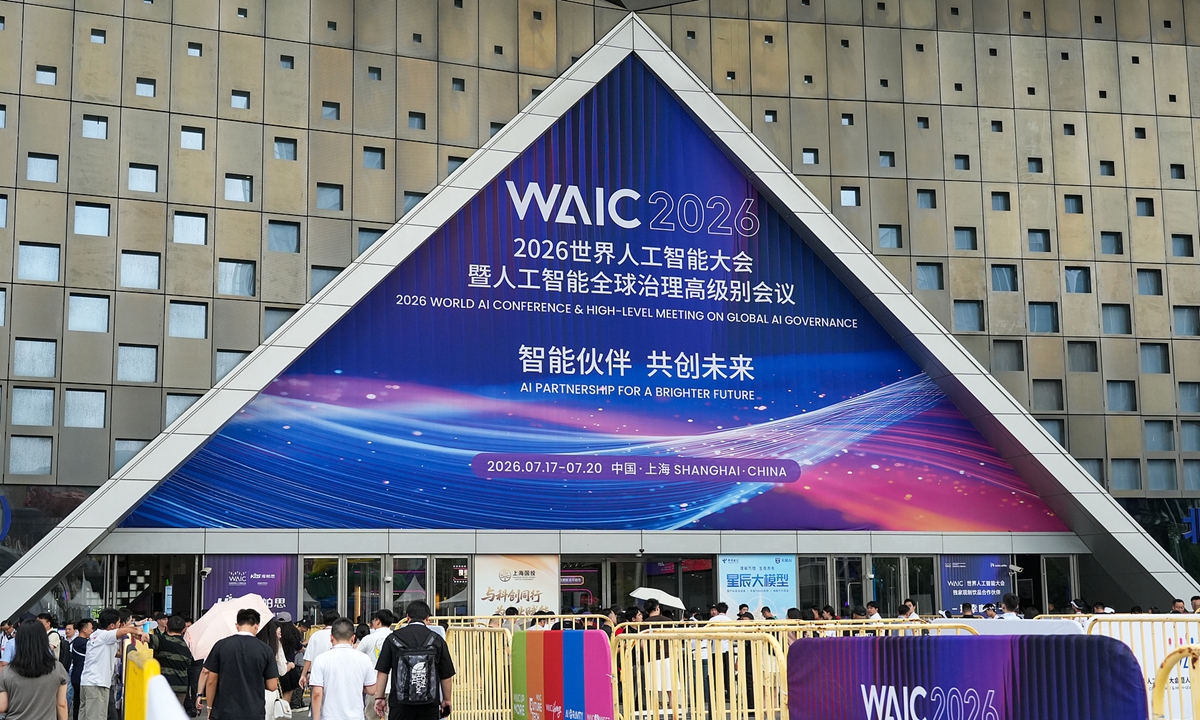
Visitors line up at the entrance to a pavilion of WAIC 2026 in Shangai on July 16, 2026. Photo: VCG
At this year's World Artificial Intelligence Conference (WAIC) in Shanghai, an unseen yet ever-present force — tokens — became the common thread running through the conference's forums and exhibition booths.
From detailed inquiries by Saudi government agencies at the Minimax booth to the consensus among Chinese and international experts on the "tipping point of agent explosion," all of this points to a fundamental shift: China's AI is moving from "chatting" to "getting things done."

Zheng Weimin, an academician of the Chinese Academy of Engineering
Does more token consumption mean stronger AI?
According to data released by the National Data Bureau, China's average daily token calls stood at 100 billion in early 2024, jumped to 100 trillion by the end of 2025, and exceeded 140 trillion in March this year — a more than 1,000-fold increase in two years. A token is the smallest unit of information processed by an LLM. Zheng believes that behind this number lies a fundamental change: AI's way of working has fundamentally changed.
In the past, LLMs handled simple Q&A. For instance, when asked "What are the transportation options from Beijing to Shanghai?" the model would answer "cars, trains, planes," consuming very few tokens. But now, agents have emerged that can actually perform tasks, he said.
"Plan a three-day business trip to Guangzhou: book flights, reserve hotels, and arrange meals for each day." To complete such a task, an agent needs to call the LLM multiple times and query various data sources, such as flight information and hotel reservation systems. "The number of tokens consumed in this process could be 10, 100, or even 1,000 times more than a simple Q&A," Zheng concluded. The surge in token consumption is essentially an inevitable result of AI moving from "chatting" to "working."
So, does higher token consumption mean more work gets done? There are various discussions on this within the industry. Robin Li, founder of Baidu, proposed using "DAA" (Daily Active Agents) this year as a new value metric for the AI era — focusing on how many agents are helping people complete tasks and deliver results each day, rather than how many tokens are consumed or how many active users there are.
During WAIC, International Data Corporation released the industry's first DAA Research Report, which showed that the global number of active agents stood at 28.6 million in 2025, is expected to reach 79.4 million in 2026, and is projected to grow to 2.216 billion by 2030. The report argues that as the number of agents grows rapidly worldwide, DAA will become an important coordinate for observing the intelligent economy and measuring AI productivity worldwide.
Zheng believes that DAA is a more scientific metric than token and represents progress in understanding token. He gave an example: If a boss evaluates employees based on "who consumes more tokens gets a higher salary," that would obviously be unreasonable. A more comprehensive evaluation system for tokens is needed, as high token consumption does not necessarily yield good results. Using DAA as a measure, at least, comes closer to the goal of "how much has actually been accomplished."
Zheng likened tokens produced by US LLMs to "sports cars" and those produced by Chinese LLMs to "buses." The distinction between "sports cars" and "buses" essentially reflects differences in token quality. To assess whether a token is valuable, at least four indicators should be considered: latency — shorter time from question to answer means better quality; throughput — more tokens generated per second and smoother responses; concurrency — the ability to serve more users simultaneously; and security and stability — the safer the output and more reliable the system, the more valuable the token.
While this comparison simplifies things, Zheng believes it highlights the core issue — the gap between Chinese and US-generated tokens lies not in software but in hardware. The quality of tokens is determined primarily by computing infrastructure. Domestic GPUs already perform well in the "P phase" (Prefill, input processing) but still lag in memory performance. In particular, the "D phase" (Decode, output generation) in inference requires high memory bandwidth and low latency. As a result, Tokens generated entirely using domestic GPUs may not match the latency and throughput of those produced with high-end foreign cards.
However, this does not mean China cannot produce high-quality tokens. Zheng's team proposed a "PD separation" solution: splitting the P and D phases of LLMs for deployment—using domestic cards for the P phase (strong computation) and a small number of foreign cards for the D phase (strong memory). With a combination of "9,000 domestic cards + 1,000 foreign cards," they can generate tokens of comparable quality. This is currently a pragmatic approach to breaking the deadlock.
When can domestic cards catch up in memory performance? Zheng estimates one to two years. "If domestic memory chipmakers like Changxin Memory Technologies can make good HBM (High Bandwidth Memory), then both P and D phases could be fully supported by domestic technology."
Prerequisites for LLMs going global
Currently, including Minimax, several Chinese companies' LLMs have successfully gained traction among overseas developers and enterprises. A widely cited figure is that in February 2026, on the global model aggregation platform OpenRouter, Chinese LLMs' monthly token calls surpassed those of US models for the first time.
Just a few months ago, token calls to Chinese LLMs remained relatively limited. Zheng told Global Times that the primary use of LLMs going global is programming, but Chinese models previously had a common problem: they were unable to handle complex software development tasks. Now the situation is changing, especially in the past month or two, as domestic LLMs have significantly improved their programming capabilities, some are now roughly on par with mainstream US models. This meets the first threshold for going global—the LLMs' own programming ability must be strong enough.
However, to truly achieve global expansion, two other conditions must be met simultaneously: the "token factory" must produce high-quality tokens, with fast computation in the P phase and fast memory in the D phase—both are necessary for high-quality output; and pricing must remain competitive, offering a clear cost advantage. Once all these conditions are met, Zheng believes, China's "token going global" will see an explosion.
RELATED ARTICLES