China to foster smart rehabilitation via brain-computer interface, advance need-driven applications: federation
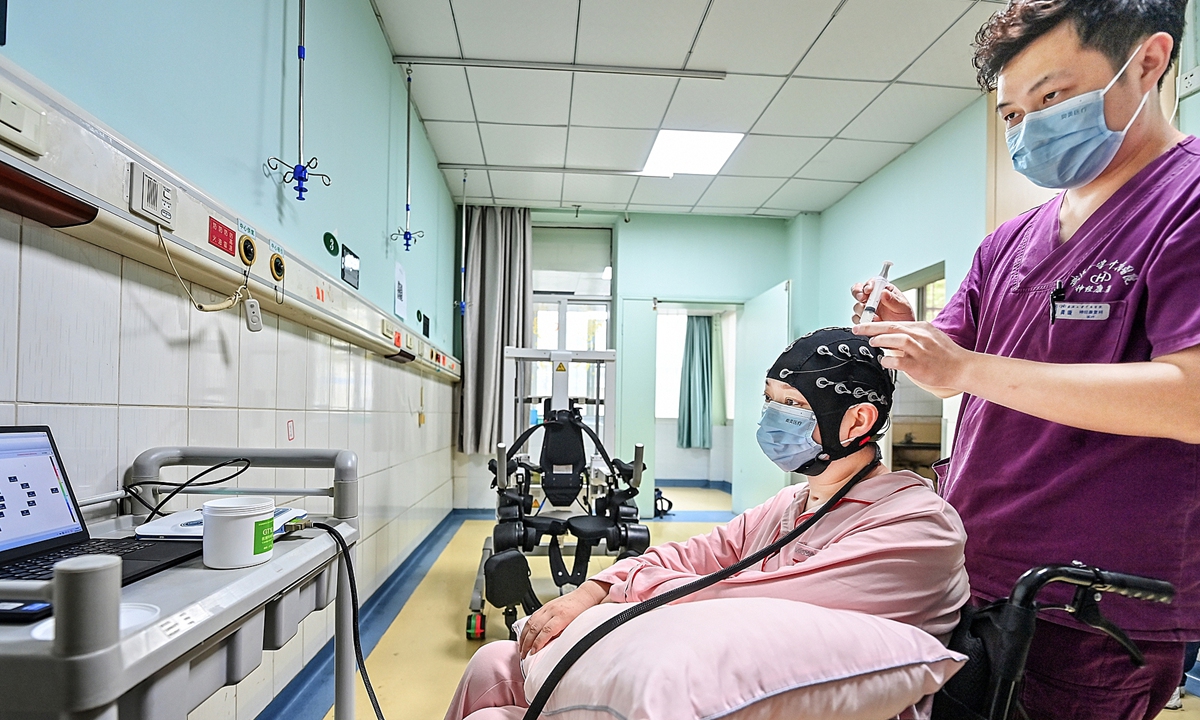
A patient surnamed Hu wears an EEG (electroence phalography) cap to control a robotic device, enabling lower-limb movemen. Photo: VCG
China vows to advance need-driven real-world applications of brain-computer interfaces for people with disabilities, including smart rehabilitation devices integrated with non-invasive brain-computer interface technology during the 15th Five-Year Plan period (2026-2030), according to the China Disabled Persons' Federation (CDPF) on Monday.At a press conference hosted by the State Council Information Office (SCIO) on Monday outlining plans for comprehensive and high-quality development of services for people with disabilities during 2026-2030, the CDPF highlighted three priorities to fully unlock the potential of brain-computer interfaces for this group: aligning innovations with disabled people's actual needs, accelerating on-the-ground rollout of relevant technologies, and boosting public outreach.
Zhou Changkui, chairperson of the board of executive directors of the CDPF, said at the press conference that work will be done to identify the technological needs of people with different types of disabilities and pool innovation resources, in order to avoid a disconnect between R&D work and the actual needs of disabled groups.
The federation will zero in on disabled people's practical needs spanning healthcare, rehabilitation, employment and accessibility, to ensure the targeted allocation of research and development resources. Throughout the whole development process, people with disabilities will be involved to ensure the final products are practical and well suited to users, Zhou said.
"Simply identifying user needs is not enough; it is equally vital to promote scenario-based applications," the official said, citing the application scenarios released by the federation at the Zhongguancun Forum in March, including barrier-free online car-hailing services for disabled travelers, smart rehabilitation devices built around non-invasive brain-computer interfaces, and the intelligent navigation tools for the visually impaired.
"Guide dogs are expensive and remain scarce, making it impossible to meet demand among people who are blind. By exploring multiple technical approaches, we are advancing intelligent guide robots, smart canes and navigation glasses. It is expected that these innovations will deliver tangible benefits to people with disabilities before long," Zhou told media at the conference.
Lastly, outreach and promotion efforts will be scaled up to help more disabled people learn about newly developed assistive technologies and relevant supporting policies. Efforts will also be made to include such assistive products in subsidy programs to lower barriers to access and accelerate real-world adoption, according to the official website of the SCIO.
In addition to brain-computer interface technologies, the Monday conference also addressed support for individuals with autism. According to Xinhua News Agency, the country will push forward lifelong support for autistic individuals covering early screening, diagnosis, rehabilitation and integrated education and rehabilitation.
That will include efforts to enforce standards on autism screening and intervention for children aged 0 to 6, ensure rehabilitation aid services for autistic children are available in all prefecture-level cities and densely populated county-level areas, and back provincial capitals, cities with independent planning status and major cities in building special education schools for autistic children, the report said.
Global Times
RELATED ARTICLES