China-Mongolia joint archaeological team discovers runic inscriptions in Mongolia dating back up to 1,300 years ago
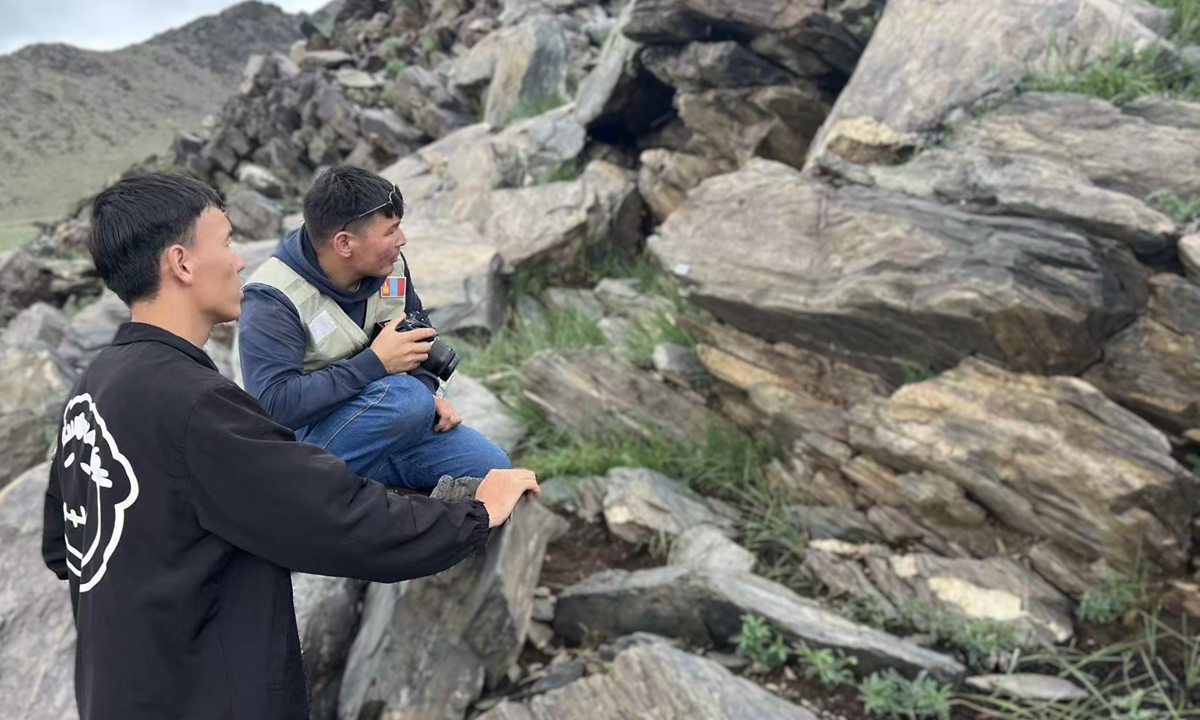
Members of the China-Mongolia joint archaeological team conducts investigation around the newly discovered runic inscription in Bayankhongor Province, Mongolia. Photo: Screenshot from website
A China-Mongolia joint archaeological team has discovered a new runic inscription during a field survey in Bayankhongor Province, Mongolia, which marks an important addition to the limited corpus of ancient Turkic inscriptions date back up to 1,300 years ago and is expected to facilitate studies of ancient Silk Road.
The inscription was discovered on an exposed natural rock surface on a mountainside and consists of several clearly preserved lines of runic characters. The carvings remain in good condition, with distinct strokes and legible inscriptions, offering valuable new material for future research, the paper.cn reported Monday.
The joint team, formed by Inner Mongolia University and the Institute of Archaeology of the Mongolian Academy of Sciences, has completed high-resolution photographic documentation, mapping, and detailed recording of the inscription in accordance with standard archaeological field procedures. A systematic survey of the surrounding area was also conducted.
The script, commonly known as Old Turkic inscriptions or Old Turkic runiform inscriptions, was the script widely used by the nomadic polities including the Turkic Khaganate, the Uygur Khaganate, and other nomadic polities across the Mongolian Plateau between the 7th and 10th centuries. The best-known examples include the inscriptions in the Orkhon Valley.
As surviving runic inscriptions are relatively rare, they serve as invaluable primary sources for the study of ancient Turkic and Uygur history. Each newly discovered inscription has the potential to provide fresh linguistic evidence and historical information.
An epigraph inscribed with both Chinese and the runic scripts from Tang Dynasty (618-907) was discovered in Xi'an, Northwest China's Shaanxi Province. The epigraph wrote the life of a Uygur prince who came to Xi'an, or Chang'an in Tang Dynasty and showcased exchanges across the Silk Road, Xinhua News Agency reported earlier.
The latest discovery further enriches the known collection of runic inscriptions on the Mongolian Plateau and provides new physical evidence for studying the historical geography, languages and scripts, tribal composition and transportation routes of ancient nomadic states. It also carries significant academic value for advancing research into Eurasian steppe civilizations and the ancient Silk Road across the grasslands.
The discovery represents another achievement of practical archaeological cooperation between China and Mongolia, highlighting the two countries' joint efforts to promote cultural heritage research and deepen exchanges between civilizations.
The joint archaeological team will work with experts in linguistics, history, and archaeology to decipher and conduct comprehensive studies of the inscription. The research findings will be released to the academic community and the public in due course.
Global Times
RELATED ARTICLES