Xi says China ready to further strengthen bilateral, multilateral strategic coordination with Brazil in phone call with Lula
Coordination brings stabilizing, constructive momentum to turbulent intl landscape: expert
By Published: Jul 27, 2026 09:50 PM

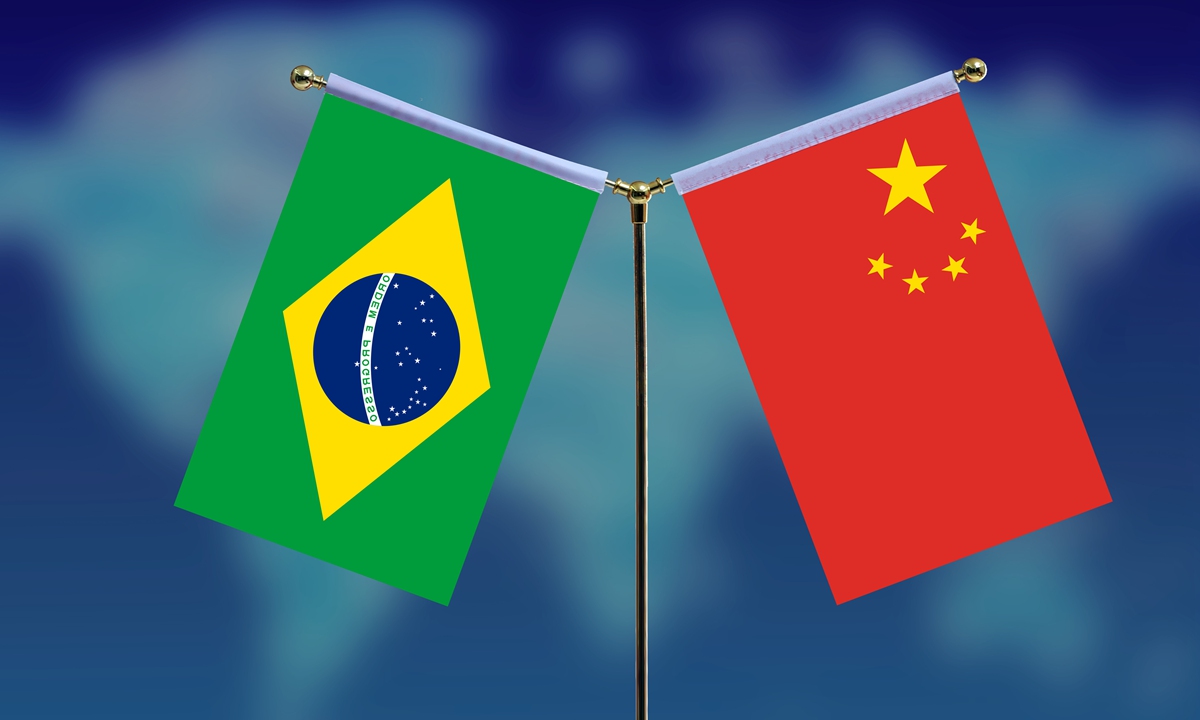
China-Brazil national flags Photo: VCG
This latest phone call marks another heads-of-state exchange between the two countries this year, following their January conversation. Additionally, Chinese Foreign Minister Wang Yi met with his Brazilian counterpart Mauro Vieira in Manila on July 22, representing another close senior-level engagement between the two sides.
Chinese analysts noted that amid intensifying geopolitical tensions and the surge of hegemonism and unilateralism, the latest talks between the Chinese and Brazilian heads of state will not only maintain the sound momentum of bilateral cooperation and deepen their strategic coordination, but also uphold multilateralism, safeguard the shared interests of the Global South, and bring sorely needed stability to the world.
Maintaining momentum
In Monday's phone call, President Xi said that in recent years, the building of a China-Brazil community with a shared future and the alignment of the two countries' development strategies have made positive progress, which has played an important role in advancing the development of both nations and improving the well-being of the two peoples, while contributing valuable stability to a volatile international landscape, Xinhua reported.
Noting that this year marks the 105th founding anniversary of the Communist Party of China and the beginning of China's 15th Five-Year Plan, and that Brazil will usher in a key domestic political agenda, the Chinese leader said China stands ready to further strengthen bilateral and multilateral strategic coordination with Brazil, thus maintaining the positive momentum in building a China-Brazil community with a shared future.
Lula said Brazil and China have made positive progress in building a community with a shared future for a more just world and a more sustainable planet, with cooperation across various fields advancing rapidly, according to Xinhua.
He said Brazil looks forward to strengthening cooperation with China in such areas as artificial intelligence, energy and mineral resources, and welcomes more Chinese enterprises to invest in Brazil to diversify bilateral cooperation and deliver more fruitful outcomes.
"In recent years, China-Brazil practical cooperation has undergone a qualitative shift and entered a new phase, breaking free from traditional trade centered on iron ore and soybeans," Jiang Shixue, a professor at the Center for Latin American Studies at Shanghai University, told the Global Times.
Zhou Zhiwei, Latin American studies expert at the Chinese Academy of Social Sciences, echoed the view. He told the Global Times that Brazil's push for reindustrialization, infrastructure development, green energy transition and digital transformation creates ample room for deeper bilateral collaboration.
Bilateral cooperation is accelerating toward high-end and technological fields, with continuous expansion in areas such as artificial intelligence, aerospace, 5G/6G, and semiconductors, said Zhou.
He pointed out that conventional North-South partnerships are often hampered by technology transfer barriers. In contrast, China and Brazil leverage industrial capacity collaboration to unlock high-tech complementarities, with closely aligned development goals and shared interests.
According to the Chinese Foreign Ministry, China has been Brazil's top trading partner for 17 years, with the bilateral trade volume reaching $187.987 billion in 2025. In the first half of this year, bilateral trade surged nearly 30 percent year on year, with over 30 percent of Brazil's exports bound for China.
Opposing external interference
The latest phone conversation between Chinese and Brazilian leaders came shortly after Washington imposed a new round of 25 percent tariffs on several Brazilian products last week, with 16.5 percent of Brazilian exports facing combined US duties of 37.5 percent, Reuters reported.
In a Sunday opinion column for The Washington Post, Lula called the new US tariffs unfair and "a strategic mistake."
In addition, citing two Brazilian officials, Reuters reported on Saturday that Brazil has denied visa requests for two US officials who planned to travel to the country to cast doubt on the integrity of its electoral system. They said that the US plan represented an attempt to shape Brazil's October presidential election, as right-leaning Senator Flavio Bolsonaro, son of ex-President Jair Bolsonaro, is widely seen as US president Donald Trump's ally by Western media.
Al Jazeera also reported that back in June, Lula urged Washington to respect Brazil and refrain from interfering in its presidential election.
According to Xinhua, during the phone call with Lula on Monday, the Chinese leader emphasized that China supports Brazil in safeguarding its sovereignty and independence, opposing external interference, and contributing to maintaining regional and world peace and stability.
"Respecting all countries' sovereignty and opposing external meddling constitutes an enduring tenet of China's diplomacy. China's renewed emphasis on this principle targets foreign meddling in Brazil's internal affairs, with no intent to intervene in Brazil's election," said Jiang.
Zhou also noted that since Washington launched military operations against Venezuela earlier this year, the US has repeatedly resorted to political meddling, economic suppression and even direct military actions in Latin America, posing severe threats to the sovereignty and security of Western Hemisphere nations.
"Against such a backdrop, deepened political mutual trust and mutual staunch support for each other's core interests between China and Brazil represent the very essence of their bilateral community with a shared future," he added.
Upholding multilateralism
Beyond the bilateral scope, in the conversation with Lula, Xi said in the face of new circumstances and challenges, China and Brazil, both important members of the Global South, should firmly stand on the right side of history, as well as the side of the progress of civilization, and play a greater constructive role in reforming and improving the global governance system, and upholding international fairness and justice.
The two sides should jointly promote the high-quality development of greater BRICS cooperation, chart the right course for cooperation, maintain the momentum of unity, deliver more outcomes, and write a new chapter of solidarity and self-reliance for the Global South, he said.
For his part, Lula said that Brazil stands ready to enhance multilateral coordination with China, uphold the authority of the United Nations, strengthen solidarity and cooperation within BRICS, firmly safeguard multilateralism, resolutely oppose power politics, adhere to resolving hotspot issues through dialogue and consultation, and jointly uphold international fairness and justice as well as world peace and stability, according to Xinhua.
Regarding global flashpoints, Lula stated via an X post following bilateral high-level talks that the two leaders discussed the Ukraine crisis, the situation in the Middle East, as well as the impact of global conflicts on worldwide food and energy security.
As major regional powers and core participants in multilateral global governance mechanisms including BRICS and the G20, China and Brazil boast extensive collaborative ties, with their bilateral relations transcending the scope of mere two-way cooperation, said Zhou. He added that both nations share identical core objectives: upholding multilateralism, preserving global peace and development, bolstering solidarity across the Global South, and elevating the bloc's collective strategic influence.
Against a backdrop of intensifying global geopolitical tensions amid US hegemony and tariff bullying practices, the closer coordination between China and Brazil, two representatives of the Global South, will deliver powerful exemplary effects and bring stabilizing, constructive momentum to an unsettled international landscape, the expert noted.
RELATED ARTICLES