ARTS / CULTURE & LEISURE
Beijing Central Axis unveils restored landmarks, digital platforms and expanded public access
By Published: Jul 27, 2026 10:18 PM

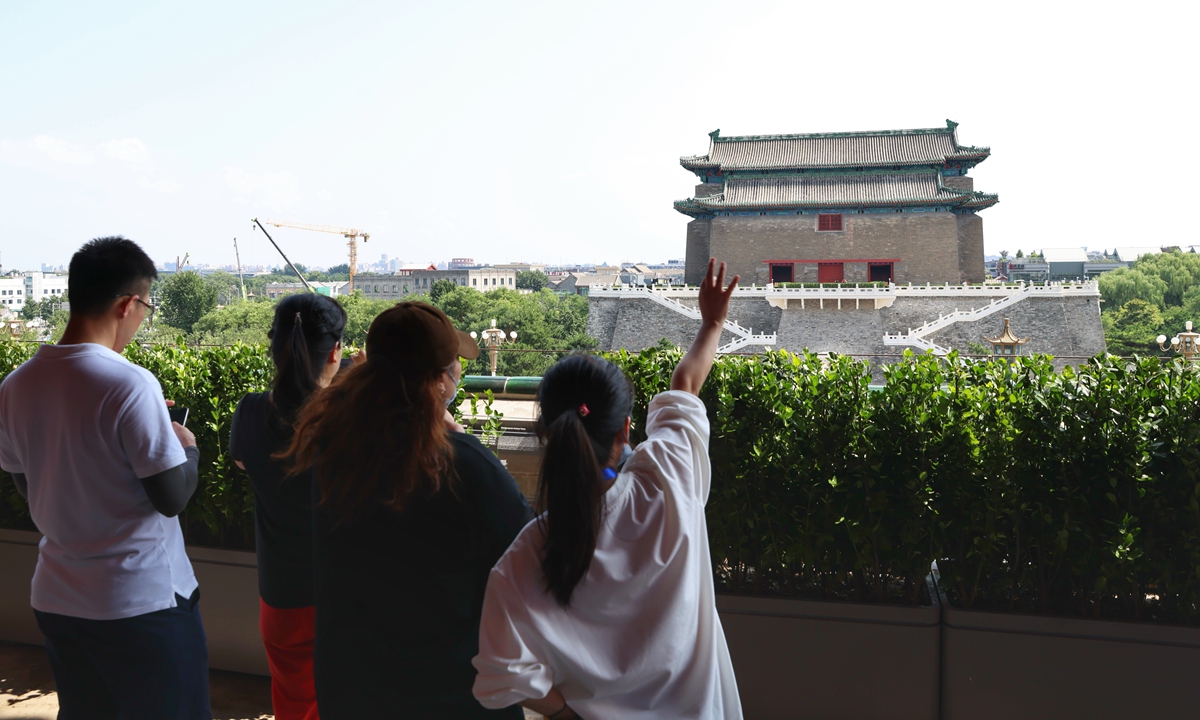
Visitors look at the Zhengyangmen Archery Tower from atop the reopened Zhengyangmen Gate Tower in Beijing on July 27, 2026. Photo: VCG
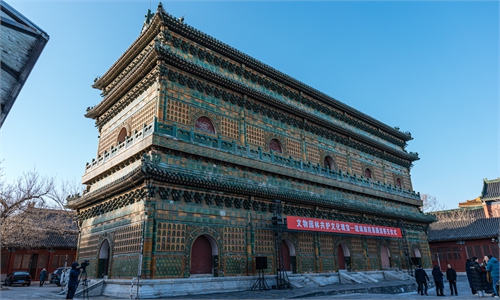
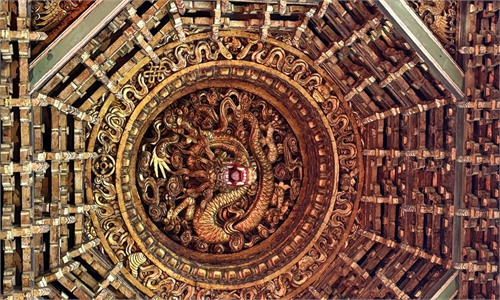
On Monday, a series of cultural institutions along the Beijing Central Axis held new exhibitions and events to celebrate the second anniversary of its successful inscription on the UNESCO World Heritage List.The Zhengyangmen Gate Tower reopened to the public after six years, while the Beijing Ancient Architecture Museum launched an exhibition on China's ancient caisson (coffered ceiling) architecture, releasing restoration videos of its prized Celestial Ceiling for the first time. Major museums also opened for special visits that day.
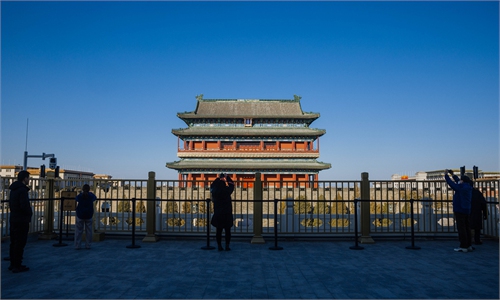
At the reopened Zhengyangmen Gate Tower, a blend of artifacts, historical images and texts, and digital displays detail over 600 years of the tower's history. Inside, scale models of Zhengyangmen - built to authentically replicate the ancient structure's proportions - allow visitors to see not only the present-day tower and arrow tower but also the original defensive and ceremonial layout of the site. According to the Beijing Daily, these models help the public gain a clear understanding of the architectural form, structural design, and spatial relationships of Zhengyangmen, and its dual functions for defense and ceremony.
Another exhibition at the tower showcased the progress made over the past two years in protecting and passing on the heritage of the Central Axis. Displays covered key achievements in preservation, public access, community participation, and innovations. Notably, the second group of Central Axis cultural heritage supervisors officially started their roles, further strengthening community-based supervision. New themed walking routes - like the planned "most beautiful walkway" - will connect major heritage spots and cultural nodes, encouraging residents and visitors to experience the spirit of Beijing's historic core on foot, according to the Beijing Municipal Cultural Heritage Bureau.
For the Central Axis, World Heritage status is not an endpoint but a new beginning. Since being listed, revised regulations on heritage protection have taken effect, along with a three-year action plan spanning 2025 to 2027 for preservation and public engagement. Key sites like the Imperial Ancestral Temple have completed transitioned out of mixed use, while heritage sites including the Temple of Agriculture and Temple of Heaven have been restored, offering an authentic view of Beijing's historic urban landscape.
According to the municipal heritage authority, more elements of the Central Axis are being opened to the public as part of preservation efforts. For example, Zhenwu Temple and Yongquan Temple in the Xicheng district - once used as residential courtyards - have been professionally restored and officially opened to the public in June as innovative cultural spaces blending tradition and modern technology.
Digitalization is one of the core innovations of the Central Axis World Heritage campaign. Over the past two years, a comprehensive "Digital Central Axis" system has been developed. According to CCTV News, the country's first heritage monitoring platform using 3D digital twin technology has been implemented in Dongcheng district, allowing for real-time visualization of sites like Zhengyangmen and Temple of Agriculture on a single digital map. This dynamic platform is supported by an extensive Internet of Things network that covers the entire axis. Nearly 30,000 5G base stations, coupled with video surveillance and environmental sensors, form an invisible digital web.
Liu Zheng, a member of the Chinese Society of Cultural Relics, told the Global Times that the Central Axis could also become an important venue for international cultural exchanges and diplomatic events. He also noted that in order to further integrate Central Axis culture into city life and the urban landscape, more focus should be placed on the area's rich intangible heritage such as traditional temple fairs and historic local brands. These living expressions of Beijing's history and culture deserve systematic discovery, protection, promotion, and innovation for future generations.
RELATED ARTICLES