Claims that China’s economy is ‘losing momentum’ do not stand up to scrutiny: People’s Daily
Debunking misconceptions about China’s current economic performance

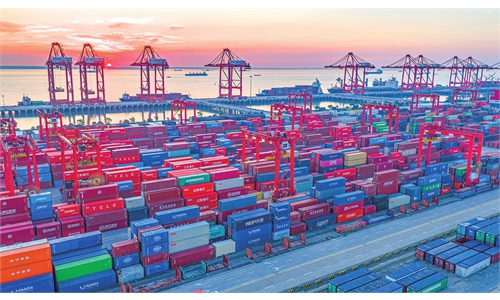
A view of Shanghai Photo: VCG
China's GDP grew 5.0 percent year-on-year in the first quarter, 4.3 percent in the second quarter, bringing growth for the first half of 2026 to 4.7 percent. The release of China's mid-year economic report has drawn close attention to the country's growth performance. Yet some foreign media outlets have once again repeated the old narrative that China's economy is "losing momentum."
In fact, whether viewed from China's own development trajectory, compared with other economies globally, or through a deeper analysis, claims that China's economy is "losing momentum" simply do not hold up to scrutiny.
Viewed over time, China's economy continues to post substantial incremental growth while maintaining a stable growth rate.
For any large economy, growth naturally tends to slow as its economic scale expands and the base becomes larger, which is fully in line with the general pattern of development. For example, the US, the world's largest economy, has recorded real GDP growth of less than 4 percent in most years over the past two decades, with its long-term average growth rate standing at only around 2 percent.
Today's China, as the world's second-largest economy, has an economic output of around 140 trillion yuan ($20.7 trillion). Achieving 4.7 percent growth in the first half of the year on such a large economic base is no small feat.
The increase in economic output remains substantial. China's GDP in the first half of this year was 3.6 trillion yuan higher than in the same period last year, the largest increase for the period in five years. In 2026, China has set its GDP growth target at "4.5 to 5 percent." Based on this target, the annual increase in GDP is expected to exceed 6 trillion yuan, equivalent to the annual GDP of a medium-sized developed economy. With such strong performance, how can China's economy be described as "losing momentum"?
China's economic growth has remained stable. In the first half of the year, the added value of industrial enterprises above designated size increased 5.4 percent year-on-year, trade in goods imports and exports grew 16.9 percent, total retail sales of goods and services rose 2.7 percent, and the surveyed urban unemployment rate averaged 5.2 percent…Since major indicators including industry, exports, consumption and employment have all remained within a reasonable range, there is simply no basis for claiming that China's economy is "losing momentum."
Looking at China's economy in comparison with the rest of the world, its resilience and strong performance stand out.
Escalating geopolitical conflicts, tight energy supplies and significantly greater uncertainty in the external environment… Since the beginning of this year, particularly since the second quarter, the global economy has seen new changes, posing severe challenges to economies around the world.
The US economy is expected to slow from 2.7 percent growth in the first quarter to 2.1 percent in the second. Japan's growth is projected to ease from 0.4 percent in the first quarter to 0.2 percent, and the eurozone is expected to grow by around 0.5 percent. Some international institutions expect growth in major economies worldwide to slow by varying degrees in the second quarter of this year.
Viewed from a global perspective, there is no need to be overly concerned about the slowdown in China's economic growth in the second quarter.
Against the backdrop of significantly rising inflationary pressures in many countries, China has maintained moderate price increases, generally stable employment and an improved balance of payments. Monthly indicators including industry, services, imports and exports, and the PMI gradually improved in the second quarter, showing that China's "health indicators" are clearly stronger.
A deeper analysis shows that while China's economy may experience fluctuations in the short term, its overall trajectory remains positive.
Any economy will inevitably experience fluctuations in the course of its development. However, normal fluctuations should never be simply equated with the risk of "losing momentum."
In the first half of the year, some indicators, including consumption and investment, did experience fluctuations. However, viewed from a dialectical and long-term perspective, China's fundamentals remain sound, and these issues will eventually be resolved.
Looking at consumption, its structure is undergoing adjustment, while its potential remains vast.
After China's per capita GDP surpassed $10,000, its consumption structure began to upgrade at a faster pace, shifting from subsistence and basic consumption toward development-oriented and higher-quality consumption, and from a goods-dominated model to one that places equal emphasis on goods and services.
In the first half of the year, cultural, tourism, sports and leisure markets remained vibrant, with the 5.3 percent year-on-year growth in service retail sales serving as clear evidence. With multiple measures in place to expand and upgrade consumption, the spending potential of China's more than 1.4 billion people across food, clothing, housing, transportation, tourism, shopping and entertainment will be gradually unleashed.
Looking at investment, its pattern is improving, while prospects remain broad.
In the first half of the year, fixed-asset investment declined year-on-year, but investment in new growth drivers such as new energy, artificial intelligence and integrated circuits showed strong momentum. For example, investment in high-tech industries increased 4.6 percent year-on-year, while investment in intellectual property products rose 9.4 percent. This shows that while overall investment faces pressure, new sources of support are emerging.
China is a large developing country. From cities to rural areas, from new urbanization to new industrialization, and from investment in physical assets to investment in people, there is still substantial potential for investment.
As efforts related to implementing major national strategies and enhancing security capacity in key areas, carrying out large-scale equipment upgrades and consumer goods trade-in programs, continue to advance, and the development of the "Six Networks" - including water networks, new-type power grids, computing power networks, next-generation communication networks, urban underground pipeline networks and logistics networks - moves forward, investment vitality will become stronger. Meanwhile, with a number of national-level special plans rolled out and reforms such as building a unified national market gaining momentum, investment space will expand further.
Looking ahead, China's economic fundamentals remain solid, and new growth drivers are gaining strength.
On the market front, transformers, gas turbines and intelligent equipment have seen surging global demand, while cooling appliances such as refrigerators, air conditioners and ice makers have gained popularity in Europe. New orders received by China's shipbuilding industry account for more than 80 percent of the global total.
Looking at the figures, China's value-added industrial output above designated size increased 5.4 percent year-on-year in the first half of the year, while goods exports have maintained growth for 11 consecutive quarters. The strong performance of the real economy highlights China's solid advantages in global competition, which is also the foundation supporting the economy's long-term positive outlook.
More importantly, as technological innovation gains momentum and China's manufacturing sector undergoes "systematic upgrading," China's growth momentum is becoming increasingly robust. Preliminary estimates show that new growth drivers, including high-end manufacturing, the digital economy and modern services, accounted for more than 40 percent of economic growth in the first half of the year. The strong performance of these new growth drivers serves as a stabilizer in overcoming downward pressure and countering concerns that China's economy is "losing momentum."
It should also be noted that in recent years, China's macroeconomic authorities have demonstrated strong macroeconomic regulation capabilities and well-established response mechanisms. In the second half, more proactive and effective macroeconomic policies will be introduced in response to changing circumstances, helping gradually resolve problems arising in the course of development and transformation and injecting new momentum into sustained economic growth.
No matter what challenges lie ahead, China's economy will remain resilient and steadfast. The 2026 mid-year economic report fully demonstrates that China's economy has solid foundations, multiple strengths, strong resilience and enormous potential. The conditions supporting its long-term positive outlook and the fundamental trend toward continued improvement remain unchanged. As China's economy continues to grow stronger, the so-called "China collapse theory," "China peak theory" and "China slowdown theory" will once again be proven wrong.
This was compiled and translated by the Global Times English edition based on an article published in the "Chisu Jinsheng" economic commentary column of the People's Daily on July 24, 2026.
RELATED ARTICLES