Claims that China’s policies are ‘ineffective’ totally disregard the facts: People’s Daily
Debunking misconceptions about China’s current economic performance
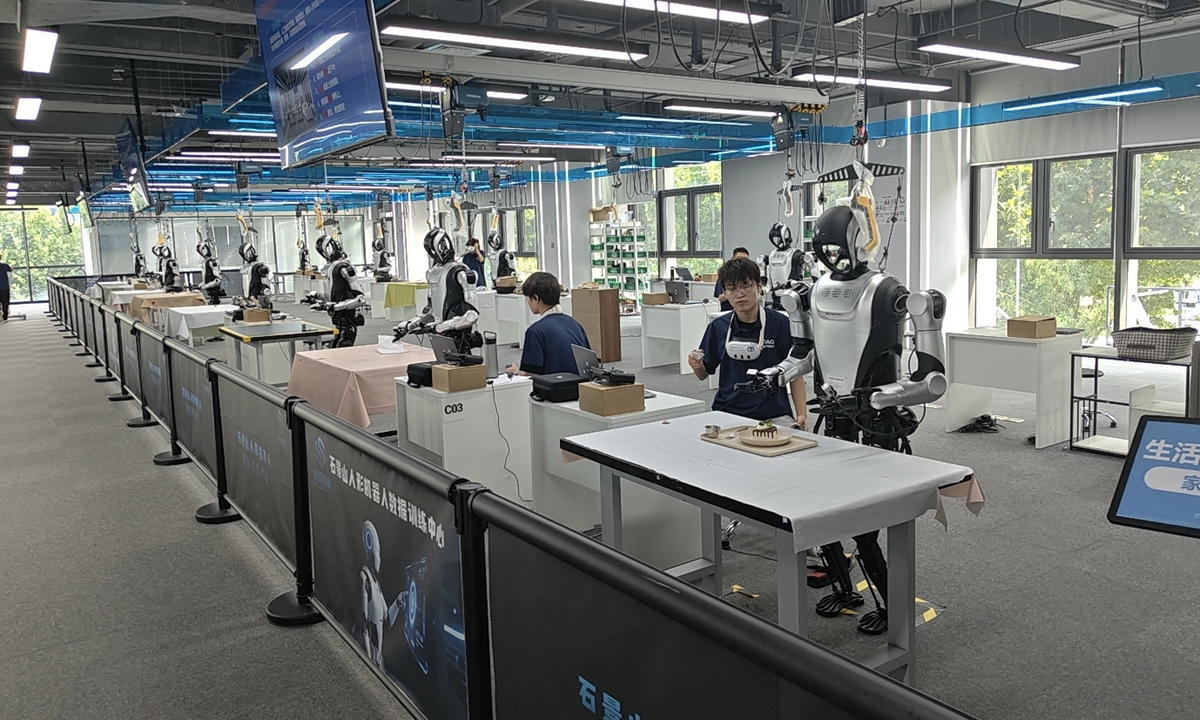
Workers train robots at the Humanoid Robot Data Training Center in Shijingshan district, Beijing on July 22, 2026. Photo: Zhang Yiyi/GT
Yet some foreign media, fixated on minor fluctuations in quarterly growth rates and changes in financial data, have hastily put forward the one-sided claim of “diminishing policy effects.” They asserted that the impact of China’s multiple rounds of stimulus policies has gradually weakened, that the effectiveness of credit transmission to the real economy has continued to decline, and that the room for policy maneuver has kept narrowing, among other assertions. Such interpretations ignore China’s economic fundamentals and the complete logic of macroeconomic regulation, and they cannot withstand the dual test of facts and theoretical scrutiny.
Judging from the economic data, amid a sluggish global recovery, ongoing geopolitical conflicts, and pressure on external demand, China’s economy has navigated against the current, risen to the challenge, and stabilized its foundation—itself powerful evidence that macroeconomic policies are taking effect.
China’s first-half economic growth was in line with the full-year target. The consumer price index (CPI) rebounded moderately while the producer price index (PPI) returned to growth from earlier declines. Most major industries, including high-tech manufacturing and digital product manufacturing, maintained double-digit growth, and output of key emerging products also rose at double-digit rates.
Under multiple pressures, the Chinese economy did not stall and continued to rank among the front-runners in growth rates among major global economies. If the policies truly suffered from “diminishing effects” as some foreign media claim, how could the multiple goals of expanding total economic volume, optimizing structure, and safeguarding people’s livelihood have been advanced simultaneously?
From the perspective of economic theory, there has never been a simple linear relationship between economic growth rates and the effects of policy stimulus. Macroeconomic regulation generally involves transmission lags, and it often takes several months – or even spans across cycles – for policies to fully translate into corporate investment, market output, and household consumption. At the same time, China’s macroeconomic regulation upholds the organic integration of cross-cyclical and counter-cyclical adjustments, while coordinating the goals of stabilizing growth, adjusting structure, and preventing risks.
When Western media apply the single yardstick of short-term stimulus to evaluate China’s refined and long-term-oriented regulatory approach, they neither understand the multiple objectives of China’s macroeconomic governance nor fully grasp the inherent laws of modern macroeconomic operations. Their conclusions are therefore inevitably biased.
Objectively speaking, the slowing of marginal stimulative effects after the continuous use of a single policy tool is a universal economic pattern. However, different policy instruments experience this diminishing marginal effect at different paces, each with its own transmission cycle and peak effectiveness. By combining policy tools and staggering their implementation, overall stimulative effects can be maintained at a stable level from a macroeconomic perspective.
This is precisely the core logic of China’s macroeconomic regulation: rather than relying on continuously “increasing the dosage” of a single tool, it employs a combination of policy measures in place of a single-pronged approach, thereby achieving a smooth and sustained overall regulatory effect.
The policy layout in the field of boosting consumption is highly representative. This year, China’s central government has continued to allocate funds from ultra-long-term special treasury bonds to support the trade-in program for consumer goods, while establishing a complementary 100-billion-yuan special fund for fiscal-financial coordination to boost domestic demand. These two major policies cover mainstream consumption scenarios including automobiles, home appliances, smart digital products, and lifestyle services.
At the same time, ultra-long-term special treasury bond funds have supported the construction of cold-chain logistics infrastructure, and pilot cities for modern commercial circulation systems have received fixed central government subsidies. Chinese authorities have also approved the establishment of 41 new duty-free shops for inbound international travelers at ports of entry to expand cross-border consumption scenarios, while 50 cities have launched pilot programs for prize-winning invoices to continuously stimulate public willingness to consume.
With various policies working in concert, China’s total retail sales of consumer goods rose 2.7 percent year-on-year in the first half of the year. Service consumption continued to grow faster than goods consumption, while county-level markets and new forms of online consumption remained active. The superposition of multiple policies has generated aggregation and multiplier effects, effectively offsetting the pressure from the slowing marginal impact of any single policy. This is a concentrated reflection of China’s institutional strengths and the source of confidence that macroeconomic regulation always retains ample policy tools.
Policies in investment, foreign trade and other fields have likewise delivered tangible results. Policies supporting new infrastructure construction and industrial transformation and upgrading, which were introduced at the beginning of the year, have continued to be strengthened. And in the first half of the year, investment in the purchase of equipment and instruments rose 8.1 percent year-on-year, with notable growth in investment in new energy, artificial intelligence (AI), integrated circuits and other fields.
Meanwhile, a series of measures to stabilize foreign trade have continuously optimized customs clearance, settlement and supported cross-border logistics services, helping foreign trade entities expand into emerging markets and supporting the scale of goods trade imports and exports to surpass 25 trillion yuan – a new level.
The evaluation of the effectiveness of macroeconomic policies requires a cross-cyclical and long-term perspective. A large number of policies that focus on fostering new quality productive forces and improving income distribution constitute foundational “latent efforts” that consolidate long-term potential. And their effects are difficult to reflect immediately in quarterly growth rates.
For example, continuous investment in large-scale equipment upgrades, computing power networks, new-type power systems and other new infrastructure is laying a solid long-term foundation for the digitalization and greening of industries. Tax incentives for scientific and technological innovation and support policies for specialized and sophisticated enterprises that produce novel and unique products are being continuously improved, nurturing new drivers of growth. Supporting reforms for urban-rural integration are steadily advancing, continuously unlocking the potential of China’s ultra-large domestic market.
These long-term arrangements do not seek short-term data spikes; instead, they focus on accumulating resilience for sustainable growth. Western media, confined to judging by short-term growth indicators, naturally fail to grasp the deeper value of these policies.
Various narratives that talk down the Chinese economy keep being refreshed, and “diminishing policy effects” is merely a new packaging of the old story. Such claims can hardly disrupt China’s pace in advancing high-quality development based on its national conditions. At present, the macroeconomic policy toolbox is well-stocked and macro regulatory tools are abundant. As various measures to stabilize growth continue to take effect, the potential of domestic demand, industrial vitality, and innovation momentum will be further unleashed.
Having weathered many storms, our resolve has only grown stronger; having only just crossed the first mountain pass, the road ahead is still long. By adhering to the general principle of seeking progress while maintaining stability and continuously improving the macroeconomic governance system, the Chinese economy will surely forge ahead through the waves.
This was compiled and translated by the Global Times English edition based on an article published in the "ChisuJinsheng" economic commentary column of the People's Daily on July 27, 2026.
RELATED ARTICLES