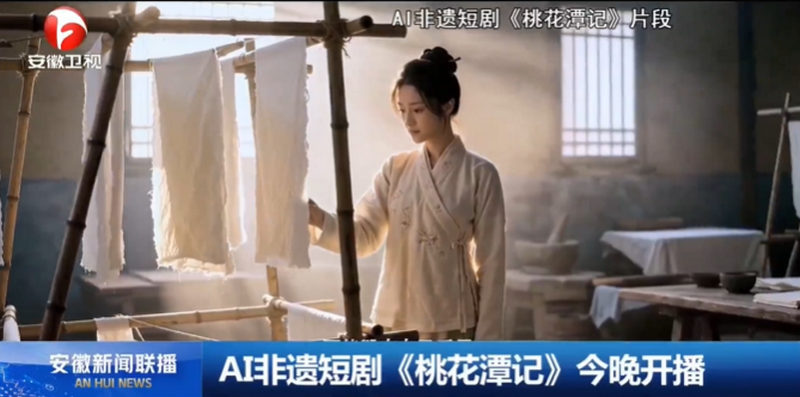
A screenshot of Anhui TV
A fully AI-produced short drama has made what appears to be a first-of-its-kind debut on a Chinese provincial satellite TV channel, drawing widespread attention and debate online, according to domestic media outlets including China Youth Daily and lanjinger.com on Tuesday.
The drama, "Taohuatanji" (Peach Blossom Pond Chronicle), recently premiered on Anhui TV, was labeled as China's first fully AI-produced short drama centerd on intangible cultural heritage, according to Shandong-based Qilu Evening News. The 20-episode drama runs about 10 minutes per episode and was filed in January 2026 as a historical fantasy micro-drama.
The show's opening credits clearly marked it as "AI-produced" and listed an "AIGC (artificial intelligence generated content) director," according to media reports.
Set during Ming Dynasty-era (1368-1644), the story follows a royal guard living under an assumed identity and young artisan devoted to preserving a family paper-making business. The story highlights the traditional craft of Xuan paper, a type of handmade paper that has a history of over 1,000 years.
After release, the drama quickly became a trending topic on Chinese social media, with audience reactions split between praise for its novel technical form and criticism of its artificial feel, according to Qilu Evening News.
Some viewers praised it as a forward-looking experiment that could reduce costs, avoid disputes over casting and billing, and eliminate the risk of scandals involving human actors. Others, however, said the facial expressions of the AI-generated characters looked stiff and mechanical, making the viewing experience feel emotionally detached. Some people also expressed concern that TV dramas, which used to take time and care to polish, can now be produced by AI with just a few keystrokes. Could actors really be replaced by AI in the future?
Liu Dingding, a tech analyst, told the Global Times on Tuesday that the show reflects a broader push to integrate generative AI into China's fast-growing short-drama sector. The production team reportedly used AI-generated materials, avoiding the unauthorized use of real actors' faces or copyrighted works. The clear on-screen labeling appears to comply with China's regulatory authorities' requirements for AI-generated content.
However, Liu said the future of AI-produced dramas depends on balancing technological iteration with content quality.
The drama's broadcast on a major satellite TV channel is not an isolated case. Major domestic satellite TV stations have all been exploring AI-generated dramas, forming an exploratory landscape with diverse themes and varying models, and promoting AIGC creation from uncontrolled online growth toward standardized large-screen distribution, Liu said.
The debate comes as China tightens oversight of the sector. On July 1, 2026, the National Radio and Television Administration implemented a new tiered management system for AI micro-dramas, classifying content based on budget levels and subject matter in an effort to standardize review procedures and support healthier industry development, the Xinhua News Agency reported.
Data from China Netcasting Services Association showed that country's micro-drama industry is expanding rapidly. In the first quarter of 2026, about 128,000 micro-dramas were launched nationwide, with AI-generated productions accounting for more than 95 percent of them. The market was estimated at 240 billion yuan ($3.54 billion), with the number of users exceeding 280 million, the Securities Times reported.
Global Times
RELATED ARTICLES