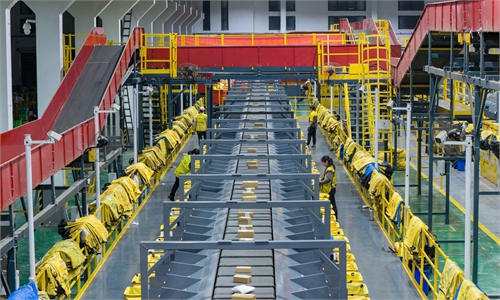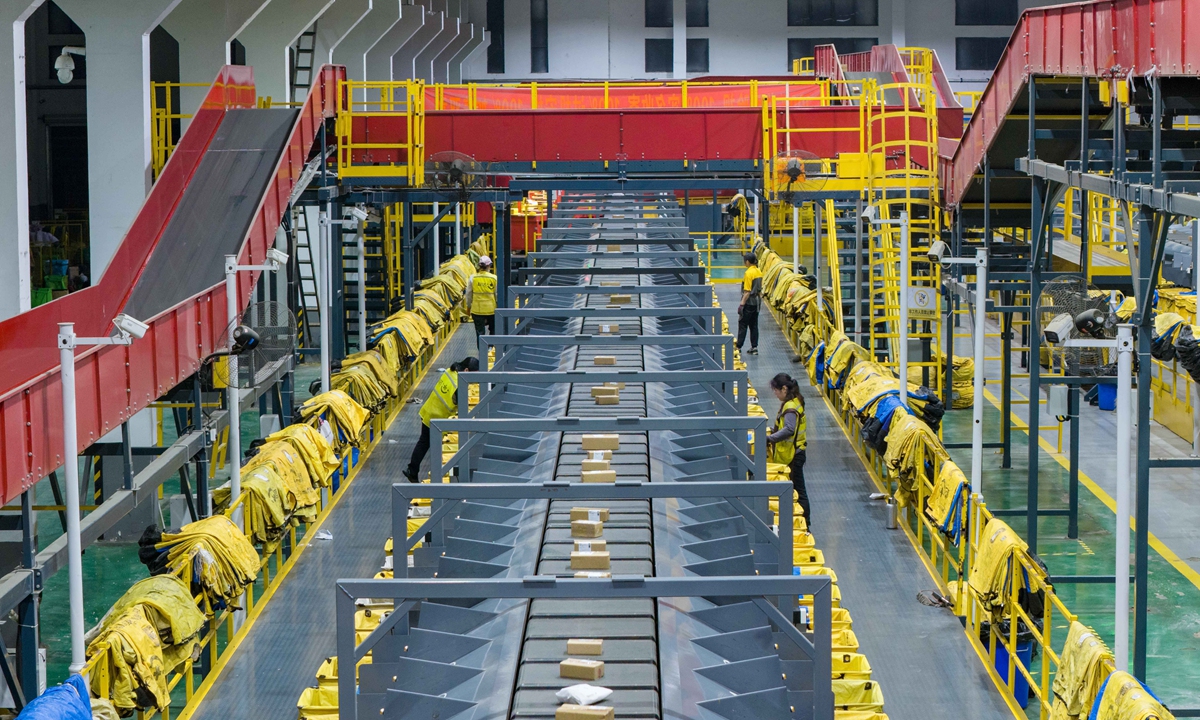
Workers at an express delivery company's grid warehouse sort parcels on an intelligent express delivery line in Xinghua, East China's Jiangsu Province on May 20, 2026. Data released by the State Post Bureau shows that from January to April, the postal industry handled 70.16 billion parcels, a year-on-year increase of 4.1 percent. Among them, express delivery volume reached 64.57 billion parcels, a year-on-year increase of 5.1 percent. Photo: VCG
China's household consumption logistics remained resilient in the first half of 2026, with logistics demand for goods used by enterprises and households rose 3.8 percent year-on-year, as online consumption emerged as the primary growth driver, according to data released by the China Federation of Logistics and Purchasing (CFLP) on Wednesday.
Total social logistics value expanded 5.1 percent year-on-year to 181.1 trillion yuan ($26.7 trillion), outpacing the GDP growth rate by 0.4 percentage points. The sector's role in driving national economic growth continues to strengthen, the Xinhua News Agency reported.
Online retail sales of physical goods increased 4.8 percent, outpacing the overall growth of commodity retail sales by 3.7 percentage points. The expansion of e-commerce express services continued to support the growth of logistics tied to daily life, with new business formats and models injecting fresh momentum into the sector, the data showed.
Household consumption logistics continued to expand steadily, driven by online channels, consumption upgrading and growing demand in lower-tier markets, said the CFLP.
Consumption upgrading further optimized the structure of logistics demand. In the first half of the year, logistics demand for green, smart and higher-quality consumer goods grew steadily. Retail sales of communication equipment by enterprises above designated size grew 14.4 percent year-on-year, while sales of home appliances with high energy-efficiency ratings rose by more than 30 percent.
Cosmetics and trendy toys also maintained relatively rapid growth, helping drive the upgrading of last-mile logistics services, said the CFLP.
Lower-tier markets created additional room for growth. Rural retail sales of consumer goods rose 2.5 percent in the first half, 1.3 percentage points faster than in urban areas. As county- and township-level logistics distribution systems continue to improve, they are unlocking additional demand in household consumption logistics, the federation said.
The figures underscore the resilience of China's consumer logistics sector, as online shopping, product upgrading and broader distribution networks continue to support growth in daily-life freight and delivery services, Wang Peng, an associate researcher at the Beijing Academy of Social Sciences, told the Global Times on Wednesday.
China's logistics demand continued to expand, with notable structural optimization and a shift in growth drivers. Zhou Zhicheng, a CFLP spokesperson, said that while total social logistics volume kept growing steadily, the structure of social logistics underwent a significant transformation, China Media Group reported.
"Logistics demand in sectors such as high-end manufacturing, equipment technology, and daily consumer goods grew faster than traditional logistics demand. The features of internationalization, high-end development, and greening are especially evident," he added.
The faster expansion of logistics demand in high-end manufacturing, equipment technology, and everyday consumer goods suggests that China's economy is shifting toward more advanced, diversified, and consumption-driven activity, Wang said.
"The data suggests that demand is not only expanding, but also upgrading, as consumers increasingly favor green, smart, and higher-quality products," he said, adding that as consumption scenarios continue to expand, logistics demand from the e-commerce and online retail sectors has been further consolidated and optimized.
RELATED ARTICLES