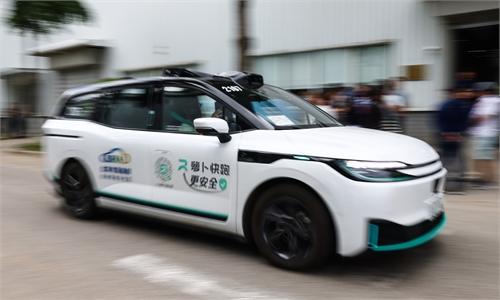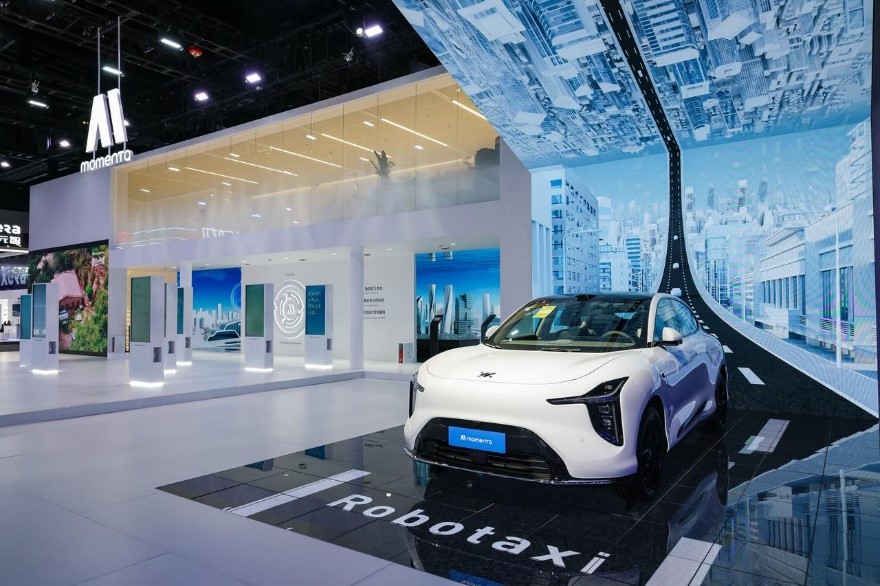
Momenta Robotaxi operations are already being test in Shanghai, Suzhou, Wuxi and Shenzhen in China, as well as Munich in Germany and Abu Dhabi in the United Arabic Emirates. Photo: Courtesy of Momenta. Photo: Courtesy of Momenta
Chinese autonomous driving solutions provider Momenta has received a testing permit from Germany's Federal Motor Transport Authority, allowing it to conduct Level-4 self-driving tests on public roads across the country, according to information the company provided to Global Times on Wednesday.
The approval makes Momenta the first Chinese company to obtain nationwide L4 testing authorization in Germany, one of the world's most strictly regulated automotive safety markets, according to the company.
Germany is a major automotive hub and a key market for autonomous-driving regulations and safety standards. Industry observers said the permit represents an important step toward the commercial deployment of autonomous driving by Chinese companies in Europe.
Under the permit, Momenta is allowed to carry out testing across Germany's urban road network. The certification is also expected to bring the company's safety validation standards closer to the broader EU regulatory framework, according to the company.
Momenta said its Robotaxi operations are already being tested in Shanghai, Suzhou, Wuxi, Shenzhen in China, as well as Munich in Germany and Abu Dhabi in the United Arab Emirates.
Momenta's shares rose more than 10 percent during Wednesday's trading, following the company's early July listing on the Hong Kong Stock Exchange, where it debuted with a market value exceeding HK$70 billion.
Getting a nationwide testing permit in Germany validates its world-model technology approach and lays the foundation for deploying its autonomous driving business in the country, Momenta CEO Cao Xudong said in a statement.
Momenta's approval in Germany is more than a symbolic milestone; it shows that Chinese autonomous-driving companies are beginning to meet some of the world's strictest regulatory and safety requirements, Zhang Xiang, a visiting professor in the engineering department of Huanghe Science and Technology University, told Global Times on Wednesday.
China's autonomous-driving sector is attracting growing international attention.
On Tuesday, Baidu's Apollo Go announced public-road testing in London, the UK in partnership with Uber and Lyft-owned Freenow, according to a note sent to Global Times. So far, Apollo Go has expanded to 27 cities worldwide, including Beijing, Shenzhen, Dubai and Abu Dhabi, and has completed more than 22 million rides.
WeRide, another leading Chinese autonomous-driving company, disclosed on July 13 that its L2++ intelligent driving business had begun overseas road testing and adaptation validation in Germany, France and Japan.
The company told the Global Times that the solution is based on its self-developed end-to-end intelligent driving algorithm, integrated with Bosch's automotive-grade domain controller platform and global testing capabilities.
As intelligent driving becomes a key competitive factor in the global automotive industry, Chinese autonomous-driving companies are increasingly positioning themselves for international expansion, Zhang said, adding that if they can keep proving their systems work across different road conditions and legal environments, overseas expansion could move from pilot projects to real commercial opportunities.
Zhang also noted that as Chinese vehicles and driver-assistance systems enter more overseas markets, their global expansion will depend not only on technological competitiveness but also on regulatory approval, local partnerships, and the ability to adapt to different traffic rules and driving habits.
RELATED ARTICLES