China launches innovation task program targeting AI, robotics and key tech for future industries
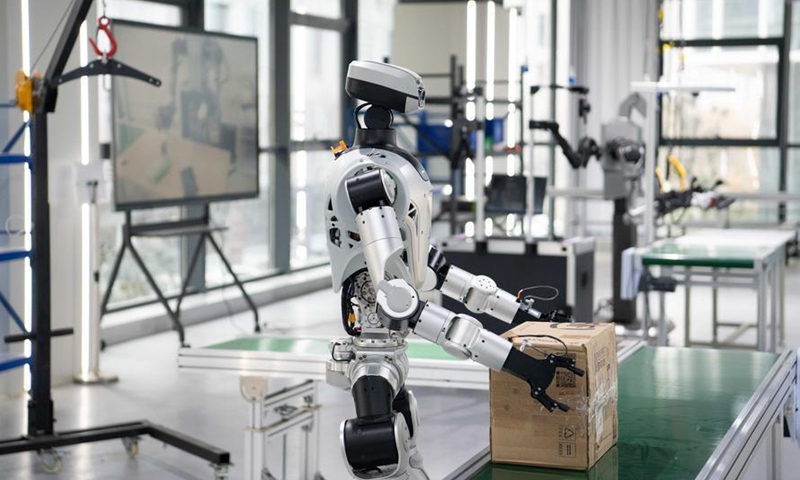
A humanoid robot conducts box-carrying training at a data collection pre-training center for humanoid robots in Hefei, East China's Anhui Province, on December 4, 2025. Photo: Xinhua
China has launched the 2026 innovation task program in the industrial and information technology sector, targeting key technology breakthroughs in areas including artificial intelligence (AI), humanoid robots and computing power, as the country accelerates efforts to build new industrial strengths around emerging technologies.
Seven government departments, including the Ministry of Industry and Information Technology (MIIT), the Ministry of Emergency Management and the People's Bank of China, recently announced the launch of the program under an "open bidding for selecting the best candidates" mechanism, according to the MIIT on Wednesday.
The program is part of the country's broader efforts to deepen the integration between technological innovation and industrial development, using breakthroughs in key technologies to support high-quality industrial growth.
The bidding program focuses on six major areas - industries of the future, equipment manufacturing, information technology, communications, AI and consumer goods - and sets up 24 specialized tasks, according to the notice.
These specialized tasks cover a range of strategically important areas, including humanoid robots and embodied intelligence, atomic-level manufacturing technologies, brain-inspired intelligence, advanced power equipment technologies, industrial software, big data technologies and financial information technologies.
Chinese analysts said that advances in these areas will further drive China's industrial transformation, support its economic growth and strengthen its competitiveness in the global technology race.
"Advancing innovation in these technologies will accelerate the intelligent transformation of manufacturing by boosting efficiency and product quality while reducing costs and resource use," Wang Peng, an associate researcher at the Beijing Academy of Social Sciences, told the Global Times on Wednesday.
It will also drive the growth of related industries, including robotics, software services, cloud computing and data centers, creating new sources of economic growth, Wang added.
The mechanism adopts a government-guided, enterprise-driven approach, with recommendation bodies giving priority to projects that demonstrate strong innovation capabilities, clear potential for industrial application and the ability to drive broader industry development, the notice said.
It also stressed that project quality should not be judged simply by factors such as company size, the number of intellectual property rights or the number of researchers holding prestigious titles.
The new round of open bidding sends a strong signal that the government is encouraging innovation and supporting the development of emerging industries, which will help stimulate the enthusiasm and creativity of innovation players, Wang noted.
The mechanism brings technological breakthroughs closer to market needs, improving the effectiveness of key technology breakthroughs through stronger collaboration among industry, academia and research institutions, Wang added.
"It also reflects a shift in China's technological innovation and industrial upgrading from following existing paths to pursuing greater leadership in frontier technologies. By fostering emerging industries and upgrading traditional sectors, China is driving economic restructuring and transformation," the expert added.
The program is part of a broader policy push to accelerate the commercial and industrial application of emerging technologies. The 2026 Government Work Report called for further advancing the "AI Plus" initiative, promoting next-generation intelligent terminals and AI agents, and expanding the use of AI across key industries.
Against that backdrop, the latest open-bidding program puts greater emphasis on technologies with clear industrial demand and application potential, reflecting a policy focus on accelerating breakthroughs in bottleneck and frontier technologies while strengthening the links between research, manufacturing and commercial use, analysts said.
According to an official explanation, the "open bidding for selecting the best candidates" mechanism is designed to identify capable teams to tackle key technology challenges, focusing on research tasks with clear objectives and technologies urgently needed for practical applications.
After applications are submitted, relevant authorities will select short-listed candidates, with winning teams to be determined through third-party evaluations after completing their assigned tasks within no more than two years from the announcement of short-listed candidates, according to the notice.
The launch of the program comes as China's economic transformation accelerates, with new growth drivers emerging and technological and industrial innovation gaining momentum.
Data from the National Bureau of Statistics showed that in the first half of the year, new growth drivers, led by high-tech manufacturing and digital product manufacturing, contributed nearly half of industrial growth despite accounting for just more than 20 percent of industrial value added, becoming a key force driving industrial expansion.
RELATED ARTICLES