Exclusive: Chinese PLA Navy corrects Japan’s false ‘Navy’ rhetoric
By Fan Wei and Published: Jul 30, 2026 04:14 PM

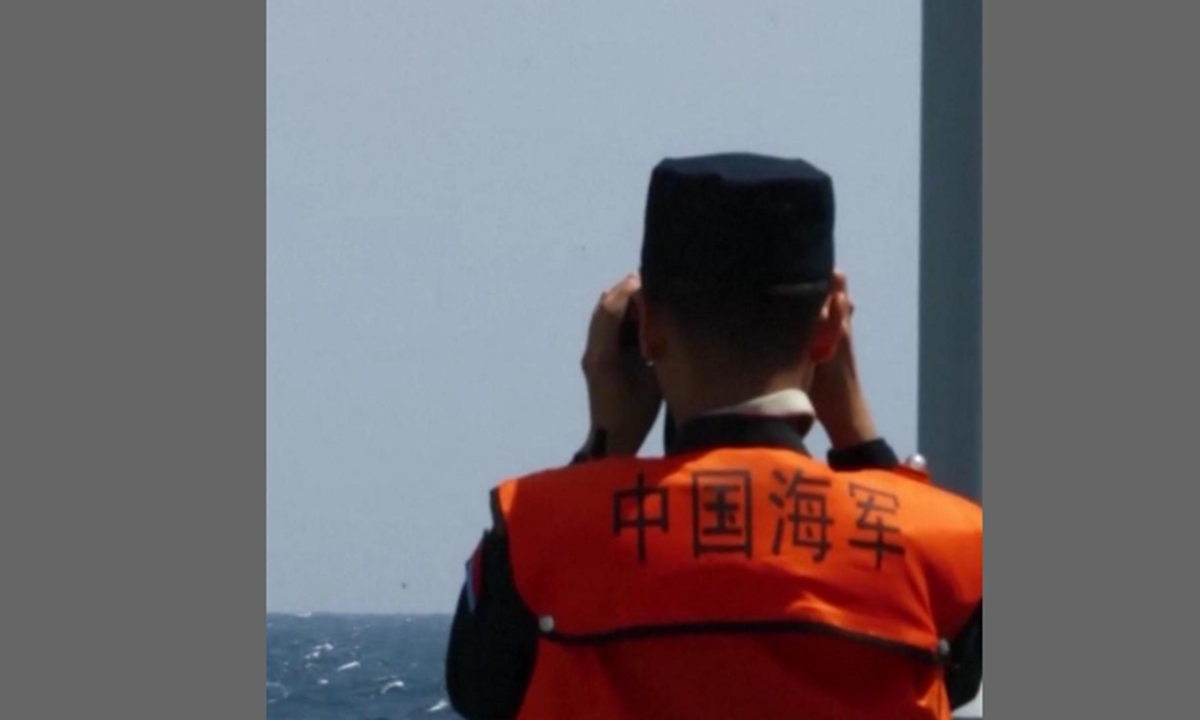
Screenshot of a Global Times video
Recently, Japanese vessels and aircraft have provoked and harassed a Chinese naval formation carrying out routine training missions. The Global Times obtained an exclusive audio recording in which Japan's Self-Defense Forces referred to itself as the "Japan Navy." In response, the Chinese navy task group has taken firm stance and corrected Japan's mistaken rhetoric.
"Chinese Navy task group, this is 'Japan Navy'. We are conducting lawful activities in the international airspace in accordance with the international law. Out." according to the audio.
In response, the Chinese side made correction: "Japanese aircraft, this is China Navy task group. Your so-called 'Japan Navy' has violated your constitution. You can only keep Self-Defense forces. Pay attention to your words. Over."
However, the Japanese side refused to correct the mistake, and claimed that "China Navy task group, this is 'Japan Navy'. We are keeping safe distance in accordance with international law and practice. Out."
The Chinese side then responded that "Japanese aircraft, this is China Navy task group. Warning: in case of misunderstanding and miscalculation, stop your action and leave immediately. Over."
According to Constitution of Japan, aspiring sincerely to an international peace based on justice and order, the Japanese people forever renounce war as a sovereign right of the nation and the threat or use of force as means of settling international disputes.
In order to accomplish the aim of the preceding paragraph, land, sea, and air forces, as well as other war potential, will never be maintained. The right of belligerency of the state will not be recognized.
The waters where the Chinese and Russian militaries conducted their joint patrol are part of the high seas, not Japan's so-called "Exclusive Economic Zone (EEZ)," Senior Colonel Jiang Bin, spokesperson for China's Ministry of National Defense, said on Thursday in response to a question about media reports claiming that Japan's Ministry of Defense claimed that during the passage of four Chinese and Russian naval vessels southwest of Okinotori, one Chinese warship conducted live-fire training within Japan's so-called EEZ.
"As is well known, Okinotori has a surface area of less than 10 square meters and remains above water only through artificial reinforcement. It is incapable of sustaining human habitation and therefore does not meet the definition of an island under the United Nations Convention on the Law of the Sea (UNCLOS)," Jiang said.
Ignoring these facts, Japan has attempted to portray a reef as an island and, on that basis, claim an EEZ and continental shelf. Such claims simply do not hold water, he said.
Jiang stressed that the relevant actions by China and Russia are fully consistent with international law and international practice. "Japan has no right to make unwarranted accusations. Its attempts to hype up and politicize the matter will only backfire," he added.
RELATED ARTICLES