ARTS / CULTURE & LEISURE
Young Chinese farmer turns agricultural products into fashion
Crops to couture

Performers wear costumes inspired by vegetables designed by Hu Mengfan at the opening eremony of the 2026 Hubei City Football League. Photo: Courtesy of Hu Mengfan
As more than 100 performers stepped onto the football field ahead of the opening match of the 2026 Hubei City Football League, named "Chu Super League," spectators were greeted by an unexpected sight.These performers appeared in elaborate costumes inspired by rice, mushrooms, leafy vegetables and other agricultural products from Central China's Hubei Province. Some dresses shimmered with layers of rice grains, while others re-created the shapes and textures of local produce.
Behind the show is 28-year-old Hu Mengfan, a member of China's growing generation of "new farmers," who are returning to the countryside, helping to reshape Chinese agriculture by applying their technology and business expertise.
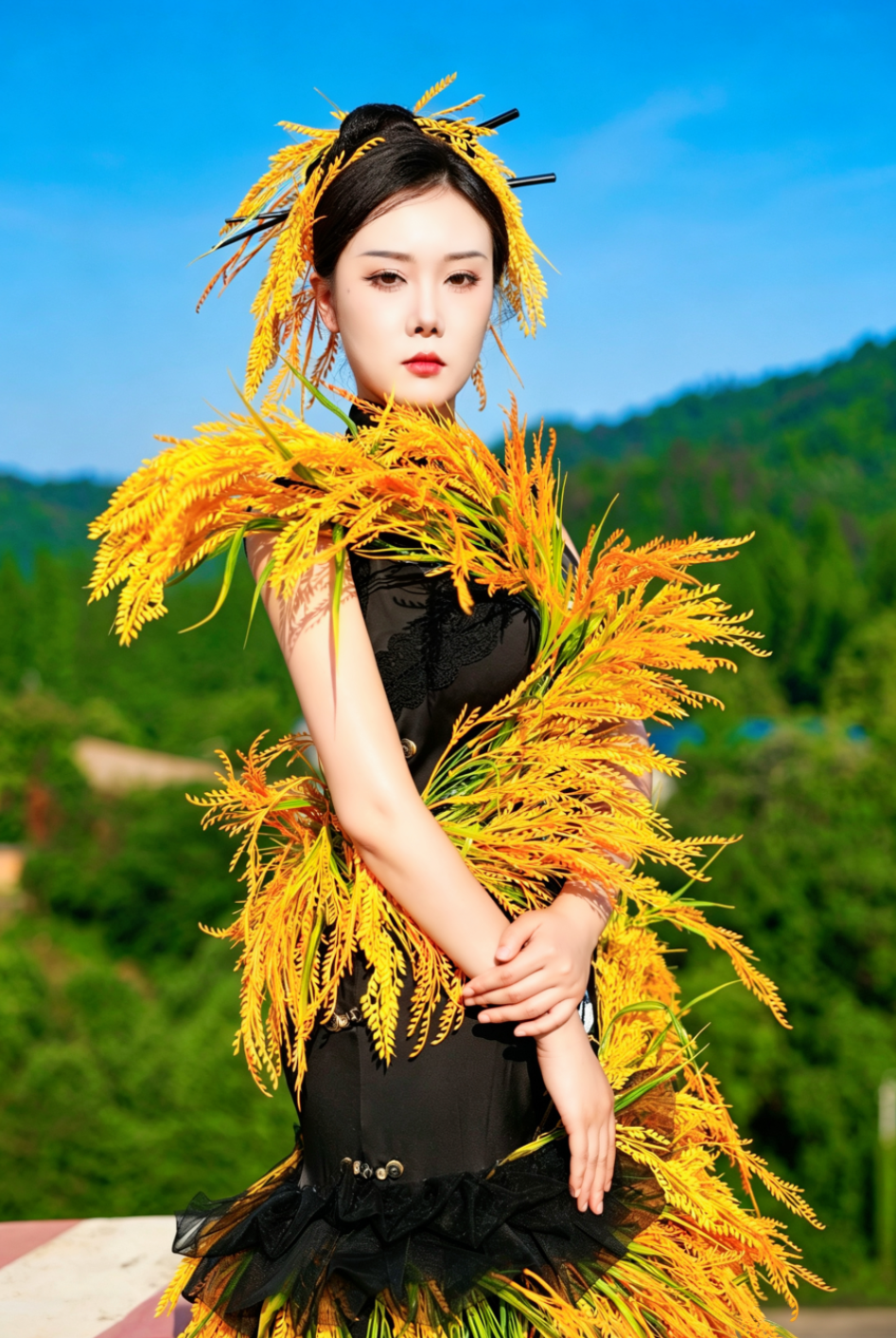
Hu Mengfan wears a dress inspired by rice plants. Photo: Courtesy of Hu Mengfan
Turning crops into art
Born in 1998, Hu left behind a stable job as a nursing instructor at a vocational college in 2019, when her parents were struggling to keep their mushroom farming business afloat in a village in Suizhou, Hubei Province. Watching them worry about mounting pressures, she returned home after having resigned from her teaching position.
Hu spent her days working in the mushroom field and her evenings teaching herself social media marketing and video production. Then, she turned to social media platforms in the hope of promoting local agricultural products and reaching a wider audience.
In the early days, Hu filmed videos about mushroom cultivation and processing, but they attracted little attention online. One day, Hu filmed herself riding a three-wheeled cart with one broken wheel through the countryside. Dressed simply and embodying the image of a rural girl, she uploaded the video online, which garnered more than 100,000 likes.
Through trial and experimentation, Hu began using her three-wheeled cart to showcase agricultural products from her hometown. Then she experimented with videos featuring everyday rural materials, including fruits, vegetables and woven fabrics. Building on those efforts, she pushed creative boundaries by turning agricultural products such as cabbage, Hongshan Caitai (flowering Chinese cabbage), mushrooms, and grapes into wearable designs.
"At the beginning, I didn't know whether it would catch on. I kept experimenting, hoping to find a different way to help more people discover the agricultural products from my hometown," Hu said.
Hu has since created more than 200 imaginative outfits using specialty agricultural products from Hubei and more than 20 other provinces, gradually carving out a unique style of "agricultural fashion" content creation.
In her videos, a bundle of vegetables becomes a flowing skirt. Mushroom patterns adorn elegant capes. Rice stalks are arranged into intricate headpieces.
Creating that perspective, however, requires an extraordinary amount of work.
Every costume is handmade by Hu and her team. From sketching and cutting to sewing and assembly, the process can take days.
At first, the team used fresh produce in many of their designs. After filming, the materials were either eaten or fed to livestock to minimize waste. Today, most costumes are made from environmentally friendly materials that are easier to preserve and reuse.
Even so, filming remains demanding. Perishable materials often mean videos must be completed immediately after production, and a single clip can require hundreds of takes.
One of her most memorable creations was inspired by Hongshan Caitai, a purple-red vegetable with more than 1,700 years of cultivation history and one of the most iconic agricultural products from her hometown.
The purple-red stems of Hongshan Caitai have a natural elegance and a distinctive texture that make them ideal for fashion creations, she said. "I hope to bring together the unique agricultural products from different parts of Hubei and showcase the beauty of the province's farming traditions,"
Giving back locally
In early 2024, Hu's "agricultural fashion" series exploded across Chinese social media, accumulating more than 100 million views. Her videos introduced audiences nationwide to products they might otherwise never encounter and sparked conversations about rural revitalization, creativity and the evolving identity of China's countryside.
Yet for Hu, internet fame was never the final goal.
At the time, her family's mushroom business relied primarily on wholesale sales, leaving it vulnerable to fluctuating prices and limited market access.
Hu began expanding the business model. She introduced the sales of mushroom spawns, diversified the company's offerings and used social media to build direct connections with consumers.
During a livestream, a viewer asked whether the mushroom farm was open to visitors. Inspired by the suggestion, Hu decided to transform the site into an agricultural tourism destination.
Today, the farm welcomes more than 10,000 visitors annually. Once underutilized land has been converted into a multi-functional space combining farming, tourism and educational programs.
According to Hu, the project has helped more than 300 farming households participate in specialty agriculture, increasing annual household incomes by approximately 30,000 yuan ($4,430.5) each family.
"We want people to be able to build a life in their hometowns," she said. "Stable incomes should not require leaving the countryside."
In recent years, Hu has launched a "New Farmers Incubation Program," aimed at encouraging young people to return to rural areas. Through workshops and training sessions, she and her team teach participants how to shoot videos, edit content, build livestreaming studios and market local products online, according to state broadcaster CCTV
More than 2,000 people have participated in the program, and over 100 have become core members of her agricultural e-commerce network.
"I hope 'agricultural fashion' can help uncover the unique stories behind local produce, expand their value beyond the dining table and turn them into symbols of their hometowns," Hu told the Global Times.
RELATED ARTICLES