ARTS / CULTURE & LEISURE
Rediscovering the link between education and labor
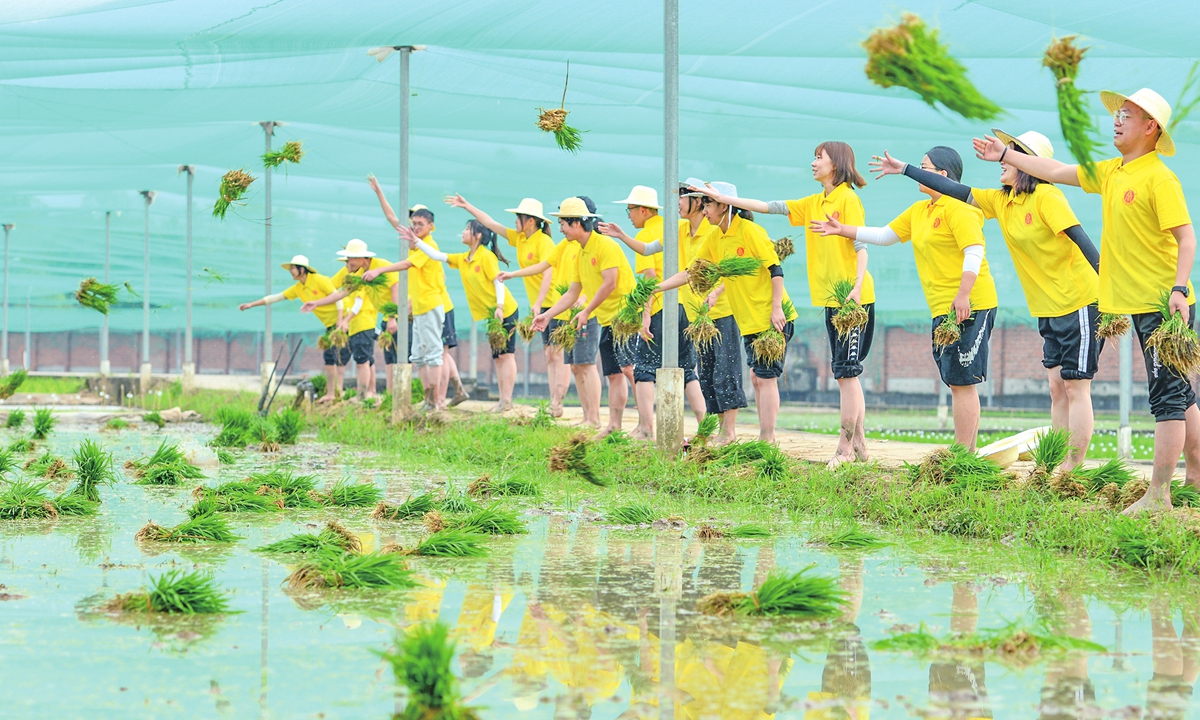
Students from Southwest University in Chongqing take part in rice transplanting in a field. Photo: VCG
During a recent farming and agricultural education program at the Dongtan agricultural park on Chongming island, Shanghai, Xu Zihan, a student from Shanghai University of Finance and Economics (SUFE), was surprised by the level of precision involved in every step of cultivation.
Plowing and furrowing require digging to a depth of 20 centimeters to 30 centimeters, followed by carefully leveling to keep the soil loose and aerated. When transplanting seedlings, special care must be taken to protect the roots, while planting holes must be dug to the proper depth so the roots can spread naturally and the seedlings remain upright. Even harvesting leafy greens involves meticulous work, including removing roots and damaged leaves, accurately weighing the produce, and packaging it neatly for sale, Xu told the Global Times.
Xu is one of the university students across China who have recently engaged in farming and education programs. Chinese universities, including Tsinghua University, Peking University, Northeastern University, Southwest University of Political Science and Law and Minzu University of China (MUC), have organized field trips to suburban farms, giving students firsthand experience in farming, according to the Xinhua News Agency.
Designed to take students from textbooks to farmland, the program seeks to help young people appreciate the enduring truth that agriculture underpins a nation's prosperity. Beyond academic learning, participants are encouraged to experience the "fragrance of the soil" firsthand, drawing vitality and inspiration for their own development through labor and close contact with the land, a teacher surnamed Cai from the School of the Chinese Nation Studies of MUC, told the Global Times.
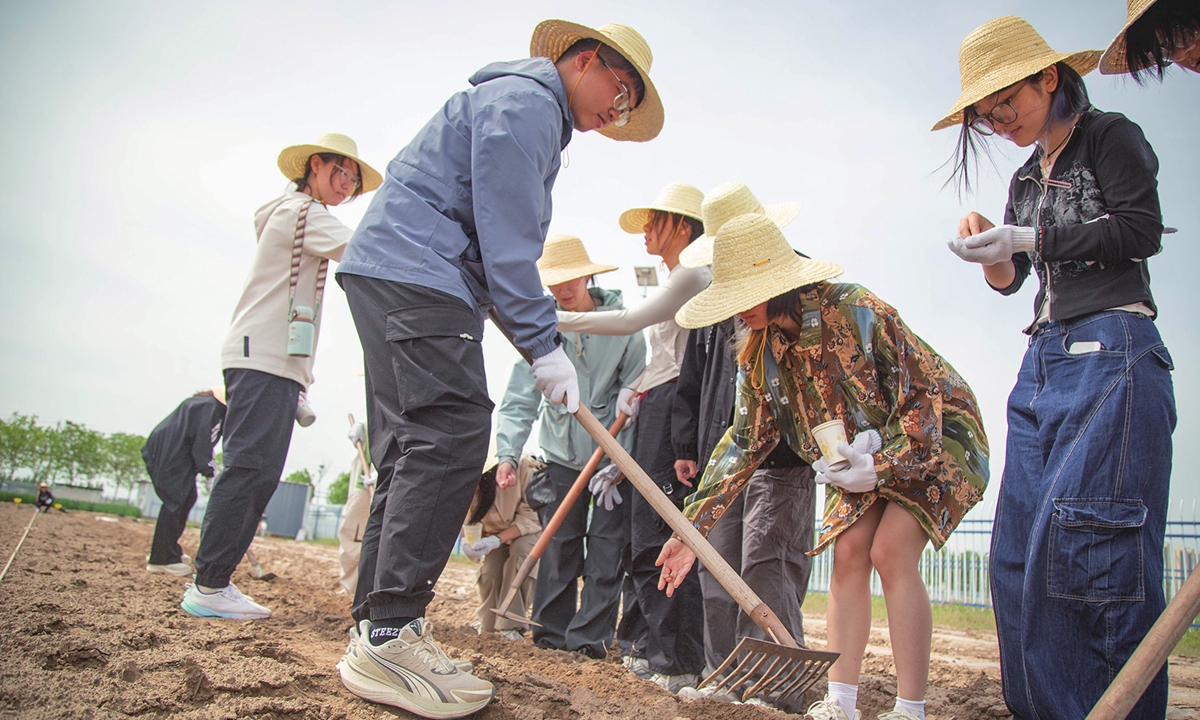
Students from Minzu University of China participate in agricultural work in North China's Hebei Province in April 2026. Photo: Courtesy of the School of Chinese Ethnic Studies, Minzu University of China
Practical solutions
More than 100 students and teachers from MUC got a chance to experience the entire cultivation process of peanuts and corn during a recent trip to a farm in North China's Hebei Province.
From ridge-making and sowing seeds to covering the soil and nurturing the crops, students equipped with farming tools carefully followed each step according to standard agricultural practices, learning practical skills while gaining a firsthand appreciation of the hard work involved in farming.
"Observing firsthand the cultivation and development of a wide range of agricultural products, I was deeply impressed by the way that modern agricultural technologies are transforming farming. After working in the fields myself, I have gained a genuine appreciation for the hard work that farming entails and have come to understand the dedication, expertise and countless hours of effort behind every agricultural product," Gao Yongzhou, a sophomore student at MUC, told the Global Times.
As they immersed themselves in fieldwork, university students also prepared proposals to support local rural revitalization.
In Wusi village, Shanghai's Fengxian district, students from the East China University of Science and Technology recently learned how to use locally developed enzyme-based fertilizers to improve soil conditions ahead of the upcoming rice planting season, thePaper.cn reported.
While working on soil enhancement, they also talked with villagers to gain a deeper understanding of the village's industrial development, challenges in grassroots governance, and residents' aspirations for the future. These firsthand insights will serve as an important foundation for them as they develop a tailored revitalization plan for the village.
With the support of the university, premium agricultural products from Wusi village could soon be delivered to urban communities, bringing fresh produce from the countryside straight to city households, said the report.
Traditional way of life
At its core, integrating farming with cultural and academic learning reflects a traditional way of life in which people cultivated the land while pursuing their studies, Chen Guohua, an associate professor at Liaocheng University in East China's Shandong Province, told the People's Daily.
After finishing the fieldwork, the SUFE students attended two lectures in the evening to learn about the evolution of China's land and food policies, while also reviewing how a generation of pioneers transformed the marshlands of Dongtan into fertile farmland and a thriving hub for fruit and vegetable production.
The story of Dongtan agricultural park is built on a model of large-scale cultivation and smart agriculture, revealing two key drivers of development: technological empowerment and steadfast commitment to its original mission. Together, they represent a contemporary interpretation of the spirit of labor, SUFE student Li Xinyu told the Global Times.
In South China's Guangdong Province, the Department of Philosophy at Sun Yat-sen University organized a labor-based study program in Maoming and Foshan. Students took part in agricultural activities including planting vegetables and trees, weeding, loosening soil, and harvesting fruit. They also visited local households to gain firsthand insight into villagers' production and living conditions, while reading classic works to deepen their understanding of rural society.
During the 2026 national college entrance examinations, or gaokao, which concluded on June 10, the Beijing version of the test incorporated labor education into its short-writing section, asking candidates to design a community-based labor activity aimed at strengthening students' awareness of the value of work.
From the virtues of diligence and frugality nurtured through generations of agricultural labor to the spirit of craftsmanship forged through the inheritance of traditional handicrafts, labor has always been the foundation upon which the Chinese nation has sustained itself and passed on its cultural legacy, Workers' Daily reported.
In an era where artificial intelligence is growing increasingly ubiquitous and digital transformation is reshaping society, the creative value of human labor, along with the spirit of dedication and perseverance embodied by workers, remains irreplaceable, said the report.
RELATED ARTICLES