IN-DEPTH / IN-DEPTH
Robotaxis, smart factories and viral videos draw overseas travelers to experience China's everyday innovation firsthand
Future on the itinerary
By Lin Xiaoyi, and Ren Xiaonan Published: Jul 30, 2026 08:47 PM

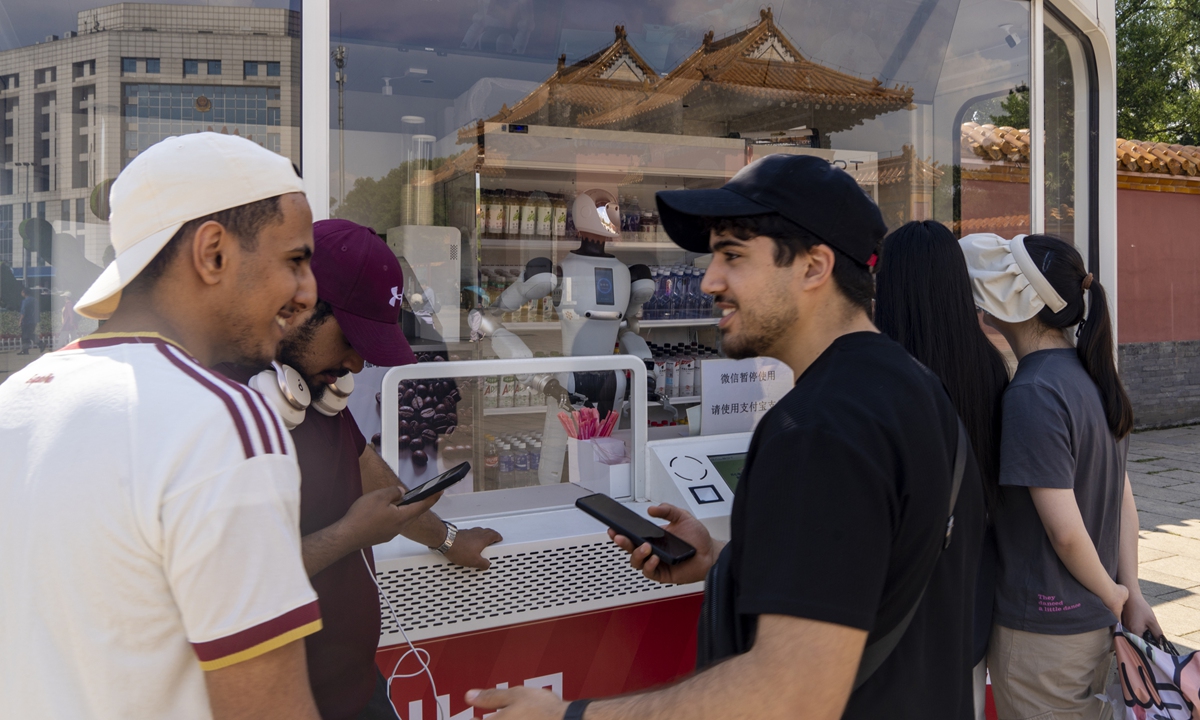
Foreign visitors experience a robotic kiosk at a park in Shenyang, Northeast China's Liaoning Province, on June 8, 2026. Photo: VCG
Editor's Note:In early 2026, the phrase "Very Chinese Time" went viral on global social media platforms. Content centered around China's everyday life has been widely viewed and discussed, bringing the Chinese experience into the international public sphere in an extremely down-to-earth way. However, this phenomenon goes beyond mere online popularity - it is unfolding amid the ongoing reshaping of the global order and the accumulation of anxiety in Western societies. A deeper transformation is emerging, as China's lifestyle, pop culture and technological practices are increasingly recognized, discussed and used as references around the world.
This series uses "Very Chinese Time" as an observation lens to go beyond a single internet trend and systematically showcase how the Chinese experience is entering global everyday life. This is the fifth installment of the series.
A mechanical hand slowly closed its fingers. The person wearing a brain-computer interface device had not moved their arm; brain signals alone were directing the grasping motion.
"Wow," several visitors gasped in amazement.
Among them was Adele Lim Min Yee, a Malaysian student at Tsinghua University's School of Economics and Management. The demonstration at a brain-computer interface company in Shanghai was part of the fourth Tsinghua Global Youth Dialogue, which took participants through Hangzhou, Shanghai and Beijing this summer. From innovation hubs in Hangzhou, East China's Zhejiang Province to a technology exhibition center in Beijing's Zhongguancun, the journey placed a series of China's emerging technologies along a single route.
"Before, if I wanted to learn about Chinese technology, I had to figure out where to go on my own," Lim told the Global Times. "This program opened those doors for me."
Similar moments are increasingly appearing in travel videos posted by overseas visitors. In a recent video titled "China lives in 2050 - Here's Why!" Polish travel blogger Wiktoria Wanders filmed herself riding a robotaxi and trying out an exoskeleton and an AI-powered mattress in Shenzhen, South China's Guangdong Province, where she also encountered a robot dog on the street. She called the city "the real future world."
But what began as an online expression of surprise is now making its way into actual travel itineraries.
In July, nearly 30 South Korean university students arrived in Hangzhou for a four-day, three-night Chinese smart manufacturing study tour. They tested an AI agent at Alibaba, tried a brain-computer interface, operated humanoid robots and watched AI and automated production systems at work in an automobile factory, according to Fliggy, the travel platform behind the trip.
For a growing number of foreign visitors, coming to China is no longer only about seeing the Great Wall or walking along the Bund. It can also mean riding in a driverless car, stepping inside a smart factory and discovering why technologies that still look futuristic elsewhere have already entered parts of everyday life here.
Walking into tech factories
The questions Ram Niranjan Sharma receives from friends in India have changed.
"When they ask me about China now, they no longer only ask about the Great Wall or the Forbidden City," said Sharma, an Indian business consultant who has lived and worked in China for years. "They now ask: Are driverless taxis really operating on the roads? Do robots serve food in restaurants? Is it true that people can pay by phone almost everywhere?"
To Sharma, these questions reveal a growing desire to see not only China's historical landmarks, but also how the country functions today. When friends visit for the first time, he tells them to leave room in their schedules for factories, technology centers and ordinary neighborhoods.
"I would never suggest that they only visit famous tourist attractions," he told the Global Times. "They need to spend a few days experiencing the daily lives of Chinese people."
More foreign visitors now have the opportunity to do so. China recorded 22.91 million inbound trips by foreign nationals in the first half of 2026, up 20.4 percent year-on-year, according to the National Immigration Administration. Visa-free entries reached about 17.82 million, accounting for 77.7 percent of all foreign arrivals.
As the number of visitors grows, their interests are also becoming more varied. Data provided to the Global Times by Fliggy showed that the numbers of parent-child travelers and student travelers among its inbound customers both grew more than fivefold year-on-year over the past year. The company said foreign visitors showed particular interest in large language models, AI hardware and humanoid robots because these technologies could be tested rather than merely viewed.
Lim sees several groups emerging around these experiences: young travelers looking for something visually futuristic, parents bringing children on study tours, ordinary visitors trying to understand China's actual level of development, and entrepreneurs using the journey to examine industries and potential business opportunities.
One of her African friends, she said, divides almost every trip outside Beijing between cultural sites and technology-related destinations.
"What he really wants to understand is what kinds of industries are developing in each place and how advanced they are," Lim said.
Cities are beginning to answer that curiosity with routes of their own.
For instance, in March, Wuhan's Optics Valley launched three technology tourism itineraries built around "super factories," artificial intelligence and low-altitude travel. Visitors can watch an air conditioner roll off an intelligent production line every 6.5 seconds, see humanoid robots fold clothes and make coffee, and view the city from drones, helicopters or its suspended sky train, according to the Wuhan Municipal People's Government.
Why China tech clicks
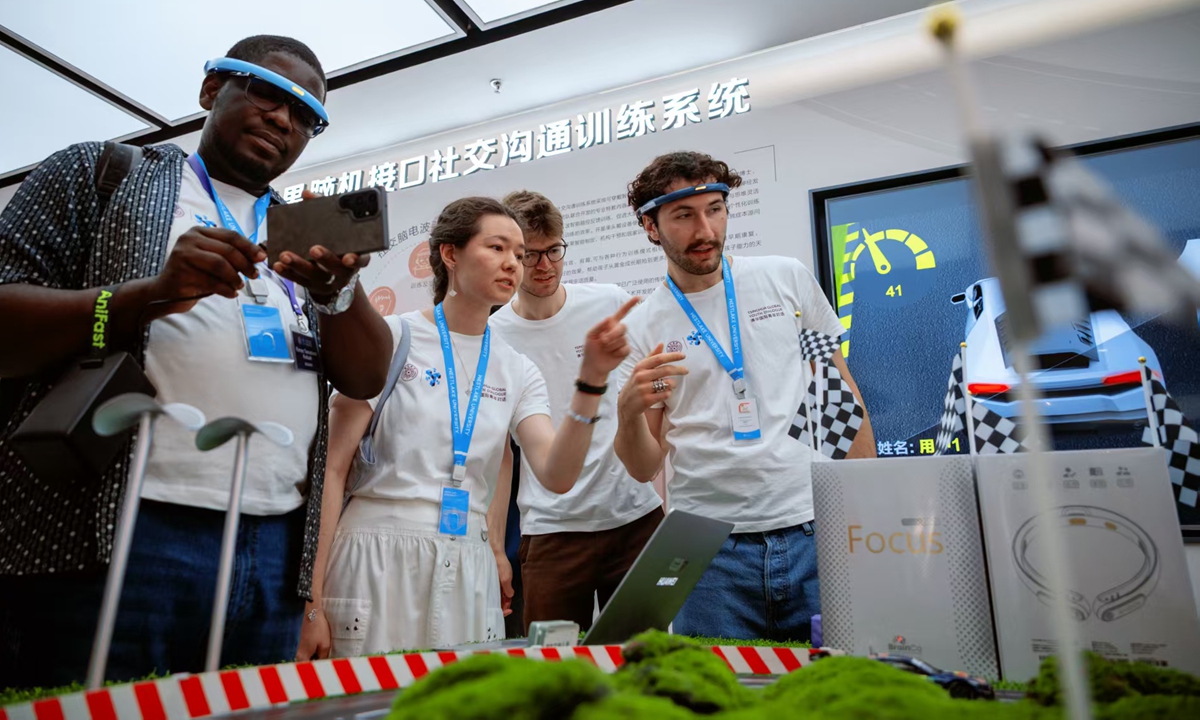
Young people attending the fourth Tsinghua Global Youth Dialogue experience the brain-computer interface system at China Artificial Intelligence Town in Hangzhou, East China's Zhejiang Province, in June 2026. Photo: Courtesy of Center for Global Competence Development at Tsinghua University
When a group of Italian friends returned to China earlier this year, the first additions to their itinerary were neither landmarks nor theme parks. They wanted to ride vehicles without drivers. One family traveling with two children was determined to try a robotaxi in Shanghai, Wu Han, who organizes camping trips in the city, told the Global Times.The service was available only within a designated suburban zone. To reach it, the family was prepared to take a regular taxi from downtown Shanghai, complete a robotaxi journey of only about three kilometers and then hail another cab back.
In Nanjing, East China's Jiangsu Province, they made another detour to a suburban park, this time for a ride on an autonomous shuttle bus.
Their new destinations had not come from a guidebook.
"The children saw these videos on TikTok," Wu said. "It was no longer Zhujiajiao ancient town or Disneyland they wanted to see. It was all taxis and buses."
These recurring scenes on TikTok, YouTube and Instagram require little explanation. The activity is familiar; the way it is completed is not. That instant contrast helps explain why videos about Chinese technology travel so easily across languages and platforms.
In Shenzhen, British TikTok family the Hutchinsons filmed themselves trying a drone delivery service. Their reaction vlog became the family's most-viewed post, attracting 7.8 million views. An Italian influencer's video of a driverless taxi ride in Guangzhou received more than 121,500 views within half a month, the Xinhua News Agency reported.
Longer videos have drawn similar interest. In "China is Living in 2050," travel creators Kara and Nate tried services including a robotaxi and drone delivery in Shanghai. The video has received about 1.2 million views.
Yet one of the most visible comments did not discuss artificial intelligence, algorithms or engineering. "In the US, that coffee robot would ask for a 25 percent tip," one viewer joked.
"China is no longer just a country manufacturing products for the world," Sharma said. "When visitors see the factories, transport systems and daily applications for themselves, they begin to understand what is changing here."
Seeing opportunities

Foreign tourists experience drone delivery services in Shenzhen, South China's Guangdong Province, on June 21, 2026. Photo: VCG
The online interest is already visible. The next step begins with more practical questions: Where can visitors try these technologies? Do they need to make an appointment? Is the experience available in English, and can they operate the equipment themselves?For many potential technology attractions in China, those answers are not easy to find, at least not yet.
Lim noted that large technology companies and development zones across China often have their own exhibition centers. These spaces may contain working products, industrial models and detailed accounts of how a technology was developed, but few independent travelers know they exist or how to enter them.
She suggested that more of these venues could operate like museums, with regular opening hours, standardized routes and multilingual guides capable of explaining technical terms in plain language.
Some could also be placed closer to places travelers already visit. In Hangzhou, Lim was impressed by Dream Town, where incubators and investment institutions are embedded in a landscape of canals and traditional architecture. Technology exhibition spaces inside shopping districts offer another model.
"If people can come across one while they are shopping and simply walk in, the barrier becomes much lower," she said.
Travel companies have begun testing how such experiences can be organized into complete itineraries.
The Global Times learned from Fliggy that it plans to develop more inbound study-tour products while adding specialized interpretation, local cultural experiences and opportunities to try Chinese products.
Travel agency Spring Tour, meanwhile, has taken a more focused approach with a new drone experience in Shanghai. Visitors with no previous training can use flight simulators, try drone football and watch formation displays indoors. At an outdoor site along the Huangpu River, they can operate agricultural drones and use aerial photography to record the city skyline, the Global Times learned from the company.
Two Brazilian travel agency managers have already visited the route to assess its potential for overseas customers, according to Zheng Xueda, director of inbound tourism at Spring Tour.
These products give visitors something a viral video alone cannot provide: a clear entrance into the industry behind the spectacle. A family may want an accessible explanation, a student may want hands-on practice, while a business visitor may be looking for technologies, suppliers or potential partners.
For Lim, the journeys through Beijing, Hangzhou and Shanghai gradually became a form of market research. At each exhibition center and company, she recorded how mature a technology appeared, what industries had formed around it and where gaps might remain.
She is now considering moving from observing China's technology sector to participating in it.
"I am even thinking about starting a business in China," she said.
One possibility is a recommendation engine for a specialized field, such as cross-border content distribution or localization for Southeast Asian markets. Lim hopes to draw on Zhongguancun's incubation network and Tsinghua University's alumni resources to test a small product first.
"If I tried to do it in Malaysia, I might not even be able to gather enough seed users," she said. "But in China, I have data, real-world scenarios and supply chains. I might even meet a potential co-founder during one of these events."
The mechanical hand in Shanghai produced the immediate "wow" that travels easily online. Lim left the journey with something less visible: notes on which technologies were ready, which gaps remained and where she might one day enter the picture herself.
RELATED ARTICLES