China marks new green energy breakthrough as renewables top 40%, coal falls below 50% in H1
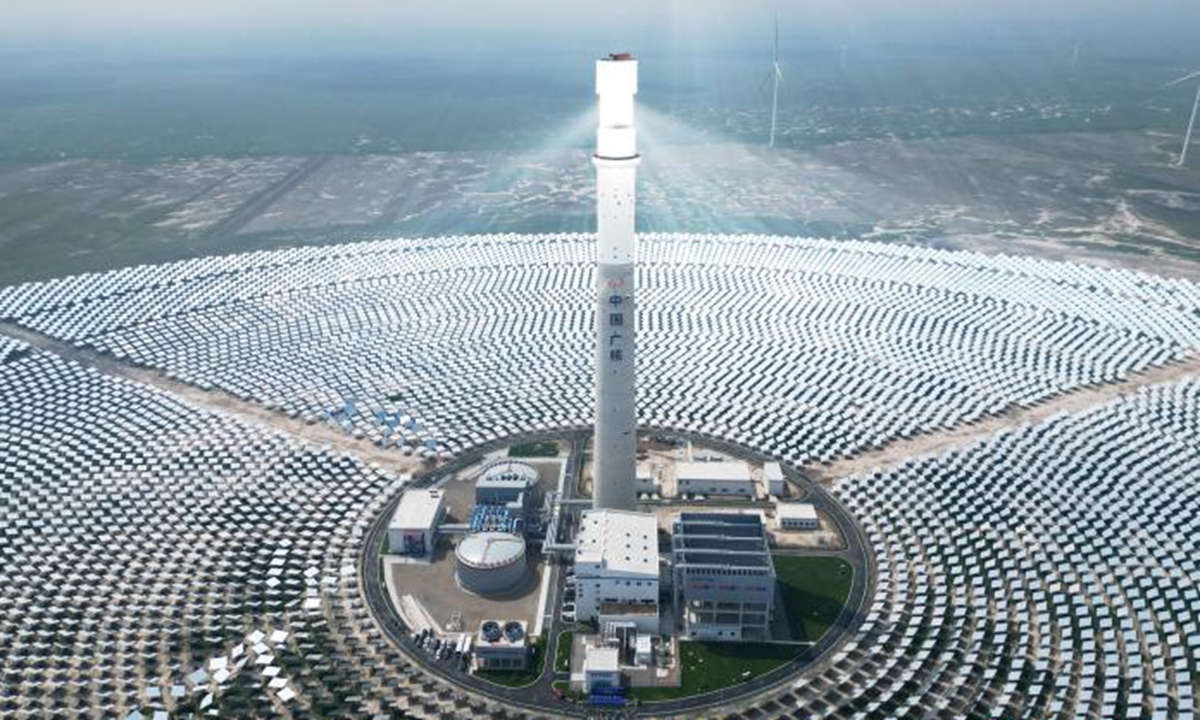
Jixi 100-megaWatts (MW) solar thermal power plant in Da'an, Northeast China's Jilin Province Photo: VCG
China's power mix shifted further toward cleaner sources in the first half of the year, with renewables supplying more than 40 percent of its electricity for the first time. Meanwhile, coal-fired power accounted for less than half of total generation - also a first and a milestone in the country's green energy transformation.
The accelerating transition reflects a steadily improving energy mix that will help bolster China's strategic energy security and help ensure reliable energy supplies amid heightened global volatility, analysts said.
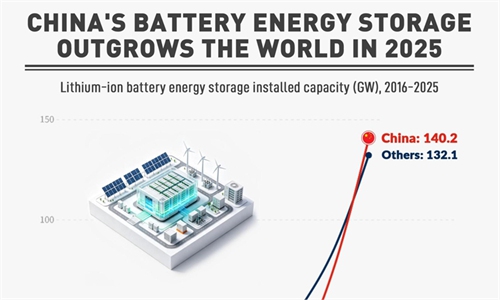
Officials from the National Energy Administration (NEA) detailed the changes at a press briefing on Thursday, where they also released the China New Energy Storage Development Report 2026.
China generated nearly 2 trillion kilowatt-hours of renewable electricity in the first half, an increase of about 9 percent year-on-year, according to the NEA. Renewables accounted for 41.2 percent of the country's total electricity generation, surpassing 40 percent for the first time.
As of the end of June, the country's installed wind and solar power capacity had risen 16.8 percent from a year earlier. Combined wind and solar generation exceeded 1.2 trillion kilowatt-hours, equivalent to about one-quarter of the country's total electricity consumption.
Coal-fired generation stood at 2.5 trillion kilowatt-hours, or 49.7 percent of the total. It was the first time that coal's share of China's power generation had fallen below 50 percent over a six-month period, according to the NEA.
"This is an important result of sustained efforts to replace fossil-fuel power generation with non-fossil energy and marks a new breakthrough in China's green and low-carbon energy transition," said Xing Yiteng, deputy director of the NEA's Department of Development and Planning.
The shift in China's energy mix shows that the foundations of the country's electricity supply, as well as market expectations, are undergoing a profound change, Zhou Mi, a researcher at the Chinese Academy of International Trade and Economic Cooperation, told the Global Times on Thursday.
On the demand side, renewable energy is gaining wider market acceptance; on the industry side, generation efficiency and renewable energy supply capacity are continuing to improve, Zhou said.
"This positive trend reflects both the impact of earlier policy guidance and the growing alignment between industrial development and market demand, laying a more solid foundation for stable energy supplies," he added.
Despite the decline in coal-fired generation, China's capacity to safeguard its energy security has continued to strengthen as the green and low-carbon transition gathers pace.
Domestic oil and gas supplies remained generally stable and orderly in the first half. Crude oil output by industrial enterprises above designated size rose 0.9 percent year-on-year, while natural gas production increased 1.6 percent, according to the NEA.
"The foundations for reliable electricity supplies were also further strengthened. China's total installed power generation capacity surpassed 4 billion kilowatts, far exceeding the capacity of any other major economy," Xing said.
Amid global geopolitical tensions, traditional fossil-fuel supplies remain heavily reliant on maritime and other cross-border transport, leaving them vulnerable to disruptions in producing regions and along shipping routes, Zhou said, adding that in contrast, renewable energy can provide a more continuous and stable source of domestically available energy.
Making rational use of fossil fuels while developing a complementary mix of energy sources can strengthen the resilience of China's energy system in terms of supply stability, sustainability and end-use applications, helping build a safer, more diversified and better-coordinated energy landscape, the expert noted.
On June 25, the National Development and Reform Commission and the NEA jointly issued the 15th Five-Year Plan for Building a New Energy System, setting the goal of initially establishing a clean, low-carbon, secure and efficient new energy system by 2030.
The subsequently released 15th Five-Year Plan for Renewable Energy Development calls for China's power generation mix by 2030 to feature "half from non-fossil energy, nearly half from renewable energy and 30 percent from new energy sources."
RELATED ARTICLES