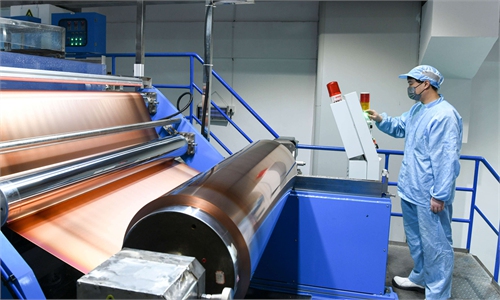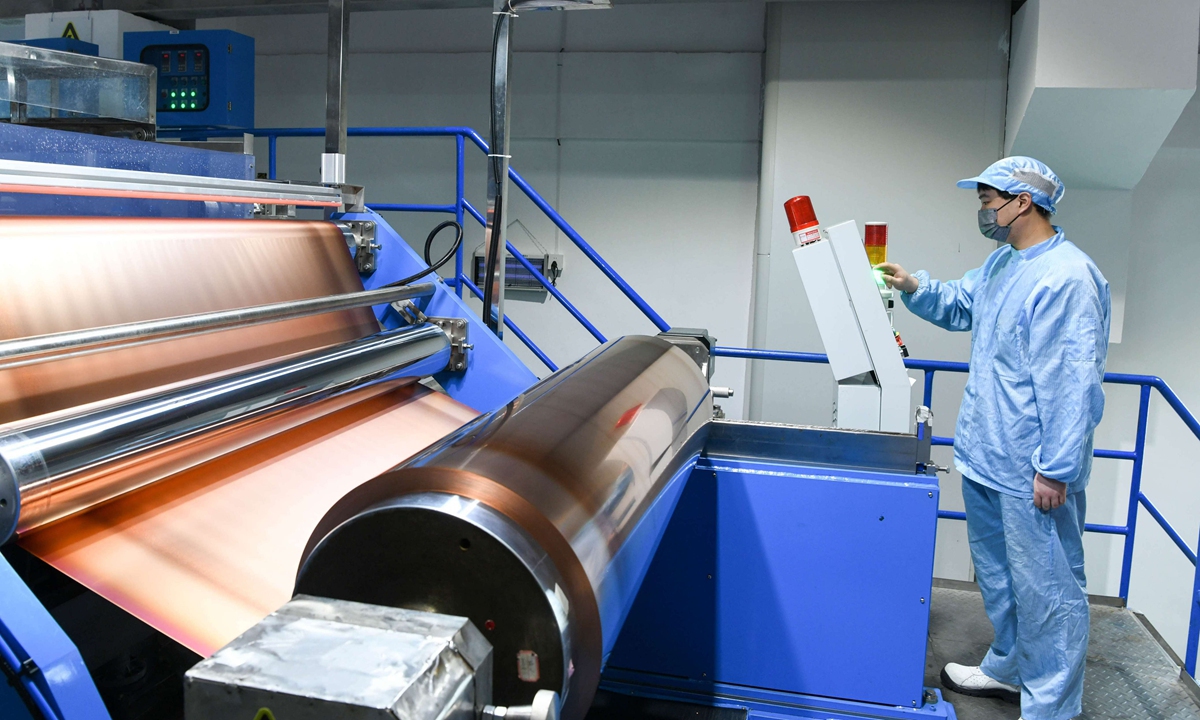
A worker produces electronic copper foil at a company in Tongling, East China's Anhui Province, on May 28, 2026. The company has accelerated breakthroughs in the high-end copper foil segment, achieving faster and lower-loss signal transmission. Its products have become core materials for artificial intelligence servers and other fields, providing support for the independent and controllable development of China's electronic information industry chain. Photo: VCG
China's nonferrous metals industry sees stronger growth amid surging demand from computing power sector, according to industry data and media reports.
Data released by the China Nonferrous Metals Industry Association on Wednesday showed that China's output of the 10 major nonferrous metals totaled 41.513 million metric tons in the first half of the year, up 3.3 percent year-on-year.
Moreover, profits of above-designated-size nonferrous metal companies soared 94 percent year-on-year to 418.39 billion yuan ($61.83 billion), making the sector one of the top performers in terms of profit growth among industrial industries.
Within this strong performance, demand for "computing metals" has seen a particularly sharp surge. According to CCTV News, driven by the construction of artificial intelligence computing infrastructure, prices of nonferrous metals including copper, aluminum, tin, tantalum and indium have risen significantly. Among them, tin prices jumped 40 percent in the first half of the year, while tantalum prices soared 158 percent and indium prices climbed 60 percent.
China, the world's largest producer and consumer of copper products, accounts for more than half of global copper consumption.
The rapid expansion of emerging industries such as AI and new energy in recent years has driven robust demand, leaving copper inventories at relatively low levels and providing further support for prices to remain high, according to CCTV News.
Morgan Stanley previously forecasted that global copper demand from data centers will surge from 740,000 metric tons in 2026 to 1.3 million metric tons by 2028.
In addition to copper, tin has become a key material in advanced semiconductor packaging thanks to its conductivity, low melting point and soldering stability. AI servers, optical modules and advanced packaging are now among the biggest drivers of incremental tin demand.
According to a report published by the China Academy of Information and Communications Technology in March 2026, global computing power is expected to grow at an annual rate of more than 60 percent over the next five years, exceeding 50 EFlops by 2030.
EFLOPS, or ExaFLOPS, refers to a unit measuring computing performance, with each unit representing 1 quintillion floating-point operations per second.
As of 2025, China's total computing power capacity ranked second globally, reaching 962 EFlops and accounting for 21 percent of the world's total.
The short-term supply-demand dynamics for "computing metals" have not undergone fundamental changes, providing support for prices, Duan Shaofu, deputy secretary-general of the China Nonferrous Metals Industry Association, told CCTV News business channel in a recent interview. However, the industry representative also noted that macroeconomic factors are weighing on valuations and geopolitical uncertainties remain, while heightened market sensitivity could increase price volatility risks.
Global Times
RELATED ARTICLES