Two attitudes toward Chinese robots: A mirror revealing who is reversing course: Global Times editorial
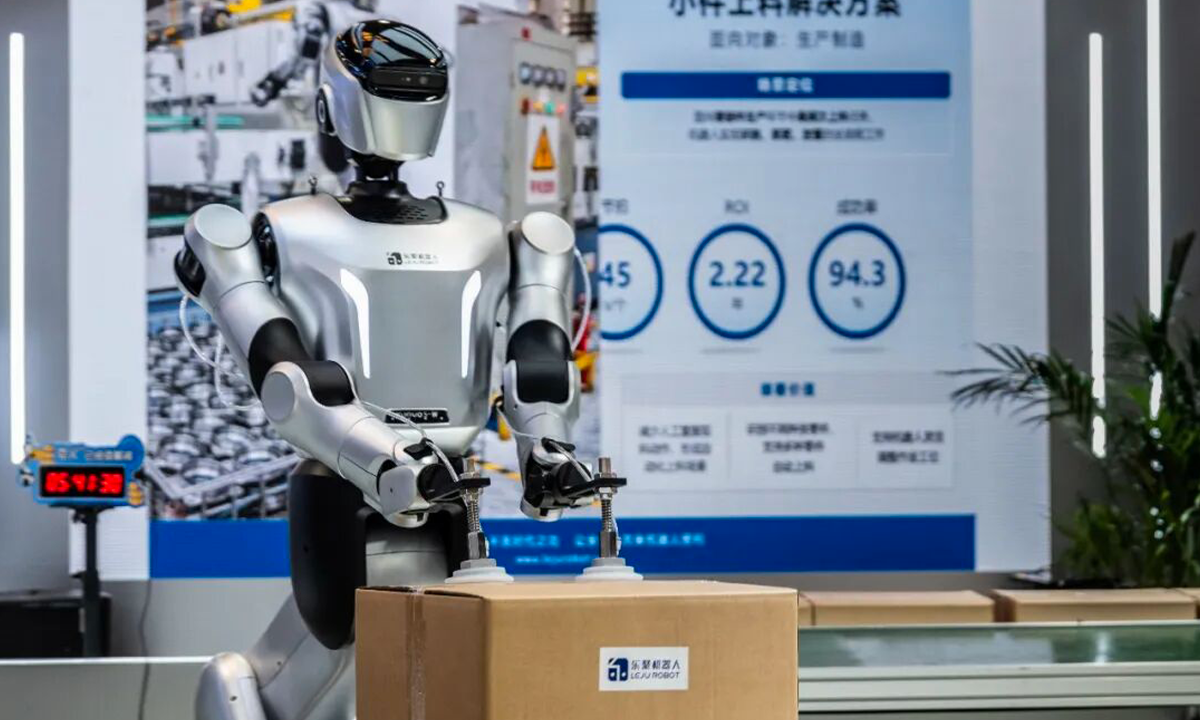
A robot is on display at the 2026 World Artificial Intelligence Conference. Photo: Wu Xue
While the British media is hailing Chinese robots for "transforming" the UK retail sector, the US is treating Chinese robots as a major threat. When it comes to the same technology, some see it as an opportunity, while others see it as a threat. History will show which vision was truly able to see what lay ahead.Recently, the US Federal Communications Commission (FCC) added foreign-made advanced robotic devices to its Covered List, effectively banning new models from entering US market. Almost simultaneously, the BBC published an extensive feature documenting how Chinese robots are "transforming the UK's retail industry." On one side stands a high wall built around "national security"; on the other lies the benefits of "boosted efficiency." The exact same technology has drawn two starkly contrasting attitudes - acting as a mirror that reflects the pragmatism of openness and cooperation against the narrow-mindedness of closed-door development.
The hypocrisy of the US ban lies in its practice of discrimination under the banner of "non-discrimination." The FCC's updated Covered List adds humanoid and quadrupedal robots without explicitly naming any country. Yet, market data points to an undeniable reality: Chinese companies accounted for roughly 90 percent of global humanoid robot shipments last year, with the US serving as the largest export destination for Chinese-made humanoid robots. Even more telling, sources reveal the FCC is expected to exempt the vast majority of non-Chinese manufacturers. This type of "precision-strike" differential policy is, in truth, targeted industrial containment against China.
Why is the US so anxious? The New York Times put it bluntly: "This is a battle for the world's mind, and the United States must win it." Such a narrow, adversarial narrative lays bare the logic of US technological hegemony. As China builds a cluster advantage in robotics - fueled by a complete supply chain, dense supplier networks, and rapid iteration - Washington's choice is not to sharpen its own competitiveness, but to erect barriers to keep China out.
However, as US media themselves predict, restricting robot imports will only rob US firms of external competitive pressure to a certain extent, while potentially slowing their own technical iteration. As for halting China's technological progress? That is likely just wishful thinking.
The BBC's latest report paints a very different picture of Chinese robots. Facing persistent labor shortages, British retailers are turning to Chinese autonomous mobile robots. "A squat silver floor robot gliding beneath a storage rack, lifting a shelf and carrying it across a warehouse to a waiting worker," so that retailers can "increase picking speeds, store more goods in spaces that are hard to reach for humans, and reduce errors." The response from the Trades Union Congress is equally revealing: Rather than rejecting automation, the organization has called for robotics to be used to raise productivity and improve jobs, rather than simply cut labor costs. It is a pragmatic view of technology that stands in sharp contrast to the zero-sum mind-set of "if we can't have it, neither should our competitors."
A similar scene recently unfolded in Beijing's Yizhuang district, where Slovak President Peter Pellegrini interacted with an AI-powered humanoid robot that answered questions with remarkable fluency. He couldn't help but joke about whether it was really a robot or a person inside.
The moment is a vivid testament to the sophistication of Chinese robotics. Across Europe, Southeast Asia, and much of the Global South, similar stories are becoming increasingly common: robotic arms working seamlessly on factory floors, autonomous guided vehicles operating around the clock in logistics hubs, and service robots providing companionship and assistance to the elderly. As one of China's "next new three" emerging industries, robotics is "gaining fans" around the world.
The global wave of intelligent automation cannot be driven by the monopoly of any single country. The US once led the way in basic robotics research, but China has achieved faster industrialization in this field through openness, cooperation and innovation-driven development. The facts increasingly show that Washington's approach is harming not only itself but also the broader ecosystem of global technological collaboration.
In June, Unitree Robotics and Nvidia jointly unveiled the H2 Plus, a new humanoid robot reference design. However, in the same month, the Pentagon added Unitree to its list of "Chinese military companies." When the urgent demand for collaboration from the business community is repeatedly disrupted by political interference, the overall pace of global technological innovation suffers.
Robots are legitimate commercial products, and all participants in global trade, including the US, stand to benefit. By overstretching the concept of national security and disregarding strong appeals from industries in both China and the US, Washington is attempting to prop up domestic industries through protectionist policies. Such an approach ultimately harms others without benefiting oneself. China has made clear that if the US persists, it will respond with firm countermeasures.
When it comes to the same technology, some see it as an opportunity, while others see it as a threat. More than just two different attitudes toward robots, these represent two fundamentally different visions of the future. History will show which vision was truly able to see what lay ahead.
RELATED ARTICLES