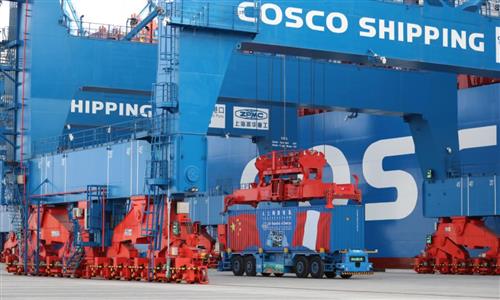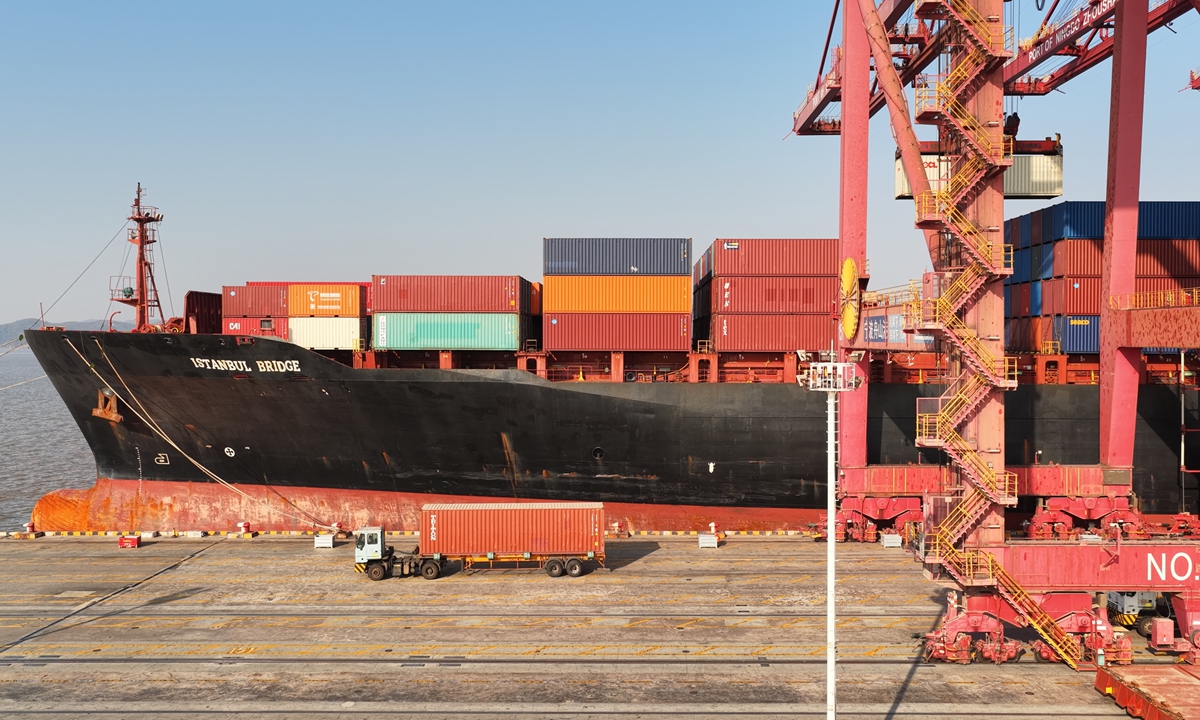
The first cargo ship of the China-Europe Arctic Express berths at Ningbo Zhoushan Port in East China's Zhejiang Province on December 6, 2025. Photo: VCG
With the arrival of summer, melting Arctic sea ice has created favorable conditions for polar maritime traffic, prompting Chinese shipping firms to roll out their official 2026 sailing schedules and ramp up large-scale capacity deployment for the open season.
As a key strategic pillar of the "Polar Silk Road," the China-Europe Arctic route is gaining market traction. Boasting shorter transit cycles and avoidance of geopolitically volatile sea lanes, the route is emerging as a secure and reliable alternative that diversifies and stabilizes China-Europe supply chains.
The China Shipowners' Association (CSA) told the Global Times that the 2026 Arctic shipping window will span from late July to late September. Multiple shipping companies have expanded their vessel investment and released the first batch of official sailing plans. The operational fleet is comprised of container ships, dry bulk carriers and multi-purpose vessels. The combined capacity of the containers and multi-purpose vessels reaches 20,000 TEUs, while dry bulk carriers have a combined deadweight tonnage of 1.4 million tons.
These ships will depart in staggered batches during the navigation season, linking major domestic ports in China and directly calling at key European hub ports to build an efficient and unobstructed polar maritime corridor for China-Europe trade, according to the CSA.
The Arctic route offers significant advantages over traditional routes via the Suez Canal and the Cape of Good Hope. Sailing distances from Chinese ports to core Baltic Sea ports in Europe are cut by nearly one-third, sharply shortening overall transit time. More importantly, the lane entirely bypasses high-risk waters including the Red Sea and the Strait of Malacca, helping ensure the timely delivery of export orders, according to the CSA.
New New Shipping Line Co, one of the operators of the route, told the Global Times on Wednesday that the overall transit time on the Arctic route is shorter than that of traditional shipping routes. For example, a voyage from Shanghai to St. Petersburg takes 38 to 45 days via the Suez Canal, while the Arctic route reduces the journey to 23 to 25 days.
The shorter transit time helps lower operating costs, and compared with conventional routes, the Arctic passage is less affected by certain geopolitical factors, the company said.
Sealegend Shipping (SLG), another operator on the route, also updated its official 2026 sailing schedule. Its vessel Dubai Tower is set to depart Qingdao, East China's Shandong Province on August 7 and arrive at the UK's Port of Felixstowe after a 30-day polar voyage.
Unrivaled advantages
A key advantage of the Arctic route lies in its naturally low-temperature environment, which creates an ideal natural cold chain. This unique condition is perfectly tailored for temperature-sensitive, high-value cargoes such as energy storage batteries, photovoltaic components and precision electromechanical products, according to the CSA.
The route's practical logistics value has been fully verified by Chinese exporters. During the voyage season last year, Chinese e-mobility company Ninebot shipped 30 containers of electric scooters and e-bikes worth millions of euros to the Netherlands through SLG.
Zhu Xuan, a representative from the company's logistics department, told the Global Times that the Arctic route freight rate is only one-third of traditional China-Europe trucking routes. "Calculations show the Arctic lane reduces the transportation cost by $30 per electric scooter compared with truck haulage," Zhu said.
As a core artery of the "Polar Silk Road," the Arctic shipping route connecting Asia and Europe carries significance for optimizing global supply chains and deepening economic and trade ties with economies along the route.
Among three major Arctic shipping passages, only the Arctic Northeast Passage features commercial viability. Running along Russia's northern coastline across the Arctic Ocean, it connects Asia and the Pacific Ocean via the Bering Strait and Northern Europe and Atlantic Ocean through the Barents Sea, available for commercial navigation in summer to greatly cut trade time and costs, according to the Xinhua News Agency.
New New Shipping Line Co said that currently the Arctic route is seasonal rather than open year-round, with a limited navigation window. The regular navigation window typically runs from mid-July to mid-to-late October each year.
The company is now deploying higher ice-class vessels to enhance its capability to operate in ice-covered waters. The company said demand for the Arctic route remains strong, covering a wide range of cargoes, and that it plans to further expand capacity in line with market demand.
Vast potential
Jian Junbo, director of the Center for China-Europe Relations at Fudan University's Institute of International Studies, told the Global Times on Thursday that Arctic route, a key carrier of the "Polar Silk Road," serves as a vital supplement to traditional southern sea lanes and China-Europe Railway Express. It improves transport efficiency, avoids geopolitical risks on busy southern waterways, and safeguards stable supply chain operation between China and Europe.
From the perspective of advancing regional multilateral cooperation, the route delivers tangible benefits to cross-border trade spanning East Asia all the way to Europe. When the route enters regular commercial operation, it will incentivize all parties along the route to jointly participate in the development of coastal supporting infrastructure and work together to safeguard the long-term stability and safety of the shipping lane, Jian noted.
The "Polar Silk Road" adds another maritime corridor alongside existing routes through the South China Sea, the Indian Ocean, Africa and the Mediterranean, and the South Pacific and Oceania, according to Xinhua.
China hopes to work with all parties to build the "Polar Silk Road" through developing Arctic shipping routes, according to a white paper released by Chinese government in 2018, per Xinhua.
In recent years, the Arctic shipping routes have increasingly come under the spotlight in the international community and have the potential to become the important routes in international trade, Lin Jian, Chinese Foreign Ministry spokesperson, told a press conference in September 2025.
China stands ready to work with Russia and other Arctic states as well as interested countries to strengthen international cooperation on the building and operation of basic infrastructure in the Arctic shipping routes and jointly advance the development and exploration of the routes and protect the environment there, Lin said.
RELATED ARTICLES