China firmly rejects Philippines' delimitation of so-called 'baselines of the territorial sea' of China's Huangyan Dao
Chinese Foreign Ministry
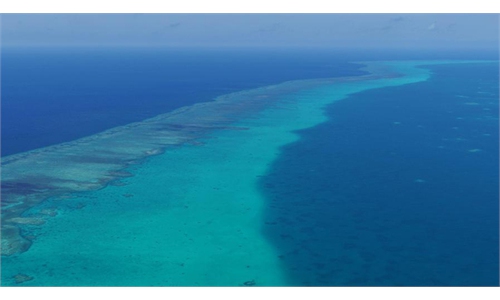
China on Friday firmly rejected and said it will never accept the delimitation of the so-called "baselines of the territorial Sea" of China's territory of Huangyan Dao by the Philippines, stressing it is illegal, null and void, according to a statement released by China's Ministry of Foreign Affairs on its website.
The statement came after the Philippines claimed it has deposited its official nautical chart of Huangyan Dao and its surrounding maritime zones with the United Nations Secretariat.
By depositing the chart, the Philippines' Department of Foreign Affairs (DFA) claimed Manila formally notifies the international community of its normal baselines and the geographic extent of its applicable authority and jurisdiction at Huangyan Dao, per the Philippine News Agency.
A statement from the Philippine side claimed the move marks yet another "milestone" in the country's continuing efforts to "uphold international law" and "reinforce the legal certainty" of its maritime entitlements, according to the report.
With regard to the Philippines' illegal and false claims, China's Ministry of Foreign Affairs said in the Friday's statement that Huangyan Dao is China's inherent territory. China has indisputable sovereignty over it and its adjacent waters, and has sovereign rights and jurisdiction over the relevant waters. China has continuously, peacefully and effectively exercised sovereignty and jurisdiction over Huangyan Dao. The territory of the Philippines has been defined by a series of international treaties, and Huangyan Dao has never been a part of it. The Philippines' illegal territorial claim over China's Huangyan Dao is completely baseless under international law, according to the ministry.
The ministry also said the Philippines' delimitation is a grave infringement upon China's territorial sovereignty and a serious violation of international law including the United Nations Charter and the United Nations Convention on the Law of the Sea (UNCLOS).
The Philippines' so-called "Maritime Zones Act" issued under the pretext of UNCLOS illegally includes China's Huangyan Dao and most of the islands and reefs of China's Nansha Qundao (Nansha Islands), and relevant waters into the maritime zones of the Philippines, and attempts to solidify the illegal "award of the South China Sea arbitration" in the form of domestic legislation. It severely violates China's territorial sovereignty and maritime rights and interests in the South China Sea, and is illegal, null and void, the statement said.
China's territorial sovereignty and maritime rights and interests over Huangyan Dao and Nansha Qundao shall under no circumstances be affected by the so-called "Maritime Zones Act," it added.
China urges the Philippines to earnestly respect China's territorial sovereignty and maritime rights and interests, and refrain from any act of infringement or provocation in Huangyan Dao. Otherwise, China will respond resolutely, according to the statement.
Chen Xiangmiao, director of the World Navy Research Center at the National Institute for South China Sea Studies, told the Global Times that under international law, declaring territorial sea baselines requires prior confirmation of sovereignty over Huangyan Dao. China's sovereignty over Huangyan Dao was settled well before the Philippines lodged formal claims in the 1990s.
Manila's unilateral designation of baselines around Huangyan Dao thus has no basis under international law and is illegal and void. It represents an overt violation of China's territorial sovereignty and lays bare Manila's attempt to expand territorial claims by exploiting legal procedures, Chen said.
According to the expert, the Philippines has intensified lawfare in the South China Sea and staged unilateral provocative acts at Huangyan Dao and Ren'ai Jiao for two core considerations. For one, it aims to capitalize on the tenth year of the unlawful arbitral award to globalize its misleading narrative and illegitimate maritime claims. For another, the Marcos government intends to deliver political gains through such coordinated moves before the end of its tenure.
Unlawful legal offensive
On Thursday, the Philippines also formally presented its claim for an extended continental shelf in the "West Philippine Sea" area facing the South China Sea to the United Nations Commission on the Limits of the Continental Shelf (CLCS).
The oral presentation, made as a follow-up to Manila's submission of the application to the UN in 2024, was reported by The Philippine Star.
China's mission to the UN also issued a rebuttal on Thursday following the Philippines' presentation before the CLCS. The Chinese side said that the submission flagrantly infringes on China's sovereignty, sovereign rights and jurisdiction in the South China Sea, according to an X post by China's mission to the UN.
Some Chinese experts said the move is unlikely to produce substantive legal results, as the rules and procedures of the CLCS have already determined the limits of what the commission can address.
"The Philippines' oral presentation will not bring about any substantial legal outcome, but it is intended to create a recurring legal and political issue, keeping the South China Sea disputes visible and continuously discussed within international legal institutions," Yang Xiao, a research professor at the Institute of Peaceful Development under the Chinese Academy of Social Sciences, told the Global Times on Friday.
The Philippines' extended continental shelf claim not only seriously infringes upon China's territorial sovereignty and maritime rights and interests, but also overlaps with claims made by other Southeast Asian countries, including Malaysia and Vietnam, Yang noted.
According to the UN commission's website, the latest communication it received on the Philippines' claim was from Malaysia on July 24, The Philippine Star reported on Thursday.
Malaysia said in its note verbale that it "reaffirms its categorical rejection of the Philippines' Partial Submission." Manila's claim, according to Malaysia, is "unacceptable, and does not conform with international law, including the 1982 UNCLOS," the media report said.
The core intention of this application is not to obtain substantive recommendations from the CLCS, but rather to maintain a false legal narrative over the South China Sea issue through continued appearances on international legal platforms, and to provide a legal basis for strategic coordination under the US-Philippines alliance framework, Yang noted.
The Philippines, under the banner of "upholding a rules-based maritime order", is in fact using UNCLOS as a political tool to unilaterally pursue geopolitical interests. This is a typical act of "unilateral provocation and legal abuse" aimed at legitimizing and perpetuating claims that infringe upon China's territorial sovereignty and maritime rights and interests through the UN platform, Yang added.
According to Chen, Manila's recent wave of provocations stems from the Marcos administration's radical South China Sea policy. They are fueled by covert support and encouragement from external players such as the US and Japan, and result from domestic special interest groups putting their own gains above the Philippines' national interests.
"By launching this legal offensive in the South China Sea, all of the Philippines' maneuvers rest on the unlawful arbitration award in 2016," said Chen, "It seeks maritime and territorial expansion under 'legal' pretenses, which actually damaged the contemporary international law of the sea regime."
Yet Manila's provocations will only heighten China-Philippine tensions and trap the Philippines in an ever-deepening quagmire, Chen added.
RELATED ARTICLES