China’s tech innovation isn’t a threat but the only lifeboat to the global economy: Russian scientist
Editor's Note:
Artem Oganov (Oganov), a distinguished professor at the Skolkovo Institute of Science and Technology and chief scientific officer of Sber University in Russia, and a foreign expert at China's Xinjiang Technical Institute of Physics and Chemistry, received the 2025 China International Science and Technology Cooperation Award on July 8. What are his views on China's technological rise and China's sci-tech R&D environment? Oganov shared his perspectives with Global Times (GT) reporter Ma Jingjing.
GT: Drawing on your personal journey, could you share what has motivated you to conduct your research in China for so long?
Oganov: I first came to China in 2008 largely due to scientific and cultural curiosity. I fell in love with China, seeing it as a country that understood the existential value of science and knowledge. I have had many Chinese friends from my PhD time in London, then many Chinese students and postdocs, then friends and colleagues. Every visit enriches my mind and soul. This is why I have visited China frequently since 2008. Over two decades, the most shocking shift wasn't the investment - it was the cultural shift. China went from "catching up" to asking "what's next?" before anyone noticed. Today, Chinese labs don't ask "can we do this?" - they ask "why hasn't anyone done this yet?" That is the hallmark of a true world's No.1.
Each time I visit Chinese universities, I get a lot of emotional and intellectual excitement that fuels my own progress. So many new ideas, young faces, and the true spirit of exploration - it's all very contagious.
GT: From domestically developed large aircraft and the expansion of China's large vessel fleet to breakthroughs like DeepSeek and Unitree Robotics capturing global attention, China's innovation achievements have been making headlines globally. How do you assess China's achievements in sci-tech innovation in recent years?
Oganov: DeepSeek, Unitree and C919 are surely impressive. But the real story is below the ground: fundamental materials, quantum chemistry, high-pressure physics - these and many other fields where China now produces more high-impact papers than the US or the EU. I know this because my own algorithm (USPEX) is used more in China than anywhere else - not because I'm special, but because Chinese scientists actually use tools to discover, not just to publish. And let's not forget about deeper "floors" of the breakthroughs - fundamental education and the hard work of teachers and students, the brave spirit of businesspeople, and the exceptionally hard and dedicated work of 1.4 billion people that has enabled China's economic miracle.
China already is the world's No.1 scientific superpower by many meaningful metrics. For China, the next Five-Year Plan isn't about becoming strong - it's about staying strong while everyone else is still tying their shoelaces. The "critical" part is about breaking the last remaining psychological barriers: doing science that nobody else dares to imagine, and doing it faster, getting rid of bureaucracy and flying high.
For the global economy, this isn't a threat - it's the only lifeboat. One can often read that the pace of innovation in the West has greatly decreased in the last decades. There are many reasons for this: a funding system that favors incremental research, "publish or perish" principle often leading to prolific research that lacks depth and originality, and so on and so forth. Can Chinese science bring back the taste of truly original research and breakthrough? I believe so, but of course, only time will tell.
GT: Amid the current complex global landscape, China remains firmly committed to keeping its doors open to international scientific collaboration. In your view, where does China's confidence behind this commitment originate? Besides benefiting itself, what will China's technological advancements bring to the rest of the world?
Oganov: I think this confidence comes from the simple fact that China is now the world's largest producer of scientific knowledge. Isolated systems quickly degrade. If you want to stay on top, you have to be open. I think Chinese science is doing what Chinese industry has been and is still doing - it's the locomotive of the world's development.
It's interesting to see how the West, which for decades lectured everyone about the importance of openness of science, markets, travel, etc, is now closing within itself, treating foreign companies such as Huawei and foreign citizens as threat. They were open when they were winning and demanded openness of foreign markets to boost their own economy. Now they are losing global competition, and all they can do is to close their markets. So much for the "open society," free market and other cliches.
In recent years, we see growing China-Russia cooperation in science and technology. Russia has always been extremely strong in mathematics and natural sciences, especially fundamental ones. I do see great complementarity between Russian and Chinese scientific cultures and approaches. Add to these natural resources of Russia and human resources of China. I hope we learn from each other and help each other. Working together, China and Russia are unstoppable.
GT: Recently, some Western media and think tanks are peddling "China Shock 2.0," claiming that China is achieving fast development in high-tech sectors such as renewable energy and AI and relies on foreign markets to absorb its overcapacity, thus reducing the market share of developed countries and sending more serious shock waves to the global economy compared with the era of traditional manufacturing industry. What's your comment?
Oganov: When you seriously think you are a superior breed of humans, you are not willing to admit a defeat and will search for any excuses. China didn't become No.1 in high-tech by out-investing, out-learning, and out-executing everyone. Calling China's advanced technologies "overcapacity" is like calling Michael Phelps "over-swimming."
The real shock is not China's success - it's the West's inability to accept that its monopoly on high-tech is over. If the West slaps tariffs instead of slapping itself to work harder, it will lose not just market shares, but relevance. China is not sending shock waves; it's sending a mirror.
Artem Oganov (Oganov), a distinguished professor at the Skolkovo Institute of Science and Technology and chief scientific officer of Sber University in Russia, and a foreign expert at China's Xinjiang Technical Institute of Physics and Chemistry, received the 2025 China International Science and Technology Cooperation Award on July 8. What are his views on China's technological rise and China's sci-tech R&D environment? Oganov shared his perspectives with Global Times (GT) reporter Ma Jingjing.
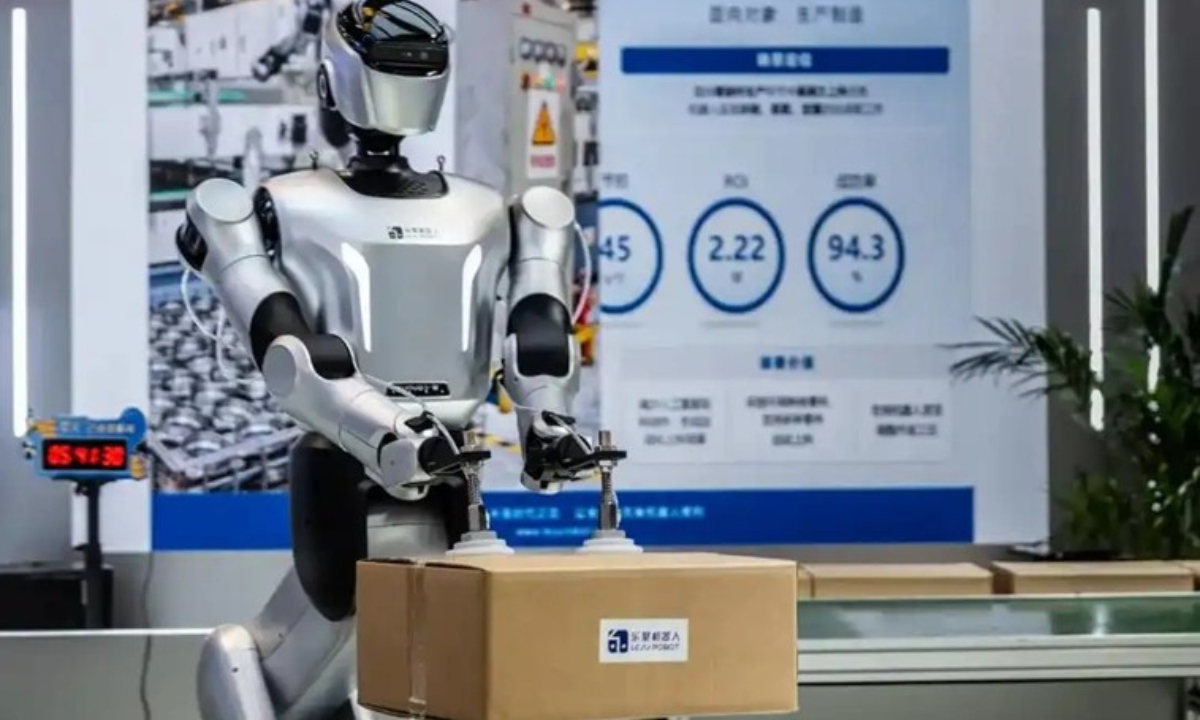
A robot is on display at the 2026 World Artificial Intelligence Conference. Photo: Wu Xue
GT: Drawing on your personal journey, could you share what has motivated you to conduct your research in China for so long?
Oganov: I first came to China in 2008 largely due to scientific and cultural curiosity. I fell in love with China, seeing it as a country that understood the existential value of science and knowledge. I have had many Chinese friends from my PhD time in London, then many Chinese students and postdocs, then friends and colleagues. Every visit enriches my mind and soul. This is why I have visited China frequently since 2008. Over two decades, the most shocking shift wasn't the investment - it was the cultural shift. China went from "catching up" to asking "what's next?" before anyone noticed. Today, Chinese labs don't ask "can we do this?" - they ask "why hasn't anyone done this yet?" That is the hallmark of a true world's No.1.
Each time I visit Chinese universities, I get a lot of emotional and intellectual excitement that fuels my own progress. So many new ideas, young faces, and the true spirit of exploration - it's all very contagious.
GT: From domestically developed large aircraft and the expansion of China's large vessel fleet to breakthroughs like DeepSeek and Unitree Robotics capturing global attention, China's innovation achievements have been making headlines globally. How do you assess China's achievements in sci-tech innovation in recent years?
Oganov: DeepSeek, Unitree and C919 are surely impressive. But the real story is below the ground: fundamental materials, quantum chemistry, high-pressure physics - these and many other fields where China now produces more high-impact papers than the US or the EU. I know this because my own algorithm (USPEX) is used more in China than anywhere else - not because I'm special, but because Chinese scientists actually use tools to discover, not just to publish. And let's not forget about deeper "floors" of the breakthroughs - fundamental education and the hard work of teachers and students, the brave spirit of businesspeople, and the exceptionally hard and dedicated work of 1.4 billion people that has enabled China's economic miracle.
China already is the world's No.1 scientific superpower by many meaningful metrics. For China, the next Five-Year Plan isn't about becoming strong - it's about staying strong while everyone else is still tying their shoelaces. The "critical" part is about breaking the last remaining psychological barriers: doing science that nobody else dares to imagine, and doing it faster, getting rid of bureaucracy and flying high.
For the global economy, this isn't a threat - it's the only lifeboat. One can often read that the pace of innovation in the West has greatly decreased in the last decades. There are many reasons for this: a funding system that favors incremental research, "publish or perish" principle often leading to prolific research that lacks depth and originality, and so on and so forth. Can Chinese science bring back the taste of truly original research and breakthrough? I believe so, but of course, only time will tell.
GT: Amid the current complex global landscape, China remains firmly committed to keeping its doors open to international scientific collaboration. In your view, where does China's confidence behind this commitment originate? Besides benefiting itself, what will China's technological advancements bring to the rest of the world?
Oganov: I think this confidence comes from the simple fact that China is now the world's largest producer of scientific knowledge. Isolated systems quickly degrade. If you want to stay on top, you have to be open. I think Chinese science is doing what Chinese industry has been and is still doing - it's the locomotive of the world's development.
It's interesting to see how the West, which for decades lectured everyone about the importance of openness of science, markets, travel, etc, is now closing within itself, treating foreign companies such as Huawei and foreign citizens as threat. They were open when they were winning and demanded openness of foreign markets to boost their own economy. Now they are losing global competition, and all they can do is to close their markets. So much for the "open society," free market and other cliches.
In recent years, we see growing China-Russia cooperation in science and technology. Russia has always been extremely strong in mathematics and natural sciences, especially fundamental ones. I do see great complementarity between Russian and Chinese scientific cultures and approaches. Add to these natural resources of Russia and human resources of China. I hope we learn from each other and help each other. Working together, China and Russia are unstoppable.
GT: Recently, some Western media and think tanks are peddling "China Shock 2.0," claiming that China is achieving fast development in high-tech sectors such as renewable energy and AI and relies on foreign markets to absorb its overcapacity, thus reducing the market share of developed countries and sending more serious shock waves to the global economy compared with the era of traditional manufacturing industry. What's your comment?
Oganov: When you seriously think you are a superior breed of humans, you are not willing to admit a defeat and will search for any excuses. China didn't become No.1 in high-tech by out-investing, out-learning, and out-executing everyone. Calling China's advanced technologies "overcapacity" is like calling Michael Phelps "over-swimming."
The real shock is not China's success - it's the West's inability to accept that its monopoly on high-tech is over. If the West slaps tariffs instead of slapping itself to work harder, it will lose not just market shares, but relevance. China is not sending shock waves; it's sending a mirror.
RELATED ARTICLES