Exclusive: Type 071 amphibious transport dock, H-6K bombers involved in PLA’s drills around Huangyan Dao; move aimed at countering series of Philippine activities: experts
Chinese People's Liberation Army (PLA) Southern Theater Command conducted naval and air force patrols in the territorial waters and airspace of China's Huangyan Dao and the surrounding maritime and air areas on August 1, 2026. Photo: Courtesy of Chinese People's Liberation Army (PLA) Southern Theater Command
The exercises are aimed at testing and improving the troops' practical capabilities in safeguarding national territorial sovereignty and maritime rights and interests, per the statement.
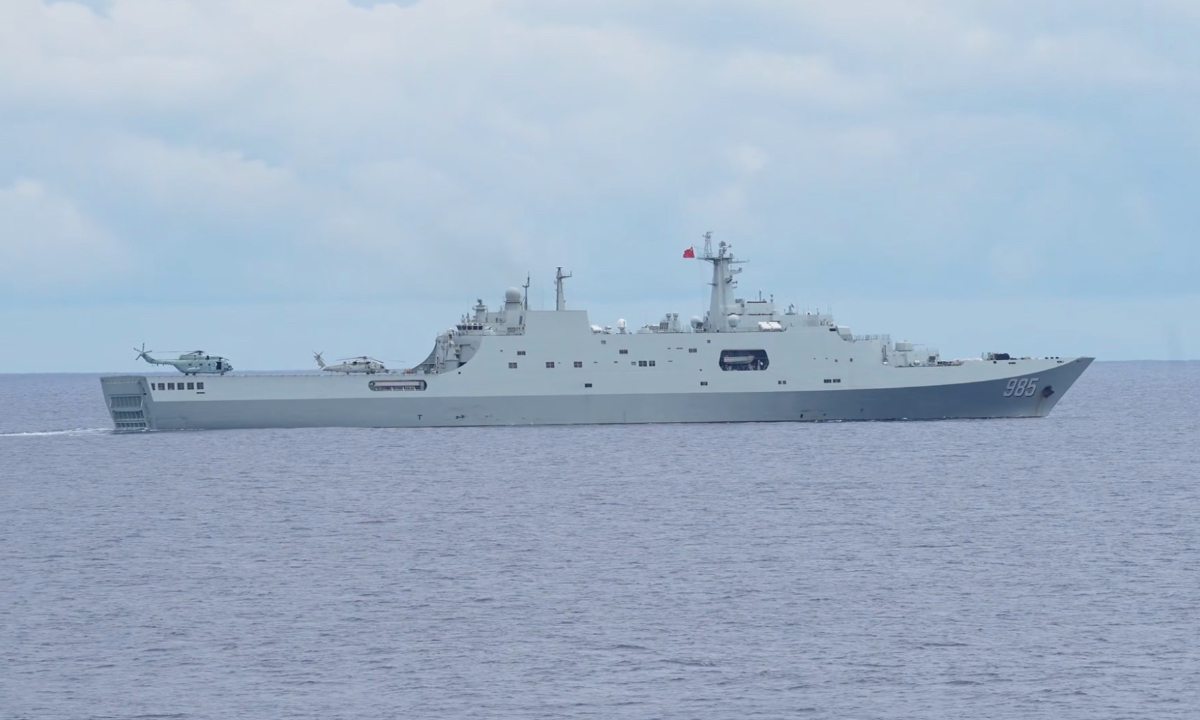
Footages obtained by the Global Times on Saturday showed a H-6K bombers, each armed with four YJ-12 supersonic anti-ship missiles taking part in the drills, while a Navy Type 071 amphibious transport dock as well as Type 054A and Type 056A warships had arrived in the exercise area.
Among them, the Z-20J and Z-8C helicopters conducted takeoffs and landings from the Type 071, carrying out operations over the waters surrounding Huangyan Dao. The Type 726 air-cushioned landing craft also operated from the Type 071 landing ship. This demonstrates that the Southern Theater Command conducted the latest emergency response and handling drills in the waters around China’s Huangyan Dao through coordinated sea-air operations.
Although the PLA did not explicitly identify any specific country as the target of the drills, Chinese experts said the exercises were primarily aimed at countering a series of recent moves by the Philippines in multilateral maritime forums as attempts to challenge China’s sovereignty over Huangyan Dao.
Earlier, the Philippines has deposited its official nautical chart of so-called Bajo de Masinloc (Huangyan Dao) and its surrounding maritime zones with the United Nations Secretariat, claiming the act showed Manila formally notifies the international community of its normal baselines and the geographic extent of its applicable authority and jurisdiction at Bajo de Masinloc, per Philippines News Agency.
Chinese Foreign Ministry on Friday issued a statement on the Philippines' delimitation of the so-called "baselines of the territorial sea" of China's territory of Huangyan Dao, revealing the move "is a grave infringement upon China's territorial sovereignty and a serious violation of international law including the United Nations Charter and the United Nations Convention on the Law of the Sea.
“It is illegal, null and void. China firmly rejects and will never accept it,” per the statement.
The H-6K bomber armed with four YJ-12 supersonic anti-ship missiles is capable of effectively engaging a wide range of maritime targets, from frigates and destroyers to larger warships. The deployment demonstrates the PLA’s capability to destroy any naval vessels deemed a threat to China’s national security, Song Zhongping, a Chinese military affairs expert, told the Global Times on Saturday.
The missile has a range of 400 to 500 kilometers, fully covering the waters around Huangyan Dao, and is capable of sustained supersonic cruise throughout its entire flight, with a terminal penetration speed of up to Mach 4 to Mach 5. It is reportedly capable of severely damaging or even disabling large surface vessels weighing tens of thousands of tons, Zhang Junshe, another Chinese military affairs expert, told the Global Times.
Zhang noted that the Z-8C helicopter is responsible for the large-scale deployment of personnel and supplies, and the Z-20J helicopter combines troop transport capabilities with accompanying fire support, carrying out missions such as rapid helicopter insertion and seizure of key positions.
The joint maritime-air exercise organized by the PLA Southern Theater Command demonstrates the Chinese military’s capabilities in maritime strike operations and amphibious landing and island seizure operations, Zhang said.
Beyond safeguarding China’s sovereignty claims in the South China Sea, China’s military drills also serve as a deterrent to the Philippines and other external actors, attributing to regional peace and maritime stability. China’s ability to safeguard its territorial interests has significantly strengthened and will continue to improve, and that the exercises demonstrate China’s capabilities while contributing to maintaining regional peace and stability, Duo, director of the Research Center for International and Regional Issues at the National Institute for South China Sea Studies, told the Global Times on Saturday,
The drills were mainly a countermeasure and a rights-protection response to a series of Philippine actions aimed at advancing territorial claims over Huangyan Dao through maritime diplomatic channels, Ding said. The expert noted that whether it was the Philippines’ alleged provocations against Chinese coast guard vessels in the South China Sea ahead of ASEAN ministerial meetings, or its recent attempt to establish baselines around Huangyan Dao, these actions reflect Manila’s efforts to amplify its claims over the island and its surrounding areas.
The Philippines also seeks support from external countries to back these illegal provocations, and China’s response would not be limited to diplomatic measures but would also include military actions, like today’s drills, Ding said.
“The initiators of the militarization of the South China Sea issue are the US and the Philippines,” Ding said.
Earlier, the US and Japan joined the Philippines in maritime exercises in the South China Sea in five-day drills from Jul 21 to 25, and in May, the Philippines and the US conducted the Balikatan exercise. The act drew criticism even inside the Philippines, with Philippine fishing and farming communities reportedly suffering livelihood disruption caused by the drills, and secretary-general of Bayan, a national coalition of activist group, said the Philippines should distance itself from US military planning, starting with ending joint exercises, Al Jazeera reported.
Ding predicted that the Philippines and external countries may continue to increase risks in the Huangyan Dao area and the broader South China Sea, including by involving civilian vessels and using small aircraft in activities China considers provocative, and China’s drills were unlikely to be a one-time activity.
The inclusion of air forces in the latest drills was also significant, as it served as a targeted response to recent Philippine activities involving small transport aircraft and helicopters, Ding said.
On Thursday, the PLA Southern Theater Command and the China Coast Guard also conducted patrols and inspections in the waters and airspace around Huangyan Dao.
China’s law enforcement forces and military units would likely take part in a more regular and targeted arrangement in the future, Ding noted. “And any consequences arising from actions that infringe upon sovereignty will ultimately have to be borne by those responsible.
RELATED ARTICLES