China slams US UFLPA move against Chinese firms as economic coercion, vows rights protection
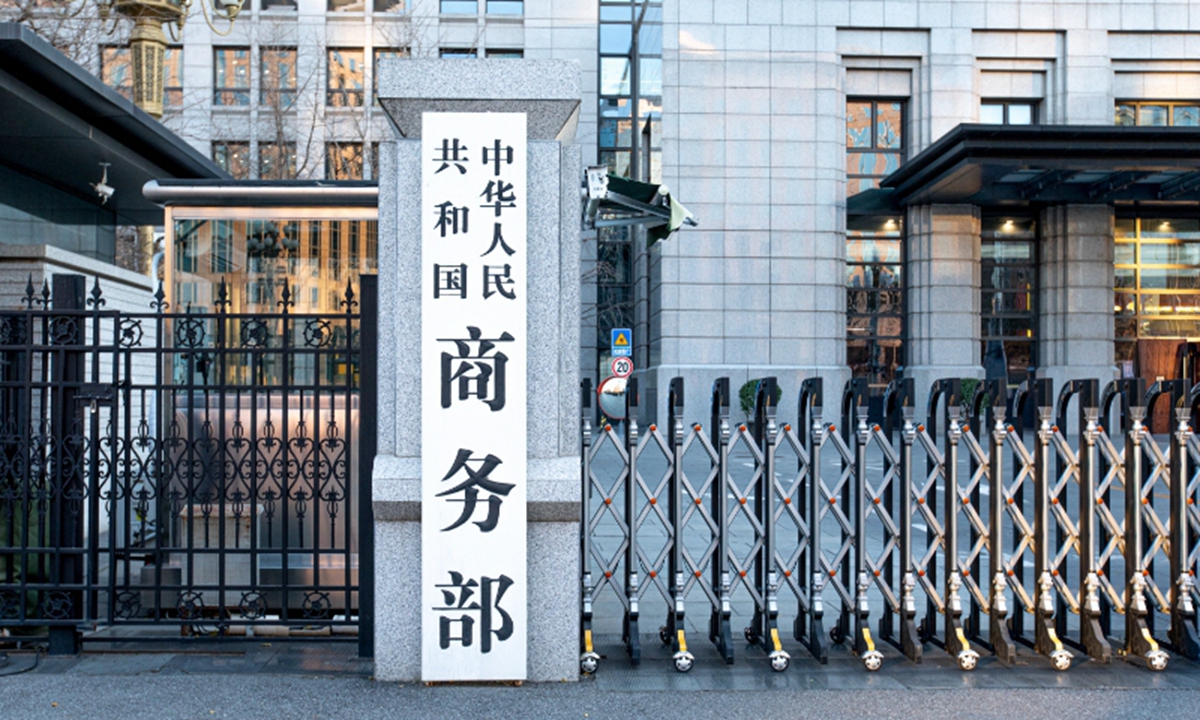
The Ministry of Commerce of China File photo: VCG
A spokesperson for China’s Ministry of Commerce (MOFCOM) on Saturday strongly condemned and firmly opposed the US decision to add more than 40 Chinese entities to the so-called “Uyghur Forced Labor Prevention Act” (UFLPA) Entity List, saying the move is completely groundless. The US has continued to impose unilateral sanctions on Chinese companies under its domestic law under the pretext of so-called “human rights” and “forced labor,” which constitutes typical acts of economic coercion, according to the spokesperson.
The remarks came after the US on Friday once again imposed restrictions on Chinese companies over alleged “human rights abuses”. Chinese experts criticized the move as a further “no-bottom-line” act of economic coercion against China, urging Washington to properly view China-US economic ties and stop taking actions that further fragment global supply chains.
Particularly, on July 30, the Chinese and US lead officials for economic and trade affairs held a video call, during which the two sides had candid, in-depth and constructive exchanges on maintaining the stability of bilateral economic and trade relations. Just one day later, the US introduced egregious measures that undermine China’s interests, seriously deviating from the consensus reached by the two heads of state, the spokesperson said. “China strongly condemns and firmly opposes such actions.”
The spokesperson stressed that China has consistently opposed forced labor. Xinjiang region enjoys social harmony and stability, economic prosperity, and people are living and working in peace and contentment. There is no such thing as so-called “forced labor” in Xinjiang in any form, the spokesperson said.
The US measures have seriously infringed upon the lawful rights and interests of the companies concerned and severely undermined the stability of global industrial and supply chains, the spokesperson said. China urges the US to immediately stop attacking and smearing Xinjiang region, stop manipulating the so-called “forced labor” issue, and stop its unreasonable suppression of Chinese companies. China will take necessary measures to firmly safeguard the lawful rights and interests of Chinese enterprises, the spokesperson said.
According to a Reuters report, the US’ latest additions of Chinese companies into UFLPA Entity List include companies in the pharmaceutical, metals, cotton, food and lithium production sectors, bringing the number of entities on the list from 144 to 187.
It is also the largest number of entities added in one action since the Act was signed into law in December 2021, the report claimed.
Xin Qiang, deputy director of the Center for American Studies at Fudan University, told the Global Times on Saturday that the US has maliciously smeared China’s normal labor practices and industrial development under the guise of so-called “forced labor” allegations, using the issue as a pretext to pursue economic suppression. He said such moves reflect Washington’s attempt to contain China’s development, while also serving the interests of certain anti-China forces in the West that have deliberately hyped up Xinjiang-related issues and fueled ideological confrontation.
The entities targeted by the US measures are involved in sectors such as apparel, polysilicon and food, with many playing important roles in global supply chains. Restricting their access to the US market would not only affect Chinese companies but also create greater uncertainty and raise procurement costs for US supply chains, said Zhou Mi, a researcher at the Chinese Academy of International Trade and Economic Cooperation.
Notably, this is not the first time the US has recently weaponized so-called “forced labor” allegations for economic coercion, with even its allies facing related measures. Reuters reported that the move has drawn protests from its trading partners.
The US imposed new tariffs of 10 percent and 12.5 percent on goods from 60 trading partners, including the EU, Japan and China, alleging those countries failed to curb imports made by so-called forced labor.
The US claimed that trading partners had failed to clamp down on trade in goods made with so-called forced labor passing through their supply chains, according to the report.
Zhou noted that the latest move is closely linked to Washington’s recent Section 301 tariff measures, sending a negative signal to global markets by creating artificial barriers and increasing uncertainty for international trade. Such actions, he said, will further complicate the global economic environment.
Unilateral sanctions and trade restrictions ultimately hurt the interests of all parties, including US companies, according to Xin. He noted that products such as Xinjiang cotton, tomato products and polysilicon have strong competitiveness, and by restricting imports of these products and urging allies to follow suit, the US has forced businesses to seek alternatives at higher costs, raising its own industrial costs while reducing trade efficiency.
At the just-concluded video call between Chinese and US lead officials for economic and trade affairs, the two sides just agreed to further leverage the China-US economic and trade consultation mechanism under the strategic guidance of the leaders of both countries, enhance communication, build mutual trust, address differences, expand cooperation, and promote the stable and sound development of China-US economic and trade relations, thereby contributing to the building of a constructive China-US strategic stability relationship, according to Xinhua News Agency.
Recent China-US economic dialogue was aimed at implementing the consensus reached by the leaders of both countries and exploring a constructive and stable economic relationship, Zhou said. However, the US’ latest restrictive measures have undermined market confidence in the US credibility. He urged Washington to take a more objective view of China-US economic and trade ties and adopt a pragmatic approach to advancing cooperation and global economic stability.
RELATED ARTICLES