China Cotton Association slams US inclusion of 43 Chinese companies on 'Entity List' under groundless 'forced labor' claim, warns sanctions have undermined global cotton industry chain
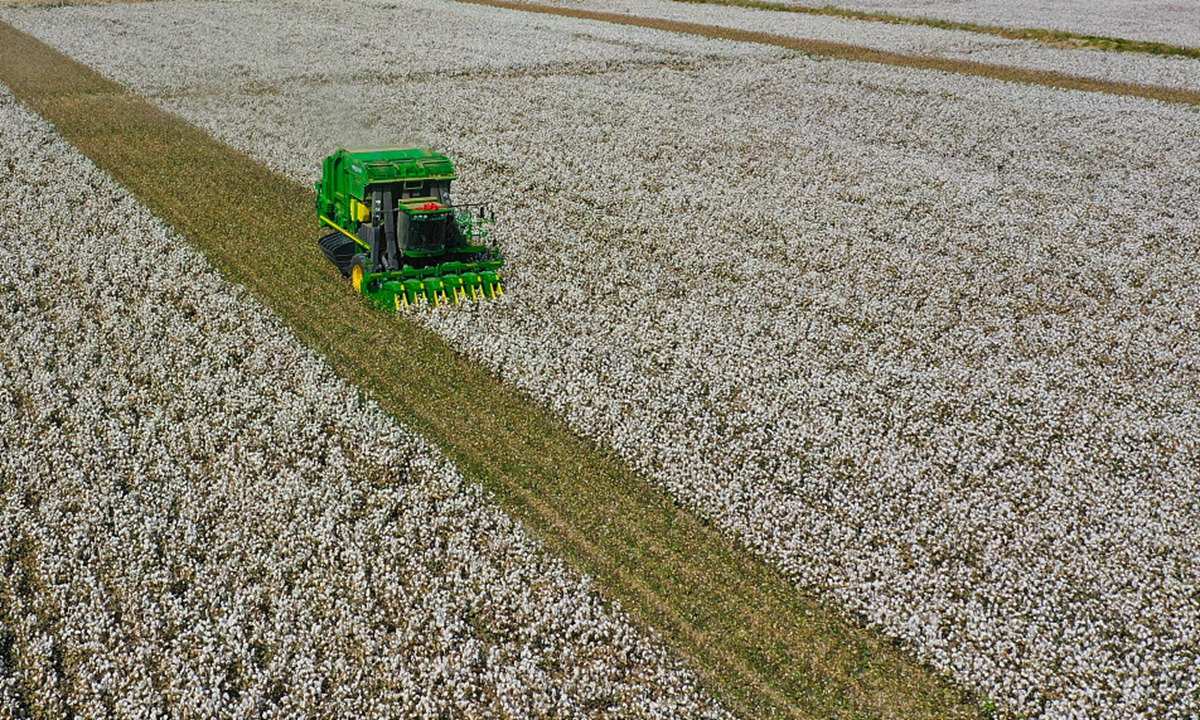
Xinjiang cotton Photo: VCG
The US Department of Homeland Security (DHS) added 43 Chinese companies, including cotton textile enterprises, to the "Entity List" under the so-called "Uyghur Forced Labor Prevention Act" (UFLPA) on Friday, a move that the China Cotton Association (CCA) said in a statement on Sunday marked the largest single expansion of the list since its establishment and seriously violated the basic principles of international trade. The Chinese cotton association expressed strong concern over and firm opposition to the US move.
According to a press release posted on the US website, effective August 3, 2026, US Customs and Border Protection will apply a rebuttable presumption that goods produced by these 43 entities are prohibited from entering the US as a result of the companies' activities.
The 43 new entities include companies in sectors including aluminum, apparel, copper, cotton, as well as tomatoes and downstream products.
In responding to the US move, the CCA said on Sunday that the US allegations of so-called "forced labor" are entirely without factual or legal basis. China's cotton industry has consistently pursued a market-oriented and modernized development path.
Today, mechanized harvesting accounts for more than 90 percent of cotton production in Northwest China's Xinjiang Uygur Autonomous Region, with the entire industry chain, from cultivation and harvesting to processing and textile manufacturing, achieving a high degree of automation and large-scale production, said the association.
Moreover, the labor rights of cotton farmers and industry workers are strictly protected under Chinese law, and employment is based entirely on free choice. There is simply no such thing as so-called "forced labor," the association said, noting that by ignoring these objective facts and applying a presumption of guilt to Chinese companies, the US is politicizing and weaponizing human rights issues in an attempt to contain the development of China's cotton and textile industry.
The US sanctions have seriously undermined the stability of the global cotton industry and supply chains. As a globally traded commodity, cotton has a highly internationalized industry chain. The US move has harmed the legitimate rights and interests of Chinese companies, the CCA said.
In the face of US suppression, China's cotton industry has the confidence and capability to meet the challenges. China has the world's most complete cotton and textile industry chain, a vast domestic consumer market, and an increasingly diversified international market presence.
The Chinese industry association called on cotton and textile enterprises across China to remain steadfast and confident, strengthen cooperation, actively expand into diversified markets, enhance supply chain resilience, and overcome external restrictions through high-quality products and irreplaceable industrial strengths.
The US move to expand the scope of the so-called Entity List is another example of its abuse of domestic legal tools and their extension into the field of international trade, He Weiwen, a senior fellow at the Center for China and Globalization, told the Global Times on Sunday.
"Such unilateral measures not only increase uncertainty for companies engaged in cross-border operations and disrupt the normal functioning of global industrial and supply chains, but may also undermine international confidence in the US commitment to openness, cooperation and fair competition," He said.
In recent years, China's cotton textile industry has strengthened its global competitiveness through digital and intelligent transformation, efficiency improvements and a more complete industrial chain. Against this backdrop, the US has repeatedly imposed trade restrictions under the pretext of "human rights" issues rather than enhancing its own industrial competitiveness, reflecting its tendency to politicize economic and trade matters, Hu Qimu, a professor at the Maritime Silk Road Institute of Huaqiao University, told the Global Times on Sunday.
A spokesperson of China's Ministry of Commerce on Saturday strongly condemned and firmly opposed the US decision to add more than 40 Chinese entities to the so-called UFLPA Entity List, saying the move is completely groundless. The US has continued to impose unilateral sanctions on Chinese companies under its domestic law under the pretext of so-called "human rights" and "forced labor," which constitutes typical acts of economic coercion, according to the spokesperson.
This is not the first time the US has used so-called "forced labor" allegations as a tool for economic pressure. Previously, the US imposed additional tariffs of 10 percent and 12.5 percent on imports from 60 trading partners, including the EU and China, claiming those countries had failed to prevent imports linked to so-called "forced labor."
China blasted fresh US tariffs imposed on China and 59 other economies over alleged "forced labor" concerns, and warned that trade wars do not serve any parties.
RELATED ARTICLES