World's largest auto show kicks off in Beijing as global players seek new tie-ups
Event highlights China open for global auto cooperation
By Yin Yeping and Published: Apr 24, 2026 11:19 PM

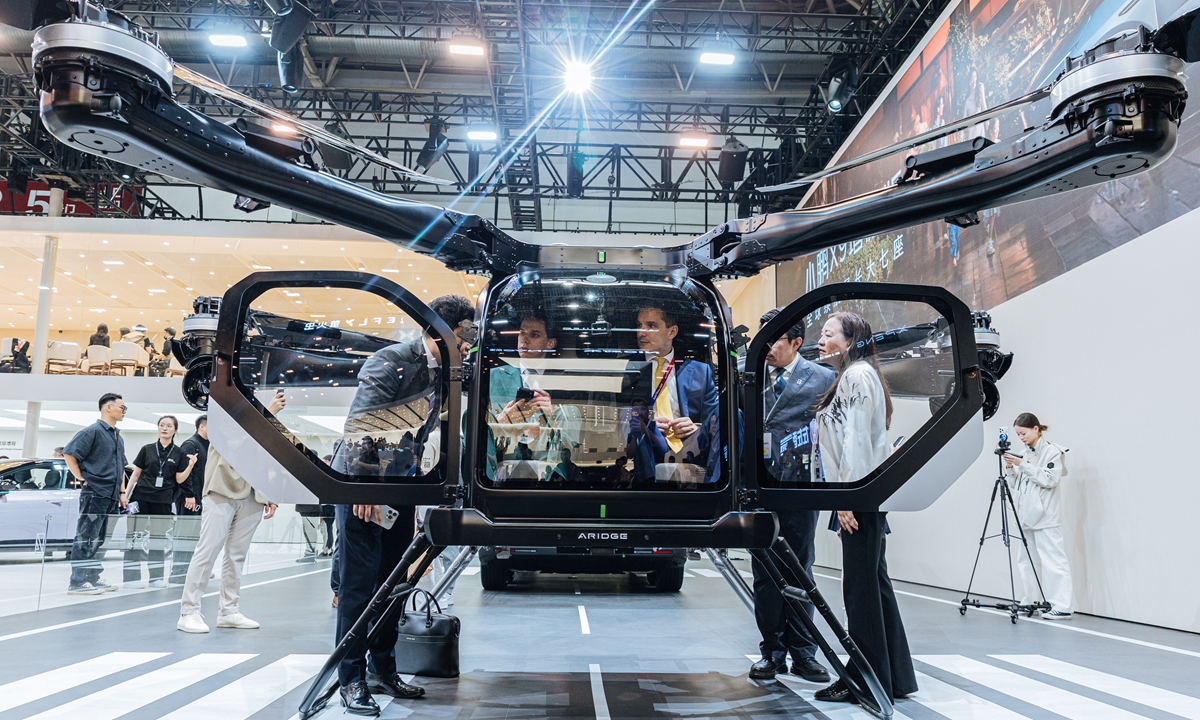
Foreign visitors try out a split-type modular flying car developed by Chinese electric vehicle maker XPENG, at the 2026 Beijing Auto Show on April 24, 2026. Photo: Li Hao/GT
At the Beijing Auto Show, which kicked off on Friday, the scene feels like a living snapshot of the global auto industry in motion. Between exhibition halls, clusters of people spill into the open space during brief pauses, with cups of coffee in hand, steamed buns in paper wrappers, and quick bites grabbed between meetings. Some foreign visitors were using chopsticks with practiced ease over bowls of noodles.The atmosphere is filled with different languages, overlapping conversations, and distant announcements from inside the halls. Spanish dealers chat in quick bursts, German engineers compare notes while scrolling through phone screens filled with schematics, and Brazilian automakers gather in animated discussion just a few steps away.
Against this backdrop, more foreign executives take the stage inside the halls delivering remarks in Chinese, while Chinese automakers bring in dealers from around the world to fill the stands. The Beijing Auto Show, in this moment, functions less like a conventional exhibition and more like a dense, constantly moving meeting point for the global automotive industry — one where China's auto sector increasingly sits at the center of attention.
The total exhibition area of the auto show reaches 380,000 square meters, bringing together nearly 1,000 automakers from 21 countries and regions. The event is expected to attract close to one million visitors, setting a new record for global auto shows and becoming the largest automotive industry gathering in the world, according to the event organizer.
The stronger presence and engagement of global companies at the Beijing Auto Show highlights China's rising importance as a center for automotive innovation and one of the world's fastest-evolving car markets, especially as the industry speeds up its transition toward electric and smart mobility technologies, Cui Dongshu, secretary-general of the China Passenger Car Association (CPCA), told the Global Times on Friday.
Window of opportunities
Many foreign respondents' first reaction during interviews was to praise the unprecedented scale of this auto show—but that is, perhaps, according to industry observers, the least important detail. What truly matters is the recognition in their words of the Chinese market's strategic importance, along with their genuine amazement at the fast-paced, ever-evolving changes in China's automotive sector toward green transformation, industry observers said.
Andreas Mindt, Head of Design at Volkswagen Brand, made a special trip from Europe—where he is usually based—to attend the Beijing Auto Show, marking his latest visit to the city.
"Everything is developing like crazy, and there are more and more electric cars. It's fantastic," he told the Global Times on Friday at noon, sandwich in hand.
He noted that the Beijing Auto Show is arguably the world's largest, surpassing Munich in scale, with more participants, global premieres, and new car launches, alongside rapid progress in EVs, battery technology, and self-driving systems.
Mindt's view was echoed by Javier Galilea, PR Manager from Changan Spain, who led a group of Spanish journalists to visit the auto show in Beijing from Madrid.
"In comparison with other European events like this one, I think it's more exotic. It's very impressive to see so many different brands and different cars on display," he said. He added that Chinese companies are already advanced in terms of technology.
With China's automotive market continuing to serve as a key arena for global competition and cooperation, international automakers are increasingly using major auto shows as a platform to showcase new products and long-term strategies.
Mainstream multinational automakers such as Mercedes-Benz, Audi, BMW, Volkswagen and other international giants are all in attendance at the auto show, the Global Times observed.
Official data shows that a total of 1,451 vehicles will be exhibited at this year's auto show, including 181 globally premiering models (up from 117 in 2024) and 71 concept cars. Both the density of new models and the intensity of concept car displays are higher than those of the previous show.
"Volkswagen Group has been part of Auto China since 1990, and no other international automotive player has such a great history like we have in China," Oliver Blume, chief executive officer of Volkswagen Group, said at the media night on Tuesday.
"China is like a fitness center for the automotive industry. We saw it, we embraced it and we changed ourselves," Blume said.
Four models from the Volkswagen, Jetta, and AUDI brands made their global debut on the night, and they are included in the new models unveiled at the auto show. The group plans to launch over 20 new energy vehicle (NEV) models in China, with approximately 30 by 2027 and around 50 by 2030—including about 30 all-electric vehicles.
A similar emphasis on both electrification and intelligent technologies can be seen in Mercedes-Benz, which is presenting nearly 40 models covering fuel-powered and electric vehicles, as well as mainstream luxury and high-end custom offerings.
"China has always been the strategic center of our global market. 'In China, for China' is the core engine driving Mercedes-Benz's continuous innovation and our firm commitment to the Chinese market," Ola Källenius, chairman of the Board of Management of Mercedes-Benz Group AG said in a release sent to the Global Times on Friday.
The German car players are not alone. "There is no doubt that we should be here," Anna Matsegora from Yandex Ads, a global technology company based in Russia, told the Global Times on Friday. "This is the top priority industry fair. We start preparing for it long before it begins—sometimes several months in advance. We know that everyone who works in this industry feels the same."
"If they have serious plans like we do, they have to be here," she added. "We want to be noticed, especially by Chinese companies looking to enter Russia. That's why we're here."
The auto show has also been widely covered by world media outlets. AP reported that China's top automakers are showcasing their latest models and technologies from intelligent driving to ultrafast charging in Beijing as they compete with global rivals in overseas markets.
Reuters reported that now, the country's auto industry is hurtling toward the next disruption: Embedding artificial intelligence in cars that will make the next generation of EVs not just network-connected, but self-reasoning machines running on Chinese chips and software.
In line with trends
Global automakers are showing a deeper level of engagement at the Beijing Auto Show, a trend Cui said reflects how China has moved beyond being just a major sales market to becoming a key hub for innovation, testing, and competition across new ideas, products, and business models.
Amid the industry's broader electrification and intelligent shift, the strong momentum at the show reflects how foreign companies are actively engaging and "voting with their feet" to pursue cooperation with Chinese partners. This growing engagement also offers a clear counterpoint to narratives around alleged "overcapacity" in China's NEV sector, the expert said.
More and more domestic and overseas car brands are putting more investment into electrification, a move that clearly demonstrates there is no such thing as "overcapacity" because the market demand is huge and expanding, the industry expert said.
According to estimates by the International Energy Agency (IEA), by 2030, the global shortfall in NEVs is expected to reach 27 million units.
Against the backdrop of rising demand for EVs, in January, Canada announced it would grant China an annual quota of 49,000 EVs. Vehicles within this quota will enjoy the most-favored-nation tariff rate of 6.1 percent and be exempted from the 100 percent additional tariff, the Xinhua News Agency reported.
China's development of EVs is not only driving its own green transition, but also creating important opportunities for global cooperation on decarbonization, as it actively integrates into global industrial, innovation, and value chains and calls for stronger international collaboration to safeguard the stability of global supply chains, said Cui.
When asked what is the main attraction of the Chinese market for foreign players, Blume from Volkswagen Group told the Global Times that it is the market size, innovation, speed, and the potential coming out from China to explore other market opportunities.
"We now have a unique role: being successful in China, being successful in the western world. Combining these strengths brings us to a win-win situation," he said.
RELATED ARTICLES