Exclusive: African space initiative eyes participation in China’s Chang’e-8 lunar mission, embraces openness and inclusiveness: African program manager
By Published: Aug 02, 2026 05:16 PM

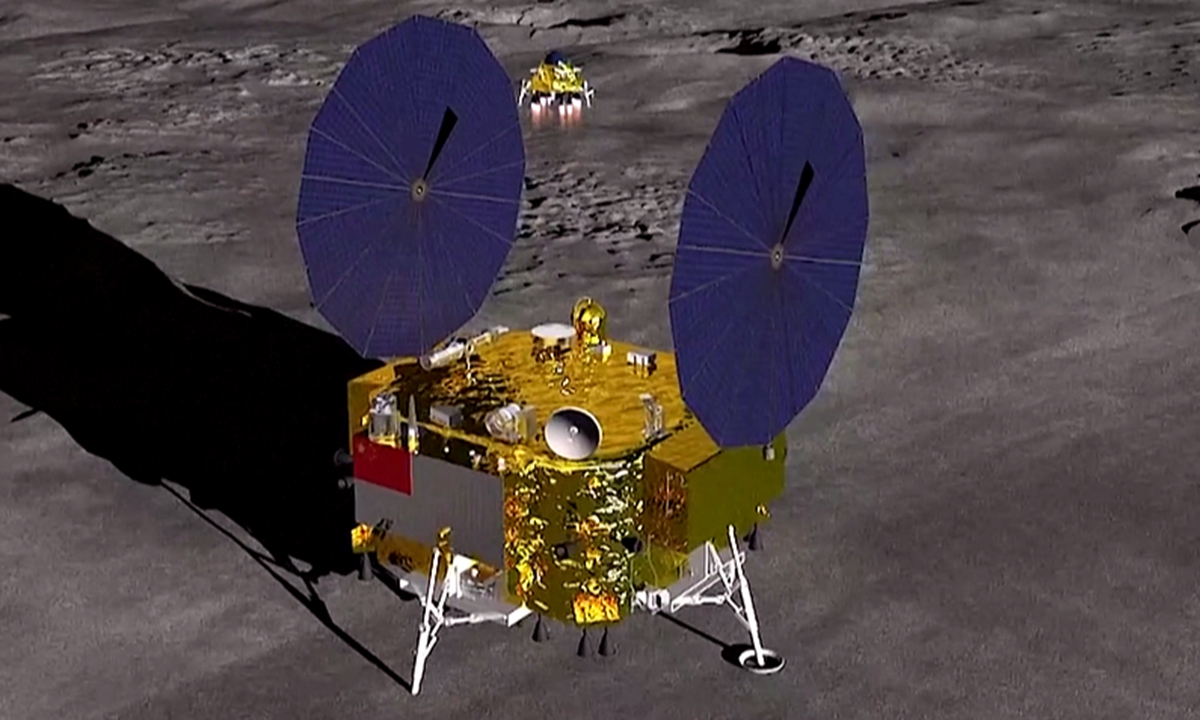
CGI of Chang'e-8 mission released by the China National Space Administration Photo: VCG
Africa is seeking to move from being a participant in space science discussions to becoming an active contributor to humanity's exploration of the Moon and deep space, with the "Africa2Moon" initiative representing a new chapter in the continent's space ambitions, Carla Mitchell, mission director of the Africa2Moon initiative and Africa Program manager at the South African Radio Astronomy Observatory (SARAO), told the Global Times in a recent exclusive interview.
The Africa2Moon program is more than a single scientific mission. It represents Africa's long-term ambition to participate meaningfully in global space exploration by developing engineering capabilities, strengthening scientific collaboration and inspiring a new generation of African scientists and engineers, said Mitchell.
At the center of the initiative, which aims to deploy low-frequency radio astronomy antennas, the Bounced African Low Lunar Sphere (BALLS), on the lunar
surface as part of future lunar exploration missions, including potential participation in China's Chang'e-8 lunar exploration mission.
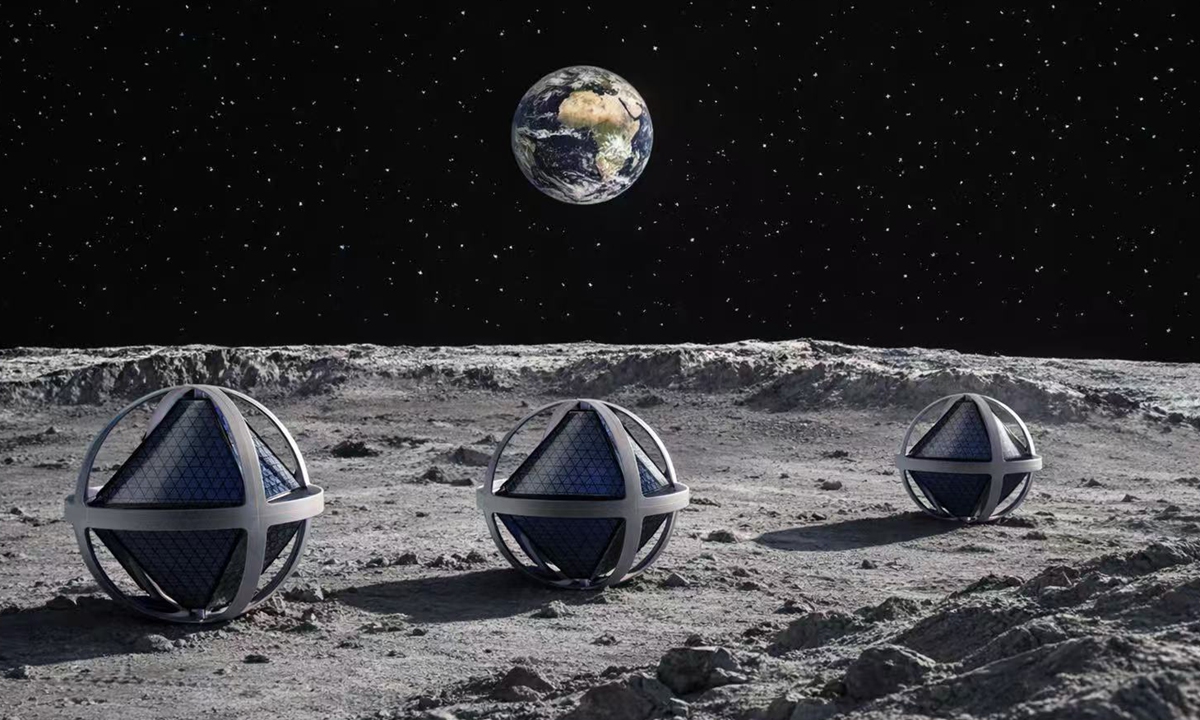
An illustration of the Bounced African Low Lunar Sphere (BALLS), on the lunar surface Photo: Courtesy of Carla Mitchell
The Chang'e-8 mission, which is scheduled for launch around 2029, will carry payloads from 11 countries and regions and one international organization. Developers of the instruments set to be aboard Chang'e-8 are from Asia, Europe, Africa and South America, according to the Xinhua News Agency.
The project demonstrates that Africa can contribute to global space exploration through innovation and technology development rather than simply observing from the sidelines, Mitchell said.
The BALLS instruments are designed to conduct radio astronomy research that cannot be effectively carried out on Earth. The Moon provides a uniquely quiet radio environment, particularly on its far side, where natural shielding from Earth's radio interference creates opportunities to study extremely low-frequency signals from the Universe.
"Beyond its scientific objectives, BALLS also serves as a catalyst for engineering development, international collaboration and STEM education throughout Africa," she said.
According to Mitchell, every stage of the program, from instrument design and testing to future operations, creates opportunities to develop African scientists, engineers and students, while building technological capabilities that extend beyond the lunar mission itself.
A milestone for Africa
Participation in China's Chang'e-8 lunar exploration mission would represent a historic milestone for Africa, according to Mitchell. "For the first time, African institutions would contribute their own scientific instrument to a lunar exploration mission, rather than participating only through Earth-based research collaborations."
Such participation would demonstrate that African institutions are capable of developing technologies that can operate in one of the most demanding engineering environments imaginable. "The significance goes far beyond the lunar surface," the scientist said.
The project could strengthen engineering capabilities, develop highly skilled talent, create opportunities for universities and industries, and build confidence that Africa can become an active contributor and potentially a leader in the global space economy.
For China and Africa, the collaboration also demonstrates how international partnerships can combine complementary strengths to advance scientific exploration for the benefit of humanity as a whole, she noted.
The BALLS project has already made significant progress, with key engineering milestones achieved, per Mitchell.
The structural engineering model has been completed, and the project has entered the qualification testing phase. Development of the electronics has also progressed well, with electromagnetic compatibility testing and extended burn-in testing completed.
"These engineering milestones provide confidence as we move toward the qualification and flight model phases," Mitchell said.
According to Mitchell, as humanity enters a new era of lunar and deep-space exploration, the Moon is becoming much more than a destination. It is emerging as a scientific laboratory, a testing ground for advanced technologies and a potential stepping stone toward deeper exploration of the Solar System.
She also praised China's achievements in lunar exploration, saying that the Chang'e program has demonstrated consistent technological capabilities through orbital missions, soft landings, sample return missions and continued development toward more advanced exploration. "Over the past two decades, China has established itself as one of the world's leading spacefaring nations through its sustained progress in lunar exploration."
Mitchell believed that looking ahead, international efforts led by China, the US and other space agencies are moving toward sustained lunar exploration, greater scientific cooperation and eventually a long-term human presence beyond Earth. "These developments will create new opportunities for astronomy, planetary science and international collaboration."
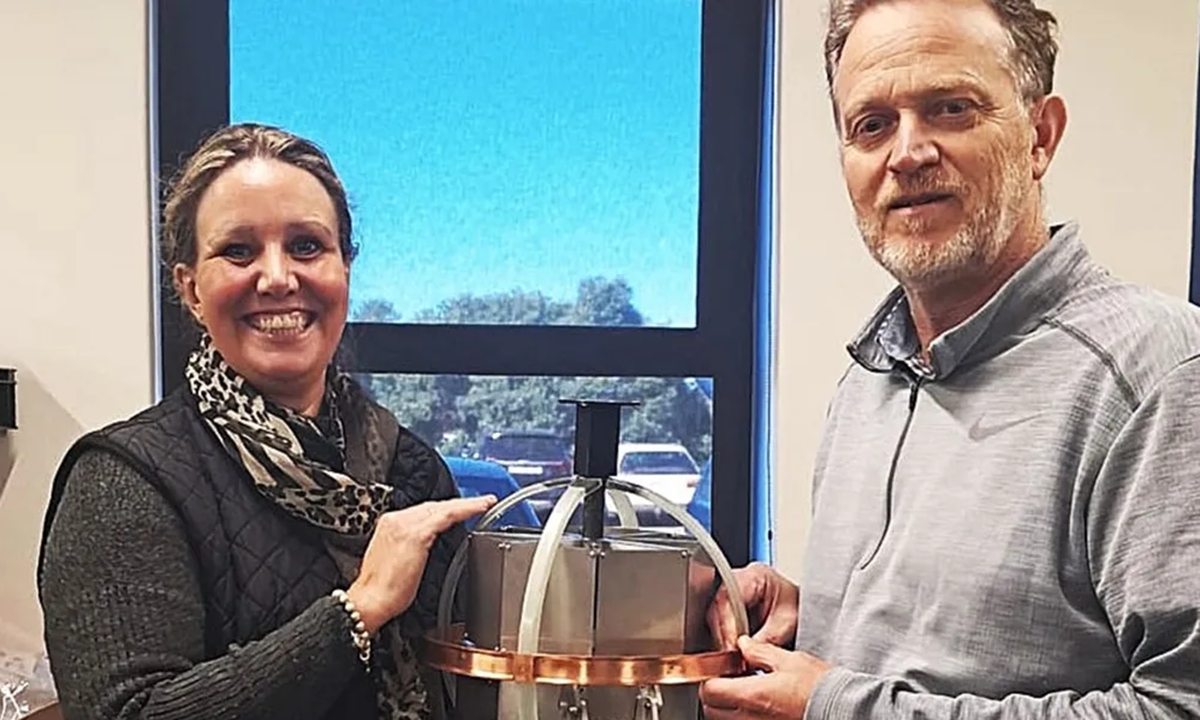
Carla Mitchell (left), mission director for Africa's Bounced African Low Lunar Sphere, and Japie Ludick, South African Radio Astronomy Observatory engineer, with one of the BALLS spheres that underwent testing. Photo: Courtesy of Africa2Moon
Openness and inclusiveness are essential
The scientist also emphasized that the success of Africa2Moon is closely linked to principles of collaboration, openness, shared ideas, clear vision and socioeconomic impact.
"Africa2Moon is designed to demonstrate a new way for humanity to collaborate as one in space exploration," the mission director said.
Openness and inclusiveness are essential principles for international space cooperation, and many scientific questions facing humanity are beyond the capability of any single nation, institution or organization, according to the scientist.
Openness encourages the sharing of knowledge, while inclusiveness allows countries with different experiences, capabilities and perspectives to contribute meaningful ideas and technologies.
For Africa, inclusive partnerships are particularly important because they provide opportunities to develop scientific capabilities while contributing original innovations.
"Collaboration should never be viewed as one country helping another. Rather, it should be viewed as multiple nations combining their strengths to achieve objectives that none could accomplish alone," the mission director said.
Science is ultimately a shared human endeavor, and discoveries made through international cooperation belong to humanity as a whole. The scientist added that the greatest legacy of Africa2Moon may not simply be a successful scientific experiment on the Moon.
Its deeper impact could come from inspiring a generation of African scientists, engineers and innovators who see themselves as participants in humanity's exploration of space rather than spectators, Mitchell noted.
The most important discoveries made through Africa2Moon may ultimately happen on Earth - in classrooms, universities, laboratories and industries - as young people are inspired to pursue careers in science, engineering and technology. "As we often say within Africa2Moon: 'Our mission is not simply to reach the Moon; it is to ensure that every young African believes they have a place in humanity's future among the stars,'" she said.
RELATED ARTICLES