COMMENTS / EXPERT ASSESSMENT
Will renewable energy open a new lane for China-S.Korea industrial co-op?
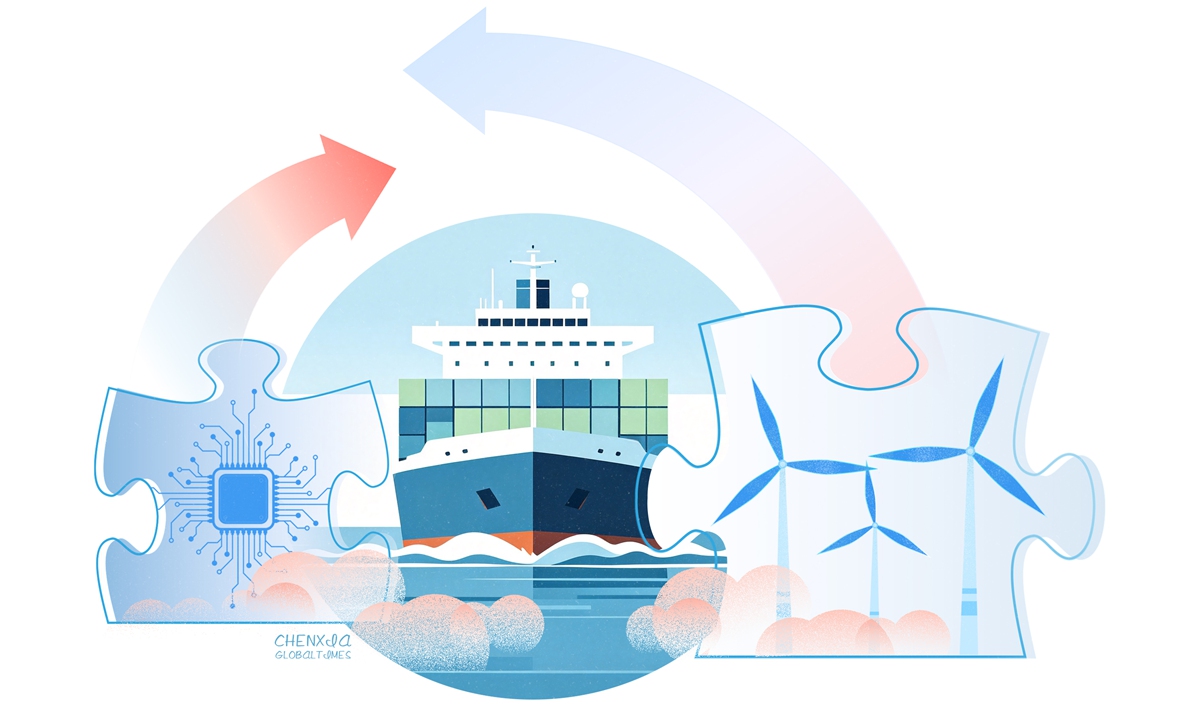
Illustration: Chen Xia/GT
South Korean exports grew faster than expected in July, supported by global demand for semiconductors and computers used in artificial intelligence (AI) infrastructure, and China has always been an important market for South Korea.
According to the Yonhap News Agency, South Korea's exports to China expanded by 96.2 percent year-on-year to hit $21.68 billion in July, exceeding $20 billion for the second consecutive month. The pace of growth highlights the resilience of China-South Korea trade and the potential for further growth in bilateral commerce.
Semiconductors have been a notable part of this growth. According to the Chosun Daily, South Korea's semiconductors export rose by 180.6 percent year-on-year to reach $22.1 billion from July 1-20, accounting for 40.3 percent of the country's total exports during the period. The increase reflects the continued spike of global semiconductor demand, with China being a major market.
The export figures point to South Korea's steadfast efforts to move further up the semiconductor value chain. In June, the country unveiled a blueprint for three flagship "megaprojects" covering semiconductors, AI data centers and physical AI in a bid to solidify the foundations of its economic growth.
Nevertheless, the expansion of these advanced industries places a less visible constraint in the spotlight: shortage of electricity.
Some experts have warned that rising power demand from data centers and semiconductor fabs could become a challenge for South Korea as the country expands its AI-related industries. These facilities are largely energy-intensive, and faster electrification will certainly add to electricity demand.
Growing power demand has become a major challenge for economies seeking to expand their AI industries, with South Korea facing potentially greater pressure.
The Chosun Daily reported in 2025 that government energy authorities projected South Korea's electricity demand to rise from an estimated 106 gigawatts in 2025 to 145.6 gigawatts in 2038, marking an increase of 37.4 percent, as data centers, semiconductor clusters and electric vehicle adoption gain pace.
This leaves South Korea with a broader challenge: how to secure enough electricity to support AI development. Nuclear power and renewable energy sources, including solar power and offshore wind, could be among the options for South Korea.
Against this backdrop, international cooperation could become one feasible approach to address the challenges of renewable energy deployment. China's rich experience in this sector is of great help. After years of expansion, China has accumulated massive experiences in large-scale renewable energy deployment, including the integration of projects across diverse geographic conditions and varying energy needs. Such cooperation could provide useful experience for South Korea as it explores ways to improve the efficiency of renewable energy development.
Green and renewable energies hold good potential as a new area of growth in China-South Korea trade, driven by South Korea's genuine need for energy. The massive energy cooperation potential will certainly create new opportunities for businesses on both sides and support South Korea's industrial development. Yet realizing this potential will depend on the openness of markets and whether companies on both sides can find commercially viable solutions.
Even so, new opportunities are emerging. From South Korea's semiconductor exports to its growing demand for renewable energy, the links between China and South Korea extend across a broader industrial chain.
If South Korea's semiconductor sector receives stronger energy support, the benefits could extend beyond more exports to China, as its exports to other economies will increase too. This dynamic allows imports and exports to reinforce each other, creating new sources of growth across the whole supply chain.
This is only one example of the greater opportunities that exist within China-South Korea industrial links. Technological progress may intensify competition in some areas, but the link between semiconductors and renewable energy shows that competition and complementarity can coexist and benefit both countries. It's time to move on.
The author is a reporter with the Global Times. bizopinion@globaltimes.com.cn
RELATED ARTICLES