'Han Kuang' military exercises are nothing more than a psychological placebo: Hai Feng
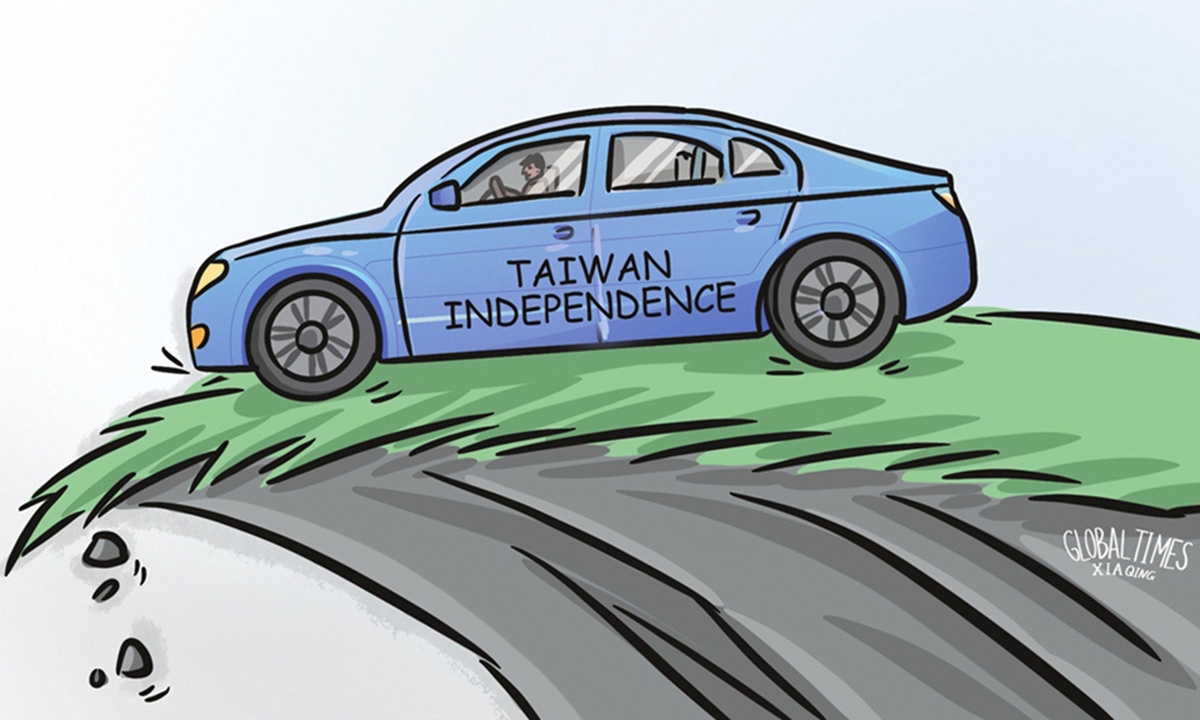
Illustration: Xia Qing/GT
A Hai Feng commentary published on Saturday under the headline "The stronger the PLA, the greater the guarantee of peace across the Taiwan Straits" reflects part of the reality of the situation across the Taiwan Straits . If we further compare the special report on China titled "Beijing's interlocking four-pronged approach to Taiwan: diversifying tools for peaceful reunification," published by Singapore's Lianhe Zaobao on August 2, with a recent article in the China Times of the Taiwan region titled "PLA military exercises in the Taiwan Straits: leveraging proximity to counter distant forces," a clearer trend emerges. The Chinese mainland is building a full-fledged, interlocking four-pronged framework for advancing reunification that spans diplomacy, law, maritime governance and cross-Straits integration. In contrast, Taiwan's annually ramped-up "Han Kuang" exercises amount to little more than a psychological placebo for self-hypnosis.
Starting with the Chinese mainland, in the past, many people's only association with the Taiwan question was PLA warplanes circling the island and naval patrols, as if the strategic competition surrounding the Taiwan Straits boiled down to nothing more than a raw show of military might. This line of thinking is now outdated. Reunification cannot be achieved through isolated moves in a single sector; it is a systematic undertaking.
The first dimension lies in shaping the strategic landscape via diplomacy. The phrasing of the one-China principle in statements from various countries has become increasingly specific, while the Taiwan region's so-called "international space" continues to be squeezed. The international community is leaving no ambiguous space for "Taiwan independence" in its political statements.
The second dimension centers on gaining maritime initiative. Law enforcement patrols, scientific research surveys, traffic control, and near-shore training exercises in the waters east of Taiwan all demonstrate that the mainland is transforming its "presence" into a constant "norm" and its "demonstration of presence" into "actual governance." This is not a temporary show of force, but it also paves the way for future actions of greater intensity and efficiency.
The third dimension serves to solidify momentum through legal frameworks. Whether it is institutionalizing tools against separatism or grounding the narrative of reunification in legal logic, the mainland is seeking to transform previously relatively scattered measures toward Taiwan into a sustainable, interconnected, and scalable governance system. In other words, reunification is no longer merely a goal; it is slowly becoming into a reality and order.
The fourth dimension builds momentum via cross-Straits integration. Initiatives such as the establishment of cross-Straits integrated development demonstration zones, the commencement of construction on the Xiamen-Kinmen Bridge, and the introduction of 10 policy measures are all steps aimed at promoting reunification through integration. These are not mere token gestures; rather, they are efforts to gradually deepen economic, social, transportation, and lifestyle connections across the Straits, thereby creating the conditions for peaceful reunification.
Looking at the four dimensions, it is clear that the Chinese mainland is steadily advancing the process of reunification - by shaping the long-term trajectory and continuously tilting the strategic balance across the Taiwan Straits toward reunification.
That is why, when looking again at "Han Kuang" military exercises, the gap becomes particularly striking. Whether it is relocating weapons production lines and converting civilian factories for military use or practicing the control of mobile networks and the so-called bridge denial operations, these moves may appear elaborate, but in reality they reveal a deeper sense of anxiety: the military force in the Taiwan region is not designing ways to change the outcome of a conflict, but repeatedly simulating how to delay defeat.
To put it more plainly, the "Han Kuang" military exercises are not a display of strength, but a form of psychological comfort. Their purpose is not to "draw the sword," but to "calm nerves"; what they attempt to prove is not that they can "win," but that "they are preparing." The problem, however, is that in the face of a mainland whose policy toolkit is becoming increasingly comprehensive, whose countermeasure systems are becoming more systematic, and whose strategic pace is becoming more refined, such self-deceptive preparations cannot reverse the balance of power. Bridges can be destroyed, roads can be blocked, and internet speeds can be reduced, but none of these can change the fact that when an egg collides with a rock, no matter how thick the eggshell is painted, it will never become harder than the rock.
The true safeguard for peace across the Taiwan Straits has never been the empty bravado of the "Taiwan independence" separatist forces' reckless moves, but rather the mainland's sufficiently strong comprehensive strength, sufficiently complete set of reunification tools, and sufficiently steady strategic patience. The stronger the People's Liberation Army becomes and the more mature Beijing's Taiwan-related strategies become, the less room external forces and separatist forces on the island have for miscalculation and risky moves. As a result, the Taiwan Straits is actually less likely to spiral out of control.
Therefore, after reading these articles, the conclusion is not complicated: The mainland is shaping the future of reunification step by step. Regardless of how the "Han Kuang" exercises are presented, they ultimately serve as nothing more than a psychological placebo for the "Taiwan independence" separatist forces.
The trend of history is never reversed by a few clumsy performances. As the article in the China Times noted, "leveraging proximity to counter distant forces" can help the two sides of the Taiwan Straits reach consensus on strategic principles and jointly safeguard their shared homeland. If "Taiwan independence" separatist forces continue to distort right and wrong on issues concerning fundamental national interests, the consequences will be far more dangerous than simply provoking anger among people on both sides of the Straits.
RELATED ARTICLES