Xinjiang region’s first robotics 9S center aims to accelerate AI applications, tap into Central Asian market: project operator
By Published: Aug 03, 2026 05:56 PM

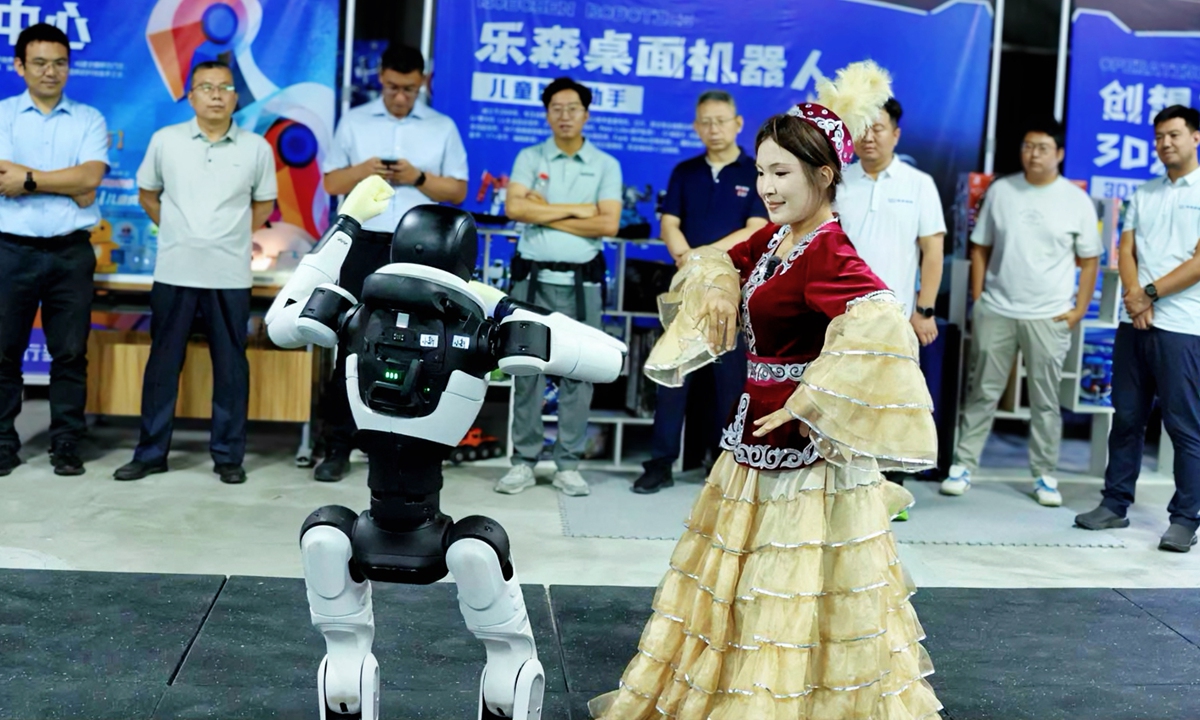
A Xinjiang local resident dances with a robot at the temporary exhibition hall at the region's first robotics 9S center on July 31, 2026. Photo: courtesy of the Xinjiang Future Era Information Technology Co, the operator of the project
The first robotics 9S center in Northwest China's Xinjiang Uygur Autonomous Region - a new platform integrating robot exhibition, sales, leasing, customized development, maintenance, science education and industrial empowerment - is under construction in Urumqi Economic and Technological Development Zone, with the project expected to officially begin operation by the end of August, the project operator told the Global Times on Monday.
The center, invested with 30 million yuan ($4.2 million), aims to build a comprehensive robotics ecosystem covering robot display, commercial applications, talent training, supply chain services and technology empowerment, according to Sun Xiukun, chairman of Xinjiang Future Era Information Technology Co, the operator of the project.
According to Sun, the "9S" are scenario (display), sales, subscription, (tailored) solution, support, showcase, success (of incubation), science (education) and skill (training).
The project will be developed in two phases. The first phase, covering about 1,400 square meters, focuses on creating an integrated platform featuring eight major business models, including robot exhibitions, experience services, education programs, retail, leasing and certification services, Sun said.
The second phase, scheduled for the second half of 2027, will expand the center by an additional 1,600 square meters and introduce more functions, including an incubator for robot-related enterprises operating in Xinjiang region, as well as secondary research and development targeting local industries such as energy, agriculture and tourism.
"The goal is not only to showcase robots, but also to promote their transition from demonstrations to real-world applications," Sun said.
The first phase of construction has already started on July 4. A temporary exhibition hall has already opened to visitors, while the official exhibition center is expected to start operation in late August.
Preparations are currently focusing on introducing eight to nine advanced humanoid robots and more than 20 categories of robots, and creating dynamic interactive scenarios involving robot dancing, robotic dogs and robot football. The center will also develop science education programs, a "science theater," robot retail services, unmanned coffee shops and robot competition events, according to Sun.
The project will be supported by a strong industrial ecosystem. Sun said the center has already established cooperation with 25 leading Chinese robotic companies and institutions, including humanoid robot developer UBTECH Robotics, quadruped robot maker DEEP Robotics, China Mobile and robot leasing platform Qingtian Rental. The resources will help ensure robot supply, after-sales services, leasing capacity and technology development, he said.
The center will also leverage the resources of the Shenzhen Electronics Chamber of Commerce, which has more than 2,600 member companies, as well as Qingtian Rental's more than 4,000 available robots and China Mobile's full-chain technology capabilities.
Beyond exhibition and commercial services, the center aims to become an industrial application hub focusing on four key scenarios: industrial manufacturing - smart manufacturing, equipment assembly and logistics operations, as well as power network inspection, smart agriculture and tourism guidance.
The center also plans to explore applications including precision assembly and heavy-load handling for energy equipment manufacturing, as well as inspection and data collection in oilfields and mining areas.
The center will also support the digital transformation of local manufacturing enterprises by providing intelligent production line upgrade solutions.
In an acritical published by the Xinjiang regional government on June 3, the region vowed that as the core area of the Silk Road Economic Belt, Xinjiang, leveraging its geographical and opening-up advantages, will certainly become an important hub for Chinese intelligent robots to enter the markets of Central Asia and Europe.
Given Xinjiang region's geographical advantages and role as a gateway connecting China with Central Asia, the center, according to Sun, is expected to serve as a regional exhibition, trading and service platform for Chinese robotics companies seeking overseas expansion.
Sun said the center will rely on Xinjiang's free trade pilot zone policies and industrial advantages to build a service network targeting Central Asian markets and promote Chinese intelligent equipment exports along the "Digital Silk Road."
RELATED ARTICLES