China revises IC layout-design protection rules to spur innovation, align with global standards
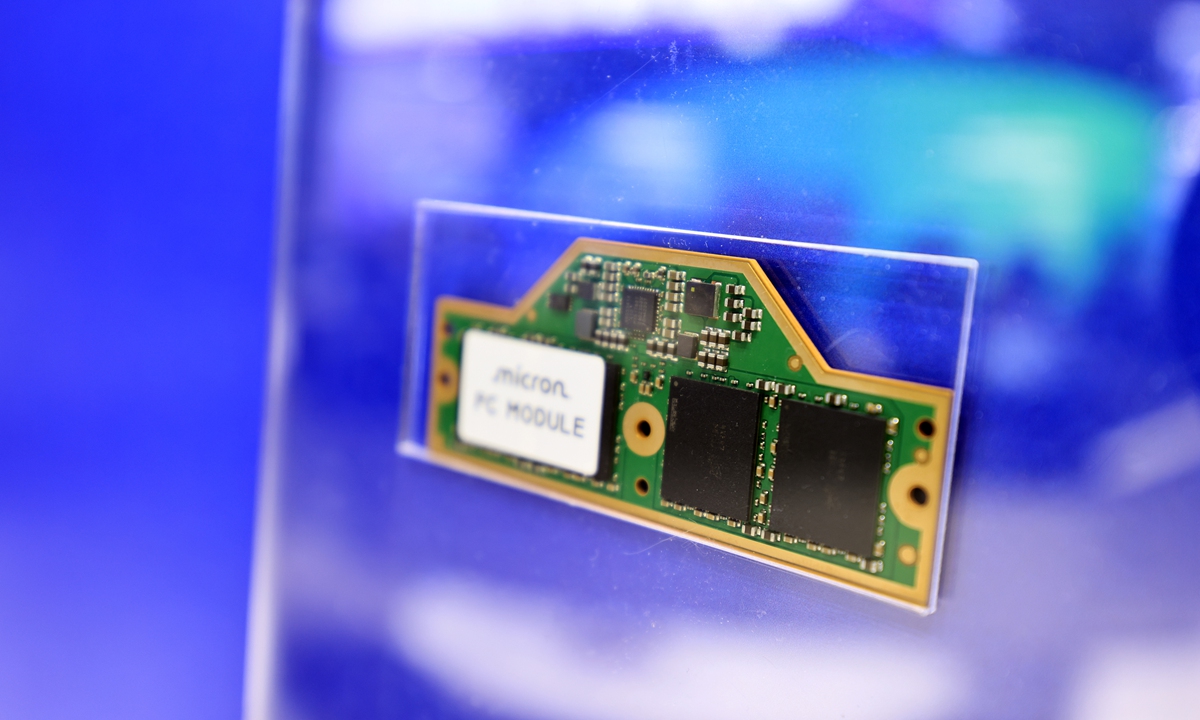
A close-up view of an integrated circuit chip Photo: VCG
China on Monday unveiled revised regulations on the protection of integrated circuit (IC) layout-designs, which will take effect on October 15, 2026, according to the Xinhua News Agency.
Comprising 54 articles across six chapters, the regulations aim to protect exclusive rights to IC layout-designs, encourage technological innovation in the sector and promote scientific and technological development.
The revision comes as China is stepping up efforts to strengthen its semiconductor industry, expand domestic innovation capacity and improve intellectual property (IP) protection in emerging technologies. Industry experts said that it signifies an important institutional upgrade to adapt the country's IP framework to the development of very-large-scale ICs, safeguard companies' research and development (R&D) investment and spur further technological innovation.
The regulations require protection efforts to follow the nation's IP strategy, broaden the scope of protection and uphold the principle of good faith. They also aim to improve application and examination procedures by curbing fraudulent filings, specifying documentation requirements, refining rejection and revocation procedures, and introducing a mechanism for the restoration of rights, according to Xinhua.
During a question-and-answer session on the revision of the rules, officials from the Ministry of Justice and China's National Intellectual Property Administration said on Monday that China attaches great importance to IP protection in emerging fields. The current regulations, introduced in 2001, have played a positive role in safeguarding exclusive rights to IC layout-designs and encouraging technological innovation in the sector. However, with the rapid development of IC technologies and the industry, it has become necessary to revise the regulations to better meet practical needs.
The revision focuses on addressing pressing issues by improving the registration, protection and administration of IC layout-designs, codifying proven practices into administrative regulations, and ensuring alignment with relevant laws, regulations and international treaties, they said.
Ma Jihua, a veteran technology industry analyst, told the Global Times on Monday that IC layout-designs have long fallen into a gray area between patent and copyright protection, with loosely defined rights, difficulties in collecting infringement evidence, low compensation, and inadequate safeguards for researchers' returns from commercialization. The revised regulations mark a significant step toward closing those gaps.
As China's semiconductor industry advances and its chip design capabilities move closer to the global forefront, stronger protection has become increasingly important, Ma said. The revision will help safeguard Chinese chipmakers' IP and R&D investment, while providing a stronger legal basis for handling a likely rise in cross-border disputes as trade expands, he added.
Notably, the development of China's semiconductor industry has taken place amid intensifying global competition and growing challenges to technology supply chains from trade protectionism.
In recent years, some countries, including the US, have tightened restrictions on semiconductor exports and technology cooperation with China, making stronger domestic innovation capabilities increasingly important, Chinese experts noted. By contrast, China's IP protections apply equally to domestic and foreign developers, underscoring its commitment to an open and non-discriminatory market environment.
At the start of the 15th Five-Year Plan (2026-30) period, China is continuing to strengthen technological capabilities and innovation capacity through policy guidance and institutional support, as the semiconductor industry moves toward higher-quality development.
The regulatory update comes amid sustained growth in China's electronic information manufacturing sector.
Data from the Ministry of Industry and Information Technology (MIIT) showed that China's IC exports rose 88.7 percent year-on-year in the first half of the year.
The MIIT data also showed that China's electronic information manufacturing sector recorded rapid production growth and maintained sound overall momentum in 2025. The value-added of major enterprises in the sector rose 10.6 percent year-on-year, 4.7 percentage points faster than overall industrial growth and 1.2 percentage points higher than growth in high-tech manufacturing.
China produced 484.3 billion ICs in 2025, up 10.9 percent year-on-year.
With China's IC production capacity continuing to expand, Ma said that compensation and the commercialization of research outcomes remain difficult issues, as the value and impact of chip design contributions are often hard to quantify. These areas are likely to remain a priority for future policy improvements.
Ma noted that IC technologies are advancing rapidly while the industry's international division of labor is becoming increasingly specialized. No single set of regulations can address every issue, making continued refinement through practice essential.
RELATED ARTICLES