ARTS / CULTURE & LEISURE
World’s deepest, largest whale necropolis discovered, as Chinese deep-sea tech unlocks 5.3 million years of cetacean history
Chinese deep-sea tech unlocks 5.3 million years of cetacean history
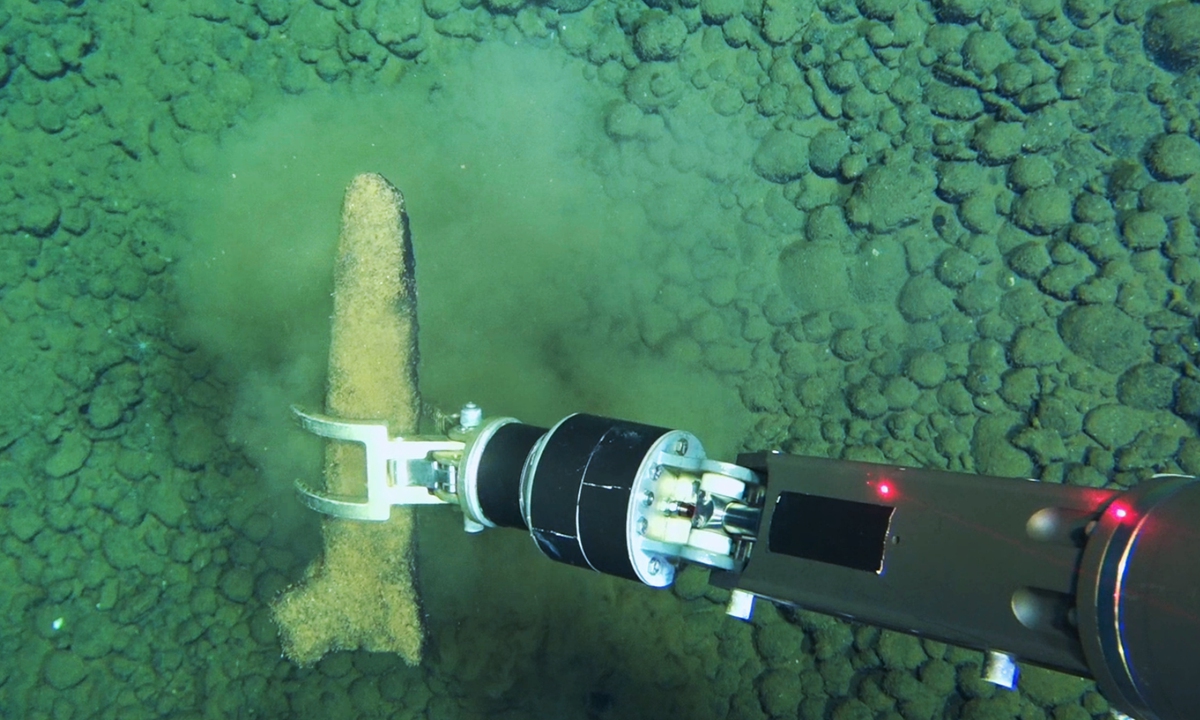
Recovery of whale fossil bones using the manipulator arm of the Chinese submersible Fendouzhe on the deep seafloor of the Diamantina Zone. Photo: Courtesy of Global TREnD, IDSSE
Nearly 6,800 meters beneath the surface of the southeastern Indian Ocean, numerous whale remains lie scattered across the seafloor, part of a vast underwater graveyard stretching some 1,200 kilometers across the Diamantina zone. More than 10 million whale remains may have accumulated there over millions of years.The discovery was made possible by China's advanced deep-sea exploration capabilities. Using the Chinese research vessel Tansuoyihao and the Fendouzhe manned submersible, scientists from the Institute of Deep-sea Science and Engineering (IDSSE) under the Chinese Academy of Sciences and their international collaborators documented 476 cetacean fossils and five active whale-fall communities across the zone.
The findings, published recently in the international journal Nature in a study titled "A 5.3-million-year-old deep-sea whale necropolis in the Diamantina Zone," found that whale falls have existed in the region for at least 5.3 million years.
A whale fall occurs when the carcass of a whale sinks to the seafloor, creating a concentrated source of organic matter and nutrients for deep-sea organisms.
Often described as "oases of life in the deep sea," whale falls can support highly specialized communities on the deep-sea floor. As the carcass decomposes, different parts of the whale support successive communities of organisms, creating a highly specialized ecosystem on the seafloor.
The expedition that led to the findings took place in 2023. During the expedition's third dive, the team spotted whale fossils at nearly 7,002 meters. The remains were partially buried in soft sediment and covered with dark iron-manganese oxides.
"We collected all whale bones and fossils using the Fendouzhe submersible's robotic arms," Zhou Peng, a co-author of the study, told the Global Times.
"Crucially, Fendouzhe is currently the world's most capable full-ocean-depth manned submersible in terms of scientific research," Zhou noted. Many co-authors were able to observe sites firsthand and make real-time decisions about which specimens to collect, an advantage particularly important for identifying and selectively sampling fragile fossils in extreme environments.
"The manned submersible Fendouzhe has created unprecedented research opportunities and is essential to the study's major breakthroughs," Zhou said.
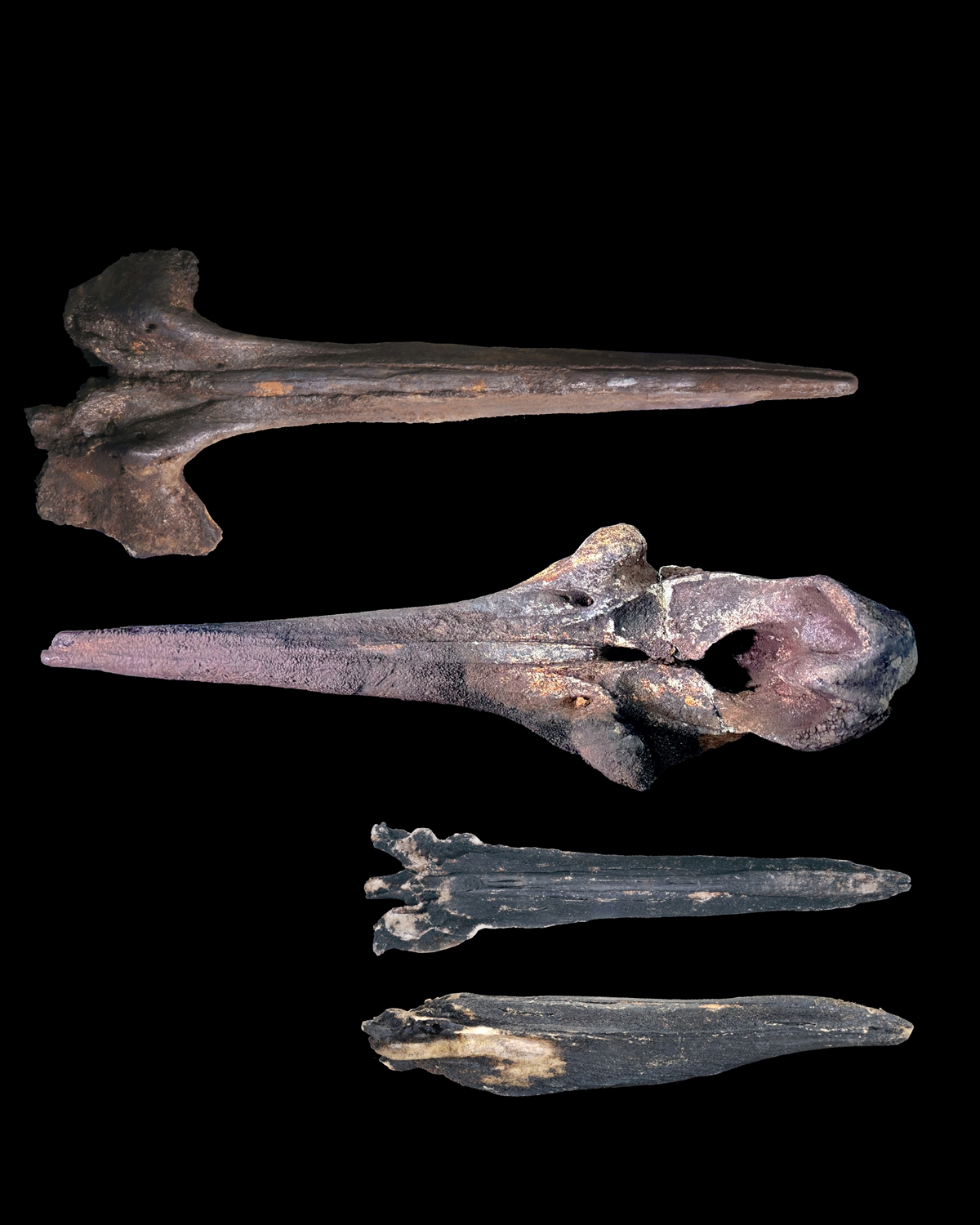
Fossil skulls of three beaked whales recovered from the seafloor at hadal depth of the Diamantina Zone. Photo: Courtesy of Global TREnD, IDSSE
Following the initial discovery, the team conducted 32 dives to map the distribution of whale falls and fossils and investigate the composition of their ecosystems.Across a roughly 1,200-kilometer stretch of seafloor, the researchers documented 485 whale-fall sites or fossil assemblages, including five active whale falls. Among them, one active whale fall located at 6,789 meters is the deepest-known whale-fall ecosystem discovered to date. The largest carcass encountered was a 5-meter-long skeleton at 5,610 meters, identified as an Antarctic minke whale. The findings pushed the known depth limit of whale-fall ecosystems down by more than 2,500 meters. Before this study, the deepest known whale fall had been reported at a depth of about 4,204 meters in the southwestern Atlantic Ocean.
Most of the whale fossils belonged to beaked whales, a group of deep-diving cetaceans whose abundance, distribution and ecology remain poorly understood and that are known primarily from rare stranding. The fossils included both extant and extinct deep-diving beaked whales. One extinct species was identified as a new species, Pterocetus diamantinae.
Using strontium isotope dating, researchers show that whale falls have been accumulating in this region for at least 5.3 million years, giving them a continuous fossil record to trace the evolution of deep-diving cetaceans, Song Xikun, one of the authors from IDSSE, told the Global Times.
"This discovery reshapes our understanding of the limits and biogeography of whale-fall ecosystems," Song said. The vast fossil record also provides an archive for tracing the evolution of deep-diving cetaceans over geological time.
Whale falls are deep-sea oases at seabeds and host unique ecosystems of relatively high biodiversity. The discovery of such a large-scale, persistent, and pulsed input of organic carbon could potentially reshape the benthic trophic structure on a regional scale, with long-term implications for benthic productivity and biodiversity, noted Song.
The researchers say other whale "necropolises" may exist in other beaked-whale habitats, such as South Africa, the Iberian Peninsula and around the Crozet and Kerguelen islands. Fossils recovered through previous trawling operations suggest that similar hidden archives may be more widespread across the global deep ocean.
"There are more fossils down there," Peng Xiaotong, lead author of the study and a research fellow of IDSSE, told the Global Times. "Whale-fall fossils have been found on other ocean floors, but they have not been verified as potential whale graveyards."
The discovery was made as part of the Global Hadal Exploration Program, which is spearheaded by Institute of IDSSE and aims to transform fragmented hadal research into a coordinated global mission to explore, understand and protect the planet's most inaccessible marine ecosystems.
"Although our primary objective was not to search for whale falls or fossils, the discovery came as a pleasant surprise," Peng said. "But that is the very meaning of exploring the hadal zone: We are venturing into the unknown, most mysterious parts of the ocean on this planet, so any kind of surprise can happen."
The team's next steps include completing descriptions of the fossil whale species with Italian collaborators and investigating the formation mechanism of the vast necropolis.
RELATED ARTICLES