ARTS / CULTURE & LEISURE
‘China chic’ experiences win over young S.Korean tourists
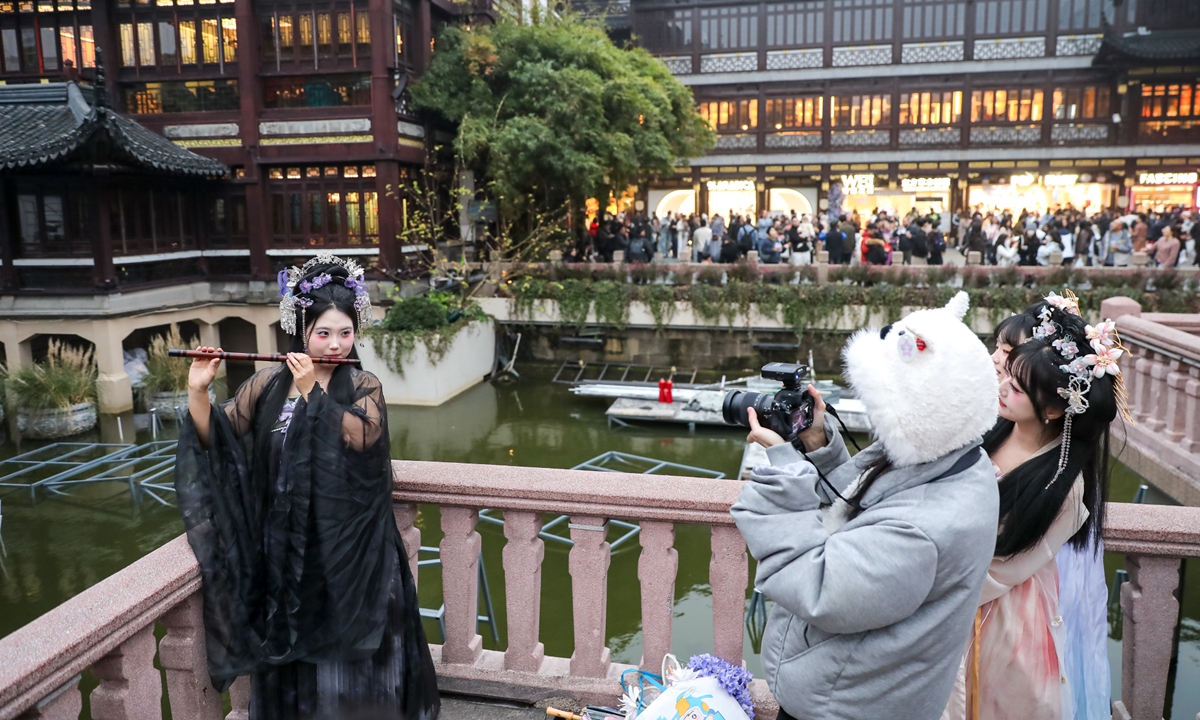
Foreign tourists at Yuyuan Garden in Shanghai Photo: VCG
For 23-year-old South Korean tourist Xuanxuan (her nickname), her trip to Shanghai would not have been complete without dressing up in traditional Chinese clothing and taking photos at one of the city's most iconic landmarks, Yuyuan Garden.During her four-day visit in May, Xuanxuan went to the garden with her mother and booked a traditional Chinese styling package that included costume rentals, makeup and a professional photo shoot. The pair spent about 260,000 won ($182) in total on the experience.
Standing among the traditional pavilions and illuminated corridors of Yuyuan Garden, she captured dozens of photos - memories she said were well worth the money.
"I don't regret spending that money at all because I was on vacation and wanted to fully enjoy the experience. It was memorable, fun, and definitely worth it," she told the Global Times. "If I visit Shanghai again, I would love to do it again."
Xuanxuan is among a growing number of young South Korean visitors who are increasingly seeking immersive cultural experiences rather than simply visiting tourist attractions. Traditional Chinese-inspired activities, including Hanfu clothing (the traditional clothing of the Han ethnic group), beauty services and self-service photo booths, have become popular choices for visitors looking to explore Shanghai in a more personal and creative way.
The trend has gained momentum as China's visa-free policy for South Korean visitors has made short trips to China more convenient. According to data from China's National Immigration Administration, South Korea was the largest source of inbound foreign arrivals to China in the first half of 2026. In Shanghai, South Korean visitors also ranked as the city's largest overseas source market, with 447,500 arrivals recorded between January and May, up 25.67 percent year-on-year, according to the Shanghai Municipal Administration of Culture and Tourism.
For many young South Korean tourists, Shanghai has become more than a destination for sightseeing and shopping. Adding a Hanfu photo shoot, trying traditional-inspired beauty services and creating social media-ready memories in historic neighborhoods have become part of the travel experience itself.
While self-service photo booths are already widely popular in South Korea, South Korean visitors say Shanghai offers a different experience.
A Chinese tourist surnamed Wang, who has tried photo booth experiences in both South Korea and Shanghai, told the Global Times that Seoul's photo booths are known for trendy concepts and celebrity-inspired styles. In comparison, she found Shanghai's offerings more diverse, blending social media-friendly aesthetics with traditional Chinese elements and creative decorations.
"The styles are not limited to the Instagram-style looks that are popular in South Korea," she said.
The appeal also extends to beauty services. In addition to Korean-style minimalist manicures, more salons in Shanghai have begun offering designs inspired by traditional Chinese aesthetics, including floral carvings, embroidery patterns and other elements associated with Chinese culture.
At shopping areas around Yuyuan Garden, many Hanfu rental stores are welcoming international visitors. Some shops have added Korean-language services to better accommodate South Korean customers. Packages usually include clothing, makeup, hairstyling and photography, with some prices starting at around 299 yuan ($44).
"I liked that there were many package options that included the photo shoot, traditional costumes and makeup together. In South Korea, it's not very common to find such a wide range of all-in-one packages," Xuanxuan told the Global Times.
She was also impressed by the makeup.
"In South Korea, we usually prefer more natural makeup, so I had never tried such glamorous, Douyin-style makeup before," she said. "It was a completely new experience for me, and I really enjoyed trying a different style."
For South Korean visitors, one of the biggest differences is not only the costumes but also the setting.
Yuyuan Garden has become a particularly attractive destination because it offers something that cannot easily be replicated in a studio. With traditional architecture, lantern-lit pathways and historic scenery, the area provides a real-life backdrop for visitors wearing Hanfu clothing.
Xuanxuan said she was also inspired by posts from South Korean celebrities who had shared their Yuyuan Garden photo experiences online. South Korean singer Kyuhyun, a member of Super Junior, drew attention after posting a behind-the-scenes vlog on his personal YouTube channel showing his Hanfu-style makeover and photo shoot at Yuyuan Garden.
Bu Xiting, an associate research fellow at the School of Cultural Industries Management at the Communication University of China, told the Global Times that the growing popularity of these experiences has been driven by both easier access to China and the rising influence of social media. As visa policies make travel more convenient, more young South Korean visitors are coming to China not only to see landmarks but also to experience local culture in a more immersive way.
Meanwhile, social media has played an important role in introducing traditional Chinese styles to younger audiences overseas. Photos and videos featuring Hanfu, historic architecture and Chinese-inspired beauty trends have helped turn Shanghai's cultural experiences into shareable travel moments, during which visitors can explore Chinese culture while creating their own memories, he noted.
RELATED ARTICLES