Record electricity demand in China reflects strong economic momentum driven by AI, EV and more
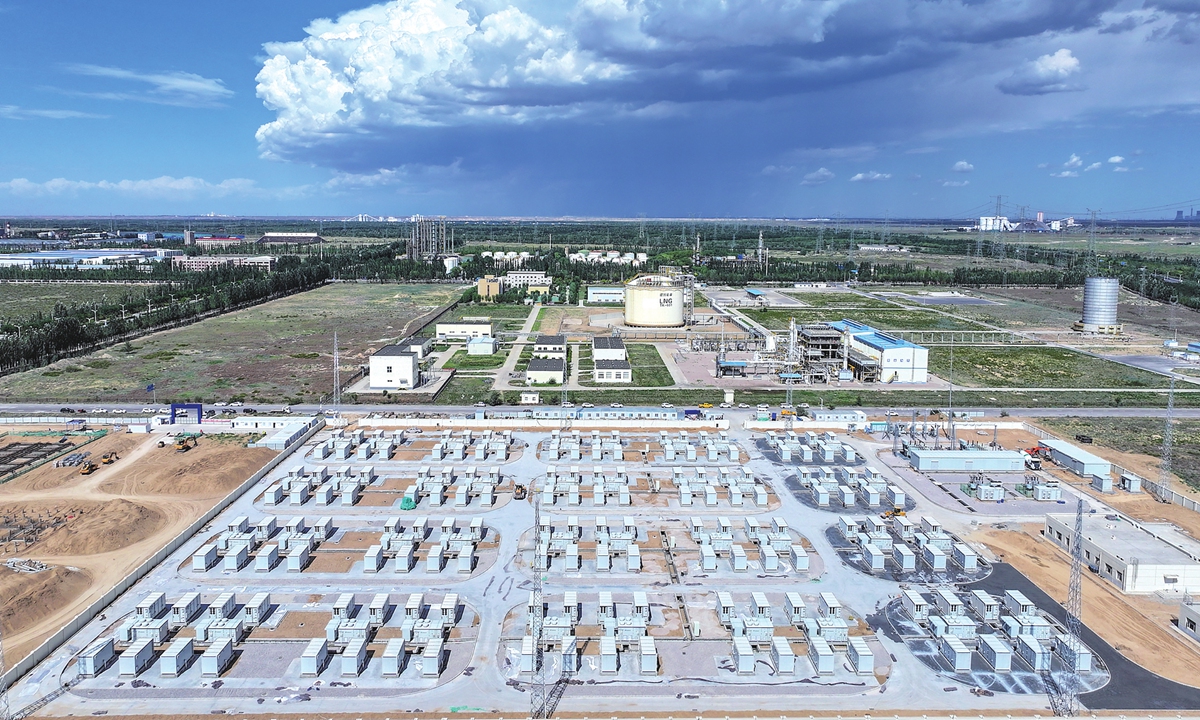
The construction site of a 200-megawatt/800-megawatt-hour shared energy storage power station is seen in Xingqing district, Yinchuan, Northwest China's Ningxia Hui Autonomous Region, on August 3, 2026. In recent years, Ningxia has accelerated the development of a new-type power system, with energy storage playing a key role in supporting renewable energy consumption and balancing electricity supply. Photo: VCG
Multiple provincial and municipal power grids across China have set new load records this summer. While heat waves bring temporary spikes in cooling demand, sustained growth in energy consumption in China is being driven by rising electricity demand from artificial intelligence (AI) infrastructure and electric vehicle (EV) charging. As a reliable barometer of economic activity, climbing energy demand also reflects robust growth momentum fueled by China's new quality productive forces, experts said.
Multiple regional power grids notched record loads on Monday. East China's Shandong Province hit an all-time peak of 131 million kilowatts. Tianjin's power load exceeded 20 million kilowatts for the first time, rising 8.15 percent year-on-year, while East China's Anhui Province registered a new summer record of 69.22 million kilowatts.
According to the National Energy Administration (NEA), the state grid load has set three new records since early July, driven by economic growth and heat waves, reaching a peak of 1.553 billion kilowatts, 45 million kilowatts higher than last year's maximum.
Official data from the NEA and the National Development and Reform Commission shows that the surge in power demand is driven by robust economic momentum. Power use from high-end manufacturing, EVs, energy storage and computing infrastructure has grown rapidly. EV charging and data center power consumption both jumped more than 40 percent year-on-year, emerging as core drivers of electricity demand.
It is estimated that China's peak power load this summer will reach about 1.6 billion kilowatts, an increase of 90 million kilowatts compared with last year, the NEA said.
While air-conditioning demand during prolonged heat waves creates temporary consumption peaks, sustained growth is driven by structural economic factors. Expanding manufacturing output supports steady power use for high-end equipment and fine chemicals. Round-the-clock data center operations and growing EV charging access keep lifting overall electricity demand, Zhu Keli, founding director of the China Institute of New Economy, told the Global Times on Tuesday.
Heat is certainly one factor, but another key driver lies in China's deepening digital and intelligent transformation, Tian Yun, a veteran economist, told the Global Times on Tuesday.
"China's AI adoption differs markedly from that in the US. In the US, AI is mostly deployed within a small number of high-value services industries. By contrast, AI applications in China are spread across all three major industries — agriculture, manufacturing and services — with extensive adoption especially in agriculture and manufacturing. This trend is pushing up overall demand for electricity," Tian noted.
Figures for the first half illustrate China's industrial transformation. The secondary sector remained the core growth driver of power consumption, contributing 3.3 percentage points to total electricity growth. Power use by high-tech and equipment manufacturing hit 6.008 trillion kilowatt-hours in the first six months, up 9.8 percent year-on-year, with electrical machinery manufacturing consumption jumping 13.7 percent, the NEA said.
The tertiary sector posted faster growth. Electricity consumption by charging services, fueled by EV and AI expansion, reached 81 billion kilowatt-hours, up 56.9 percent year-on-year, while internet data services consumed 49.4 billion kilowatt-hours, up 44 percent. Together, the two categories lifted national power demand by 0.9 percentage points, according to the NEA.
Experts noted that rising power demand reflects the rapid expansion of China's AI sector, and they called for the development of an energy system suited to the nationwide intelligent transformation across the economy and society.
"The surging new power demand is mainly driven by AI-related industries. On the one hand, this demonstrates the vigorous development of China's AI sector. On the other hand, it calls for efforts to build an energy system capable of supporting the comprehensive intelligent transformation of the economy and society," Hu Qimu, a professor at the Maritime Silk Road Institute of Huaqiao University, told the Global Times on Tuesday.
Equipped with one of the world's most reliable power grids, the country is fully capable of meeting the electricity needs of AI operations, Lin Boqiang, director of the China Center for Energy Economics Research at Xiamen University, told the Global Times on Tuesday.
China has built up leads in wind power, solar energy, EVs and energy storage. Further expansion of energy storage capacity will facilitate higher absorption of renewable energy, enabling low-carbon power supply to sustain the nation's digital and intelligent growth, Lin said.
China is accelerating its green and low-carbon energy transition. As of the end of June, combined installed wind and solar power generation capacity hit 1.95 billion kilowatts, rising 16.8 percent year-on-year, with renewables accounting for 40 percent of total power generation in the first six months. Coal-fired power output stood at 2.5 trillion kilowatt-hours from January to June and made up 49.7 percent of national generation — the first half-year reading below 50 percent, signaling fresh progress in the green shift, NEA data showed.
RELATED ARTICLES