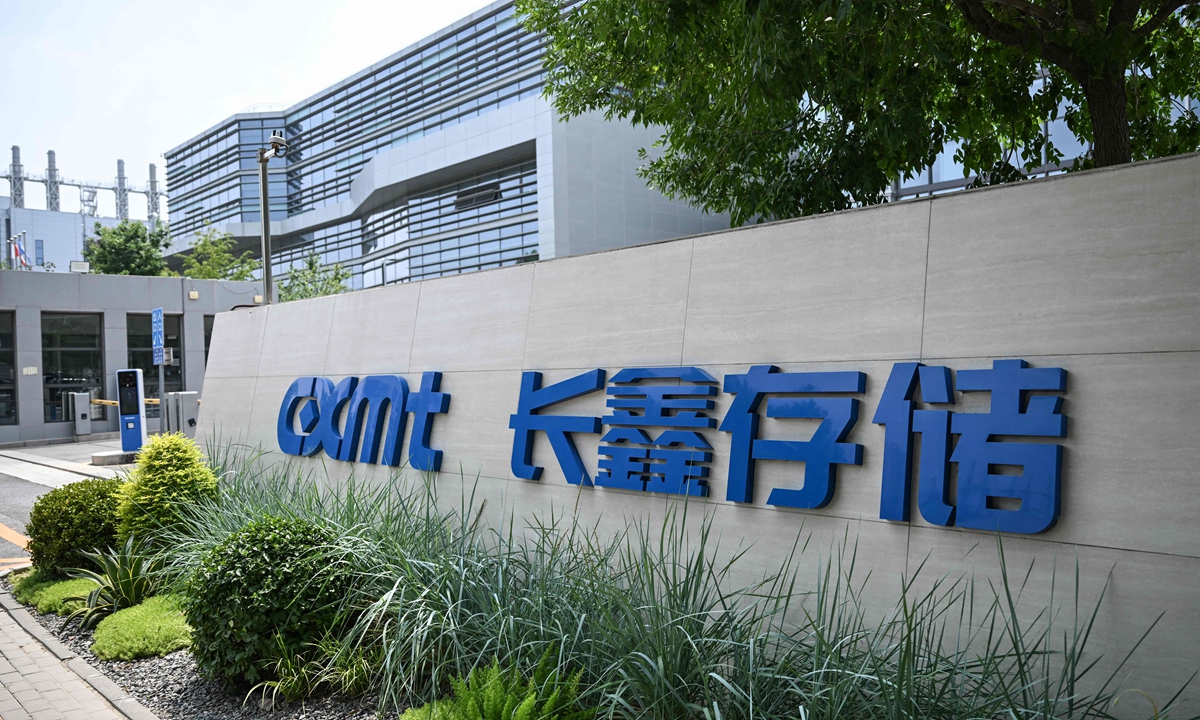
This photo shows a view of an entrance to the ChangXin Memory Technologies (CXMT) factory on the outskirts of Beijing on July 27, 2026. Photo: VCG
A second-quarter report released by market research firm Counterpoint Research on Tuesday showed that the Chinese memory-chip giant CXMT's market share surged 716 percent year-on-year to 7 percent, making it the world's fastest-growing dynamic random-access memory (DRAM) supplier during the period.
The upbeat assessment came in the second week after CXMT's STAR Market debut. With the company valued at 3.68 trillion yuan ($544.9 billion) as of Tuesday's close, industry experts said that all eyes are now on whether CXMT's strong market appeal and financing momentum can translate into sustained technological breakthroughs and market expansion.
The key question is whether its strengthened financing capacity can help the company navigate industry cycles, accelerate independent breakthroughs and expand its market share, experts said, while noting that the nation's focus on technological self-reliance and the development of hard technologies is expected to provide crucial support for the company's long-term expansion.
The Counterpoint Research report noted additional opportunities for CXMT to sustain its expansion.
Counterpoint's Vice President of Research, Neil Shah, commented in the report that if CXMT can expand its capacity and capability to meet domestic and overseas demand, starting with personal computers and potential Tier-1 international customers, the supplier's market share will balloon and look a lot different a year from now.
The report also highlighted the intense competition facing CXMT. In the second quarter, the traditional "Big Three" memory suppliers — Samsung, SK Hynix and Micron — continued to compete fiercely for market share.
Samsung claimed the top spot in the DRAM market in the second quarter, with its market share widening to 39 percent — a level last seen in 2024, according to Counterpoint Research's Global Memory Tracker. Conversely, SK Hynix's market share fell to 26 percent from 39 percent in the second quarter of 2025, despite a 214 percent year-on-year surge in quarterly revenue.
Chen Jing, vice president of the Technology and Strategy Research Institute, told the Global Times on Tuesday that the growth was driven by rising demand for domestic substitution in critical infrastructure and enterprise information technology systems, as well as new market opportunities created by global suppliers shifting capacity toward high-end high-bandwidth memory (HBM) production.
Growing artificial intelligence server demand, where CXMT's DDR5 products are becoming increasingly competitive, provided additional momentum, he added.
Chen also noted that China's memory-chip industry faces both unique advantages and challenges as it competes with established global memory giants.
The industry's strengths lie in its vast domestic market, which provides a strong demand base, as well as policy support that enables resources to be concentrated on strategic areas, helping shorten customer validation and product adoption cycles. However, technology remains a key factor in gaining global market share. The industry still needs to narrow the gap in advanced technologies.
Experts also emphasized that China's continued support for hard technologies will provide comprehensive backing for related industries to overcome cycles, achieve breakthroughs and pursue long-term growth.
For instance, one of the market's recent key focuses has been the extensive participation of the banking sector in CXMT's financing. Industry data showed that eight banks held a combined stake of about 4.5 percent on a look-through basis before the IPO, equivalent to approximately 2.7 billion shares.
Tong Lijing, an associate professor at the School of Economics and Management of Beijing Jiaotong University, told the Global Times on Tuesday that banks' unique financial functions could provide support for companies seeking to navigate economic cycles.
Unlike institutional investors, whose equity participation mainly serves as a market signal and can attract more capital inflows, banks becoming shareholders can strengthen bank-enterprise ties, reduce information asymmetry, and enable banks to better assess companies' creditworthiness and default risks, thereby providing support for subsequent debt financing, Tong said.
CXMT has become one of the world's largest DRAM producers in terms of market share, according to the Xinhua News Agency. The company reported that it has amassed nearly 7,000 patents and invested more than 20.6 billion yuan in research and development over the past three years, according to Xinhua.
RELATED ARTICLES