Top US commander’s accusation against China over SCS exposes its hegemonic double standard: Chinese experts
By Published: Aug 04, 2026 10:48 PM

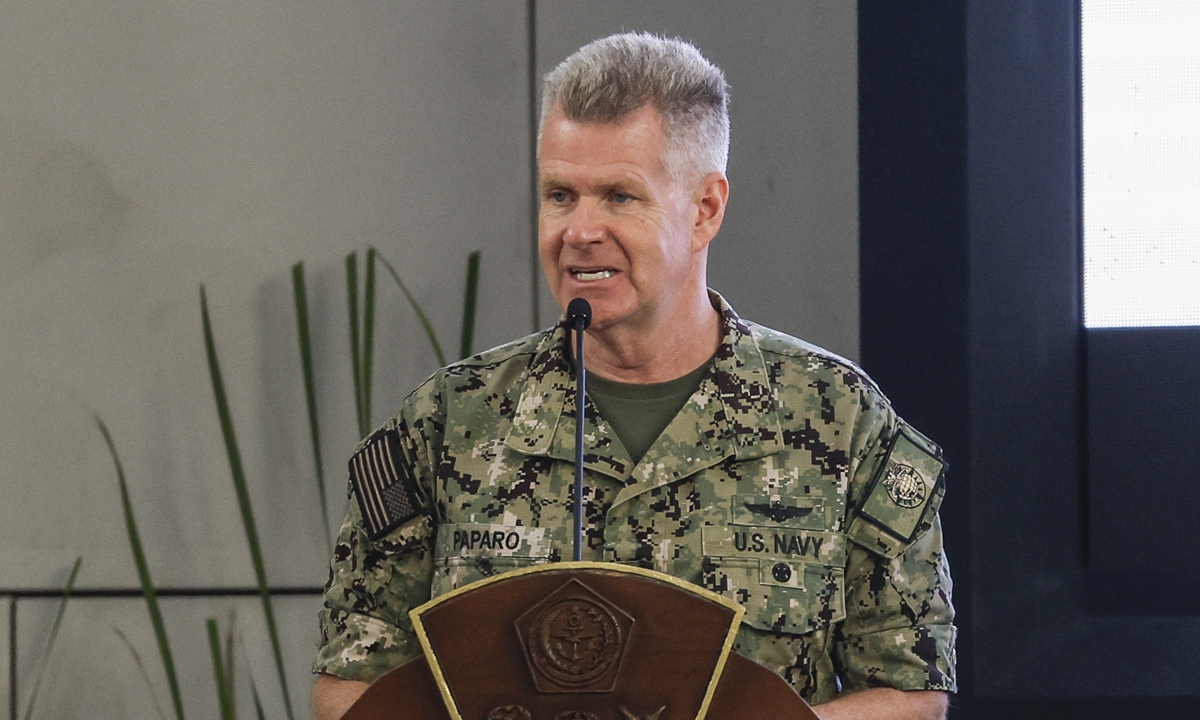
File Photo: The US Pacific Command chief, Admiral Samuel Paparo, delivers his speech during the opening ceremony of the Super Garuda Shield 2025 joint military exercise at the Navy Staff and Command School in Jakarta, Indonesia, 25 August 2025. Photo: VCG
The US Pacific Command chief's latest accusations against China over the South China Sea have drawn criticism from Chinese experts, who said on Tuesday that the Philippines' current hardline stance toward China is undoubtedly closely linked to the US' continuous reinforcement of its so-called alliance commitments and security support.Without Washington's backing and encouragement behind the scenes, Manila would not have had the confidence, capability or ambition to take such actions on the South China Sea issue, they noted.
At a regional security conference held in Kuala Lumpur, the US Pacific Command chief, Admiral Samuel Paparo, claimed on Monday that "coercive actions" by China and other actors were challenging regional stability and that the US would not allow any country to "dominate" the so-called Indo-Pacific, according to the AP News.
Paparo also accused some countries of using "false claims of legitimacy" to justify "intimidation and coercion," while portraying the US as a defender of the "rule of law."
In fact, China's actions around Huangyan Dao, including Chinese warships' and aircraft's rehearsal of control of the sea and air, coast guard officers' practice of intercepting and towing intruding vessels, and new rules for stricter legal boundaries around the national nature reserve in the past few days, came as the Philippines once again attempted to advance its claims through political and legal maneuvers.
Paparo's remarks that the US will not allow any country to "dominate" the "Indo-Pacific" actually reveal that Washington itself seeks to dominate the region, Li Qingsi, a research fellow from the National Academy of Development and Strategy of Renmin University, told the Global Times on Tuesday.
In recent years, the US has continuously intensified various forms of joint military patrols and activities in the South China Sea, and such moves are the fundamental cause of undermining regional stability, Li said.
During the conference, Paparo also claimed that "the US is clear-eyed about the complex security environment in this region. Our posture and our intent are well defined. The US is deterring China through strength, not through confrontation," adding that the US "will not let any nation dominate this region or sweep away the hard-fought sovereign rights of independent states," according to the AP News.
The US narrative about "domination" is rooted in its own hegemonic mindset. Viewing the world through this lens, Washington assumes that other countries are pursuing the same objective of regional dominance. In reality, China's vision for development and regional security is entirely different, Chen Xiangmiao, a research fellow at the National Institute for South China Sea Studies, told the Global Times on Tuesday.
China has consistently advocated common, comprehensive, cooperative and inclusive security, as well as peaceful development and shared prosperity. This is fundamentally different from the US' unilateral, hegemonic regional order based on dominance, Chen noted.
The US Admiral's claim that it does not seek confrontation is, in essence, a double standard: Washington can continue its military containment of its perceived rivals, while opposing countries are not allowed to respond, some Chinese experts said.
"The core objective of the US' deterrence strategy toward China is to preserve its dominant position in the so-called Indo-Pacific, bind regional allies to its geopolitical agenda, make them serve US hegemonic interests, undermine cooperation between China and neighboring countries, and restrict China's normal development," Li said.
The US Department of War announced on June 16 that "the US Indo-Pacific Command (USINDOPACOM) will officially restore its name to the US Pacific Command (USPACOM)," according to the official website of the command.
The US military's decision to rename the Indo-Pacific Command back to the US Pacific Command would represent an obvious strategic retrenchment made out of necessity. By hyping up the South China Sea issue, the US attempts to conceal and facilitate this process of strategic adjustment, Li noted.
Some Chinese experts also pointed out that Paparo is one of the main actors in the US military's efforts to stir up issues in the South China Sea, while the Philippines plays a supporting role.
In meeting with Philippine President Ferdinand Marcos Jr. in August 2024, Paparo claimed that the US military is open to consultations about escorting Philippine ships in the disputed South China Sea, according to US media reports.
Some Philippine officials also used this platform on regional security to hype up so-called "concerns" over China.
On the sidelines of the MILOPS conference, Philippine Defense Secretary Gilberto Teodoro claimed that "ASEAN cannot indefinitely remain a 'zone of neutrality' amid what he described as China's efforts to divide the region," according to Philippine media reports.
"This statement clearly demonstrates a lack of understanding of ASEAN," Zhou Shixin, director of the Center of Southeast Asia Studies, Shanghai Institutes for International Studies, told the Global Times on Tuesday.
As a regional organization that embraces unity in diversity, ASEAN has long adhered to the principle of neutrality in international and regional affairs, as well as in its internal affairs. The bloc's fundamental principles, which it has upheld since its establishment, will not be changed because of the position of a single member state such as the Philippines. Teodoro will not be able to successfully hijack ASEAN's agenda, Zhou noted.
When asked about China's position on the US-Philippine annual joint military exercises launched in the Philippines on April 20, in which approximately 10,000 US military personnel are scheduled to take part, with the Japan Self-Defense Forces also set to participate, and which takes place amid tense China-Philippines and China-Japan relations, Chinese Foreign Ministry spokesperson Guo Jiakun said on the same day that unilateralism and military bullying have inflicted profound disasters on the world.
What the Asia-Pacific region needs most is peace and tranquility, and what it needs least is external forces being introduced to stoke division and confrontation, Guo said.
RELATED ARTICLES