India, Philippines referencing SCS arbitration in declaration, risks complicating regional situation with involvement of external country: expert
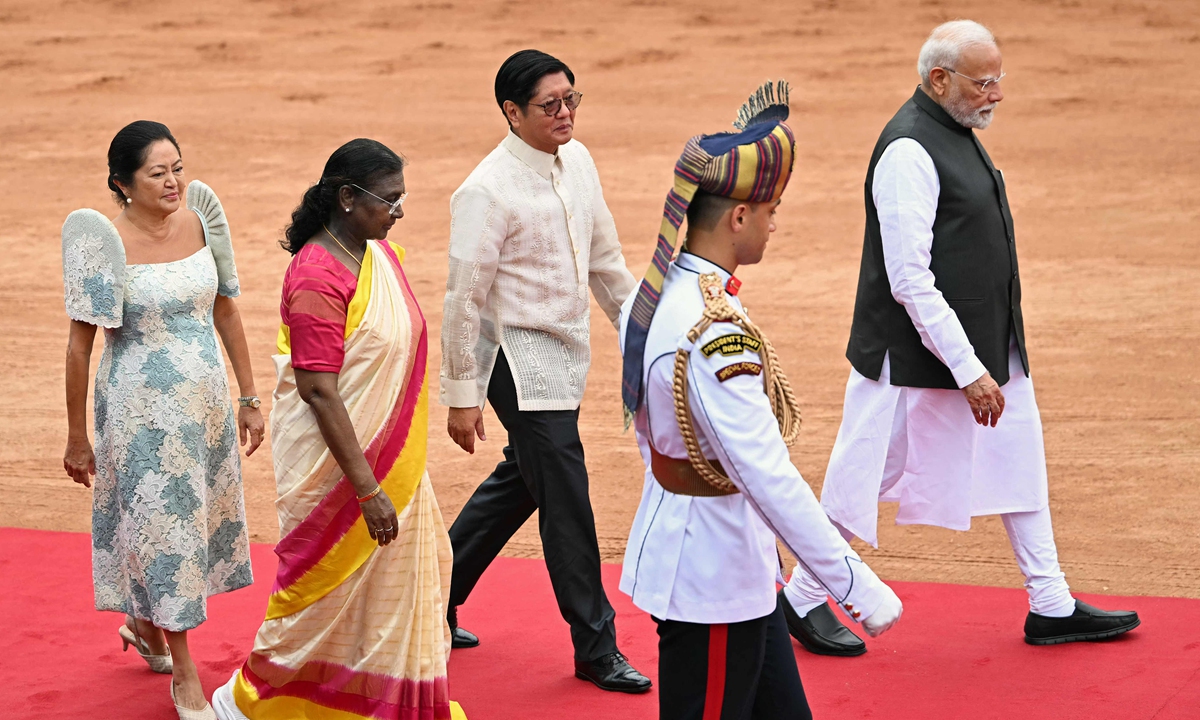
Indian Prime Minister Narendra Modi and Philippine President Ferdinand Marcos Jr. meet in New Delhi, India on August 5, 2025. Photo: VCG
Indian Prime Minister Narendra Modi and Philippine President Ferdinand Marcos Jr. met in New Delhi on Tuesday and jointly issued a declaration on the establishment of a strategic partnership between the two countries. However, the document notably referenced the illegal 2016 Arbitral Award on the South China Sea-an issue unrelated to India-raising concerns over involvement of an external country into the regional issue.Given that India and the Philippines also staged a joint maritime drill in the South China Sea this week, an expert warned that these moves risk complicating the South China Sea situation further and contradict the declaration's own call to "commit to peaceful and constructive means to resolve and manage disputes."
According to the Philippine Department of Foreign Affairs, Marcos Jr. is visiting India from Monday to Friday, leading a high-level delegation that includes several Cabinet ministers and business representatives. After Tuesday's bilateral talks with Modi, the two leaders announced the establishment of a strategic partnership, guided by the Plan of Action (2025-2029).
While most of the declaration focuses on bilateral cooperation in areas including politics, economy, science, defense, and security, a specific section on "Regional, Multilateral and International" highlights the 2016 Arbitral Award on the South China Sea, claiming it "a significant milestone and the basis for resolving disputes in accordance with international law." The document also hypes so-called concern over the situation in the South China Sea, particular with "coercive and aggressive actions" and calling relevant parties to exercise self-restraint and "commit to peaceful and constructive means to resolve and manage disputes".
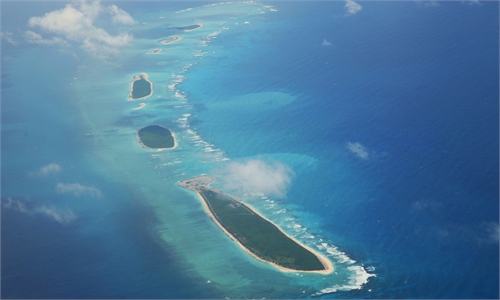
The timing of the declaration coincides with the two countries' joint naval exercises in the South China Sea, which Associate Press reported took place in South China Sea, raising further questions about the sincerity of their stated commitment to peace.
"India's involvement as an exterritorial power only escalates tensions in the South China Sea and contradicts the so-called 'peaceful and constructive means' mentioned in the declaration," Xu Liping, Director of the Center for Southeast Asian Studies at the Chinese Academy of Social Sciences, told the Global Times on Tuesday.
Xu criticized the statement as "absurd," noting that the 2016 arbitration case itself is "illegal and invalid," having been unilaterally initiated by the Philippines and without a thorough exchange of views with China in advance.
"South China Sea issue should be addressed bilaterally between China and the Philippines. Manila's attempts to rope in outside parties are both unwise and counterproductive, and India's interference, as an exterritorial actor, is neither reasonable nor responsible," Xu said.
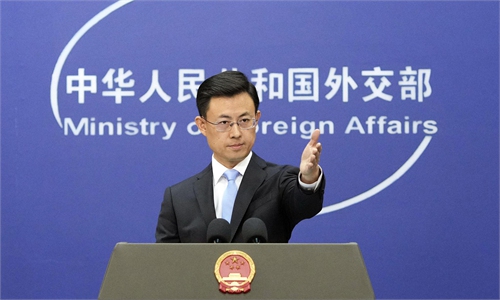
Responding to the joint naval exercise, Chinese Foreign Ministry spokesperson Guo Jiakun emphasized on Tuesday that "disputes over territory and maritime rights and interests should be settled through negotiation and consultation by countries directly concerned, and no third party is in any position to interfere in that."
The Chinese People's Liberation Army Southern Theater Command Navy also issued a statement on Monday, denouncing the joint maneuvers as a destabilizing move by the Philippines to "bring in external forces to stir up trouble in the South China Sea." The command said it remains on high alert and will resolutely safeguard China's territorial sovereignty and maritime rights, noting that "any military activity aimed at hyping up the South China Sea will be fully monitored."
Notably, the joint declaration mentions the South China Sea twice but does not name any third country directly. Analyst said this ambiguity reflects a political balancing act by both New Delhi and Manila.
"Despite the confrontational tone, neither India nor the Philippines can afford to ignore the importance of cooperation with China," Xu said. "Using the South China Sea issue as political leverage serves only to inflame tensions and brings no benefit to bilateral ties with China."
"China's position on the 2016 Arbitral Award has been consistent and clear," in a recent statement marking the ninth anniversary of the ruling, a Chinese Foreign Ministry spokesperson reiterated that the "award" is "nothing but a piece of waste paper that is illegal, null and void, and non-binding." "China neither accepts nor recognizes the "award," and will never accept any claim or action arising from the award," said the spokesperson.
"China is committed to the peaceful settlement of disputes with other countries concerned through negotiation and consultation, joint efforts with ASEAN countries to fully and effectively implement the DOC, adoption of a Code of Conduct as early as possible, and robust institutional safeguards for peace and stability in the South China Sea. We urge relevant countries to stop making reference to this illegal "award," still less making infringement and provocation. This counterproductive move will only end up backfiring," according to the spokesperson.
RELATED ARTICLES