Could India’s smartphone manufacturing growth open new space for co-op with China?

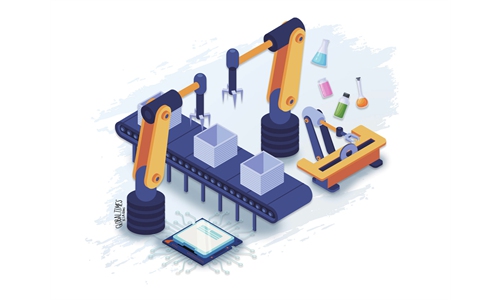
Illustration: Liu Xiangya/GT
India's smartphone manufacturing sector has drawn renewed attention after Reuters reported that the country has proposed extending tax exemptions until 2041 for foreign companies that provide machinery to contract manufacturers, potentially benefiting Apple, which has reportedly lobbied for such changes. The measure, outlined in a draft seen by Reuters, remains uncertain at this stage. Even so, the report has renewed interest in India's growing mobile phone manufacturing sector and the policies being put in place to support it.
India's smartphone manufacturing story has evolved over the past decade. The Times of India reported that India's electronics manufacturing sector has expanded steadily during this period, with mobile phone exports rising 165-fold between 2014-15 and 2025-26. The growth in exports reflects not only rising shipment volumes, but also the evolving role of smartphones within India's electronics manufacturing sector.
For an economy seeking to deepen its manufacturing base, smartphones have provided a practical starting point, supported by strong domestic demand and growing participation in global supply chains. The growth of made-in-India phones reflects the rise of a manufacturing segment that fits India's current stage of industrial development.
Against this backdrop, India's efforts to promote smartphone manufacturing are hardly surprising. Discussions in Indian media outlets over whether the country's new Mobile Phone Manufacturing Scheme could help position India as a global electronics manufacturing hub reflect the growing domestic attention surrounding the sector.
Yet smartphone manufacturing is deeply embedded in global supply chains. Its growth depends not only on local production, but also on foreign investment, international suppliers and access to overseas markets.
For India, the development of this industry will require balancing the expansion of domestic manufacturing with the international links that underpin global smartphone production. Maintaining an open economic environment that continues to attract investment not only from Apple, but also from other global technology companies, would create more favorable conditions for the continued growth of India's smartphone manufacturing sector.
In global discourse, India's rise in smartphone manufacturing is often viewed through the lens of competition with China. While competition between the two markets is inevitable, a purely competitive reading overlooks the realities of modern supply chains.
China's strength in smartphone manufacturing has been built over decades, supported by a dense network of component suppliers, engineering talent, logistics infrastructure and accumulated production experience - an industrial foundation that India is unlikely to replicate in the short term.
In practice, the global nature of smartphone manufacturing leaves room for cooperation alongside competition. If India views China as a potential partner, Chinese companies could become part of the broader ecosystem supporting the growth of its smartphone manufacturing sector, through areas such as component supply, investment and supply-chain participation.
As India's smartphone manufacturing sector enters a new phase of expansion, a broader network of industrial partners will become increasingly important to its development. Apple's role in this process has attracted considerable attention, but the company represents only one part of a much wider ecosystem.
Beyond Apple, other companies across the supply chain can also contribute to the growth of India's manufacturing base. A more diverse group of industrial partners could, in turn, strengthen India's appeal as a manufacturing destination for global technology companies, including Apple.
About three years ago, some Chinese smartphone companies encountered setbacks in India, which may have affected the confidence of some Chinese investors in the market. More recently, signs of improvement have emerged in China-India economic and trade exchanges. Against this backdrop, cooperation in the smartphone supply chain may offer a practical entry point for renewed industrial engagement.
If India takes a more open approach in this area, allowing greater space for mutually beneficial cooperation and more market-based interaction among companies, it could help rebuild investor confidence while creating more opportunities for Chinese firms to participate in India's manufacturing development through supply-chain partnerships.
Such cooperation could, in turn, encourage broader commercial engagement among companies on both sides and strengthen economic links based on shared interests. For India's smartphone manufacturing sector, a more open and connected industrial ecosystem could provide additional momentum as it continues to expand.
The author is a reporter with the Global Times. bizopinion@globaltimes.com.cn
RELATED ARTICLES