Does Nike’s reduction in distributors indicate a decline in China’s consumer power?: Global Times editorial
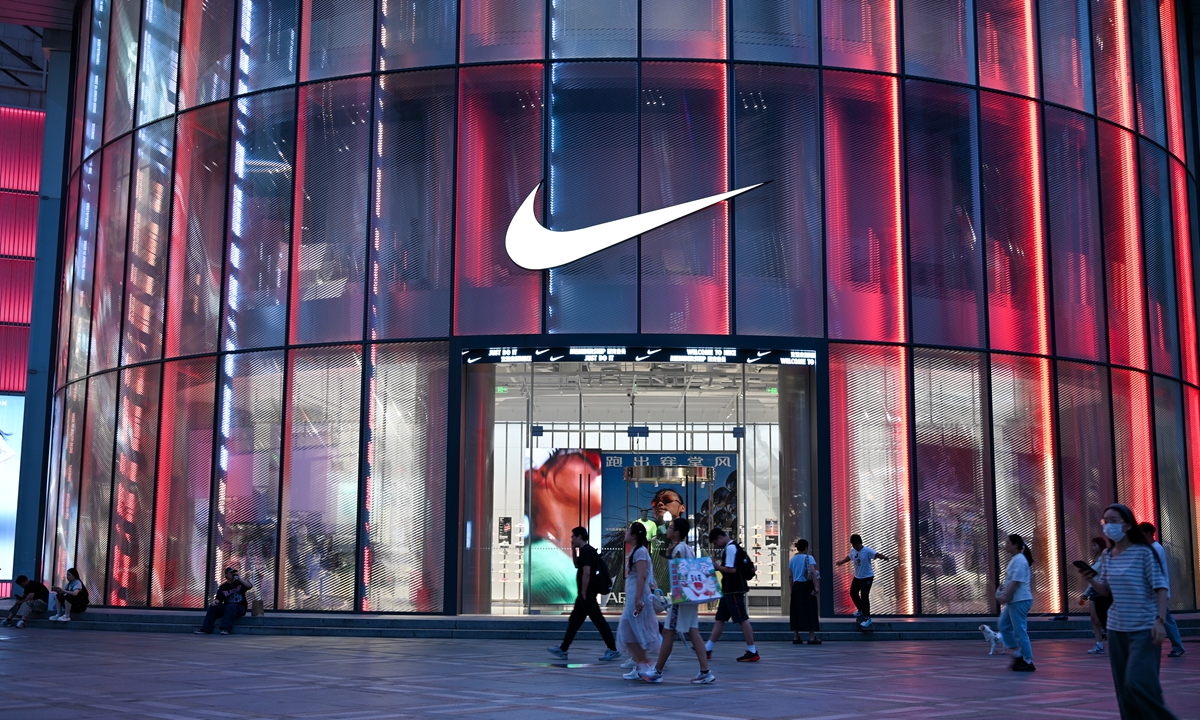
Photo: VCG
Editor's Note:
Currently, China's economy is steadily advancing along the path of high-quality development, even as domestic and international circumstances become increasingly complex. Some Western media, due to misunderstanding or bias, have repeatedly questioned or even distorted China's economic development. Accordingly, the Global Times launches the "Q&A on China's Economy" column to publish opinion pieces to present facts and clarify perceptions.
Topsports and Pou Sheng International recently announced that they had received official notification from Nike stating that, starting January 1, 2027, sales of Nike products through third-party online platforms in the Chinese mainland will be fully discontinued. According to reports, Nike's future online sales channels in China will be mainly concentrated on its official flagship stores, self-operated website and official app. The adjustment has caused considerable ripples in China's sports consumer market, with the share prices of relevant distribution partners plunging at one point and triggering a strong market reaction.
From a business perspective, this is a routine channel restructuring for a multinational corporation. However, some foreign media outlets have seized the opportunity to link Nike's strategic adjustment in China with a "slowdown" in the Chinese market, promoting a pessimistic narrative of "China's consumption fatigue" both overtly and covertly. This view is completely unsubstantiated and essentially blames China's consumers for Nike's performance decline over the past period.
Does Nike's move to reduce its number of distributors signal a lack of consumer spending power in China? Quite the contrary; data shows that China's sports sector is not shrinking but rather continuing to expand. The market has seen steady growth in recent years, reaching 2.49 trillion yuan in 2025. In the first half of 2026, China's exports of sporting goods and equipment reached 67.53 billion yuan, accounting for more than 40 percent of global exports. By 2035, China's sports industry is expected to reach a market scale of 7 trillion yuan - accounting for over 2.5 percent of GDP - and emerge as a new engine for market growth. These figures show that China's sporting goods market is demonstrating clear growth momentum, with the "pie" continuing to expand.
The impressive results achieved by numerous sports brands in China also dispel the misconception of "China's consumption decline." Among them, Anta Sports, with over 80 billion yuan in annual revenue and 12 consecutive years of positive growth, remains the leading domestic brand. International brands such as Arc'teryx, On Running, and Lululemon have also experienced double- or triple-digit growth in China. This shows that China's consumer market remains highly dynamic and continues to be a key growth hub where global brands are eager to expand their presence. Meanwhile, Nike's revenue in the Chinese mainland, Taiwan, Hong Kong and Macao for fiscal year 2026 declined by 11 percent year-on-year. To a certain extent, Nike has only itself to blame for falling behind.
China's market has always had demand; what's lacking are products and strategies that truly capture that demand. Once a dominant player in China's sports market, Nike now faces operational difficulties despite the overall expansion of the Chinese market. The root cause may lie within the brand itself. Some analysts believe that Nike's long-standing use of a global elite sports narrative has failed to adapt to the new trends of mass sports, outdoor recreation, and consumer preferences in China, creating a disconnect with the mainstream market. While domestic brands continue to innovate and iterate in running shoes, basketball shoes, and other categories, Nike's products are increasingly seen as aesthetically dull and homogenized. This lack of innovation, combined with high inventory pressures, has ultimately forced Nike to lower prices and promote sales through official channels.
From Nike's perspective, the large-scale withdrawal of online distributors and the move to regain pricing and channel control were aimed at ending chaotic price wars and reshaping its brand image. As Nike explicitly stated, the goal is to reduce channel fragmentation and improve consumer experience. Clearly, this is not a "retreat," but a strategic effort to better allocate resources, redefine roles, and deepen roots in China to secure future growth.
Undoubtedly, the Chinese market remains strategically indispensable to Nike. Although Nike's performance in China has declined somewhat, the country still is important core market outside North America. With a population of more than 1.4 billion, a steadily rising fitness craze, and a growing middle-income group, China's long-term sports consumption fundamentals remain strong. Nike has also recognized its own shortcomings in localization and has begun to proactively adjust its strategy.
Channel restructuring is simply a positive step for Nike to rebuild its core competitiveness in China. The Chinese market is large and inclusive. As one of the earliest international sports brands to enter China, Nike has witnessed the rise of China's nationwide fitness boom. Today, with the booming sports industry and a more mature competition ecosystem, we welcome global enterprises - including Nike - to hone their capabilities and compete fairly within this "playground," continuing to earn the trust and affection of Chinese consumers through superior products and services.
RELATED ARTICLES